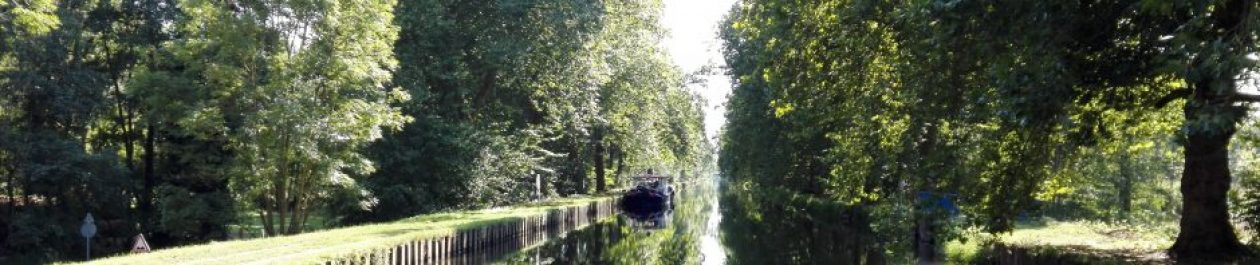
Deep into the third week of our thoroughly delightful stay in Épinal, we thought it high time we got out a bit wider and explored the region round the city. But how to do it? Well, our new best friend, Ron on his big old tjalk, had a car. And his port neighbour and close mate, Fredi had returned to Switzerland for a couple of weeks on family business, so Ron was alone and at a loose end. We suggested a day excursion and he leapt at it.
We set off on 20 October for the towns of Plombières-les Bains and Remiremont, about half an hour’s drive south. Plombières is best known as a spa town, famous for its hot springs; Remiremont, a dozen kilometres to the east, is notable as an abbatial centre and for its community of noble nuns. Both promised oodles of interesting sights, interesting histories and, we hoped, some fine refreshments.
We made Remiremont our first stop in the morning, because we hoped we might later find a better range of lunch choices in the spa town rather than the town of nuns.
Remiremont is situated on the Moselle upstream of Épinal, near its confluence with the Moselotte, in the foothills of the Vosges mountains. An abbey was originally founded there in the 7th century but by the 9th century it had become a community of Benedictine nuns. Over time they became less and less wedded to the severity of convent life and by the 13th century they were an order of secular canonesses; entry was restricted to those who could prove 200 years of noble descent. They acquired extraordinary power and privilege, including the protection of the Dukes of Lorraine, the Kings of France, the Holy Roman Emperor, and the Pope; their abbess was bestowed the title of Imperial Princess.
The canonesses lived independently within the abbey with their own circle of friends and servants. They each received a share of the abbey’s considerable income to dispose of as they wished, and could leave to visit family, sometimes for months at a time. In fact, they were only formally required to live in the convent for three months in a year and, even then, they mostly occupied elegant townhouses surrounding the church, some of which which can still be seen today. By the 17th century they were styling themselves as countesses and hosting balls, concerts and other entertainments.
The abbatial church was consecrated in 1051 but dates primarily from the 13th century. It is in a marvellous state of repair and betrays some fine ornamentation and decoration.


The townhouses of the cannonesses/countesses surrounding the church are fine buildings, where it is easy to imagine the elegant, elevated social life these singular women enjoyed.


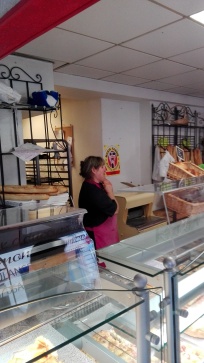
Perhaps only fitting, given the relics of all these powerful women, that it was in Remiremont we came across our first female boulanger in France. She was a little shy, but her shop displays implied a baker of considerable skill.
We proceeded to Plombières, to experience the pleasures of a hot springs spa town. Right from the start, I think, it is important to say that the town has a fascinating history and a somewhat less stellar present existence.
One approaches the town from the heights. descending into a tight valley formed by the diminutive L’Augronne River. The town is laid out in a narrow strip along the riverside at the base of the valley, and the broad, long approach along the tree-lined Avenue de Remiremont holds strong promise of prosperity and amenity. Parks and gardens and the forested hillsides lend an attractive setting.
The hot springs that surround and flow through the town were enjoyed by the Romans and over the centuries it became quite a popular spa town, visited by the likes of Voltaire, Montaigne, the dukes of Lorraine, Berlioz, Lamartine and assorted members of the Bonaparte clan including Napoleons I and III and Josephine.
The town remains proud of these visitors and temporary residents and displays little plaques on the handsome town houses they once occupied.


Plombières was also a favourite place of the lay canonesses of the Abbey of Remiremont who, when they could tear themselves away from the rigours of social devotion in that place, could partake of the waters here.


Plombières was the scene for the clandestine meeting in 1858 between Napoleon III and Camillo Benso, Conte di Cavour and Chief Minister of Piedmont, leading to the “Plombières Agreement” that is considered the precursor to the unification of Italy.
It must have been quite a place in its heyday, with baths, spas, hotels and chic townhouses with their balconies overlooking the main squares, a centre for pleasure, gossip and the warm enjoyment of one’s place in society.


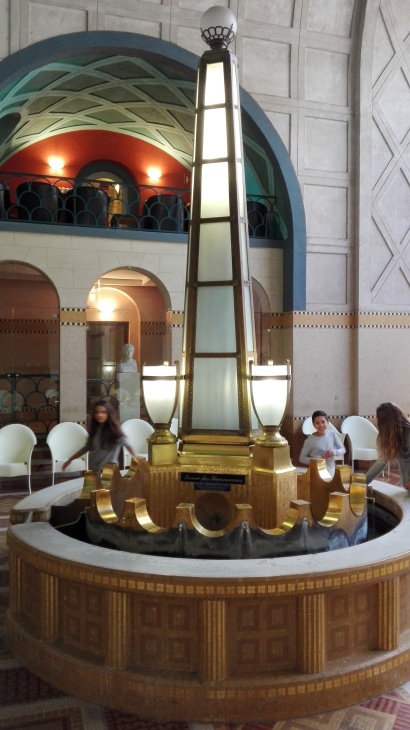
Even today, though, one can enjoy the waters, regardless of one’s social position. At the facility below, a spa with treatment rooms and a fountain of assorted mineral waters, we witnessed an elderly local, nonchalantly entering the room, armed with a couple of plastic containers, and calmly filling them with the life-giving fluids that still flow continuously from below ground. The fountain boasts four different outlets, each of which claims to provide a slightly different balance of minerals and their associated benefits. Our lady seemed either to know exactly which variety she favoured or didn’t care, because she went straight to one tap, filled her containers, nodded in our direction and went on her way.
It has to be said that Plombières does not buzz any more with the feel of a place patronised and valued by the elites. It has a lovely historic aura but also the slightly seedy feel of a place that has already experienced most of the better things that are its due.
We repaired with Ron to the place we had identified as the best place for lunch, on the way passing a crumbling pile that in the 19th century must have been a lively, luxurious hotel but was now a sad ghost surrounded by hurricane fencing. We arrived at our destination and entered the quietest casino I have ever seen. Small as it was, it still seemed cavernous because of the absence of gamblers.
At the rear, though, was a very pleasant restaurant located by the river and set, for some reason, in an old railway carriage, sumptuously appointed. The luxurious setting didn’t deter Jane and Ron, however, who each ordered a massive open burger and fries. I had a very acceptable boeuf bourgignon. We enjoyed it all and escaped without too much financial damage.


And so ended, with a pleasant drive back to Épinal, our side trip with Ron. We were glad of the excursion, and even gladder to have enjoyed it with him.
Now we were back to the serious business of getting ready to leave the boat and return to Australia.
 Scraping Through France
Nice to visit this town and surroundings once. Happy to share on our website: https://campervanfans.com/ 🙂 Have a nice weekend.
LikeLike