Buying a boat

After Looking for a boat and Finding a boat we found ourselves at a new frontier.

We’d spent years researching, months deliberating, weeks preparing and days inspecting boats for our project of summer cruising the rivers and canals of Europe. The day came in May 2016 when we made an offer, it was accepted, and we would shortly become the proud owners of our very own converted Dutch barge.

I had a sneaking feeling, though, that there would be much hard work and many obstacles to overcome before we could set off. And that suspicion proved correct.

The first thing that needed to be done was to complete the paperwork with my new friends Patrick and Pierre, the French boat brokers who had found Eben Haezer for us.

Prior to our three-day jaunt across Belgium and the Netherlands in search of a boat, I had signed an agreement with them that I would pay for their petrol, food and accommodation. That was no problem and, as we sat in the brasserie celebrating the sale just accomplished, I forked out the requisite euros.

Then we had to sign a sale contract with the owner of Eben Haezer. Patrick and Pierre provided me with a draft (in French and Dutch), plus some time to do furious Google Translating so I could discern the meaning and significance of it all. It wasn’t a complicated document, so I agreed to it and we set off to get it all signed.

The contract had a couple of important considerations. Firstly, it was subject to a survey of the boat, and the repair of or price adjustment for any shortcomings discovered. The other important element was that I was required to complete payment of the agreed sum by a certain date… and that date was only a few weeks away. It also necessitated immediate payment of a deposit.

Additionally, my contract with Patrick and Pierre, the brokers, required payment to them of their sales commission, in full, at the earliest possible date. So far, it seemed like I was paying out a lot of dosh and sacrificing a lot of uncertain time against the hope that all would turn out well. I swallowed hard and went along with the process.

I presented myself a week later for the trip downstream to Boom, on the fringes of Antwerp, where we had an appointment with the shipyard that would conduct the survey. I had also requested that, while Eben Haezer was out of the water for the survey, the shipyard would clean and repaint her hull with antifouling.

The trip from Schoten to Boom was to be a two-day affair, mooring at the public quay in Boom for the evening before entering the shipyard dry dock the following morning. There would be three of us – the owner (another Pierre), his friend Viktor from the Schoten Yacht Club (like Pierre, a professional bargeman) and myself. My brokers Patrick and Pierre had returned to their respective homes in southern France and eastern Belgium.

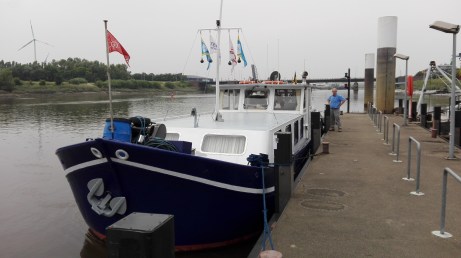
Starting off from the picturesque town and canalside yacht club at Schoten, we soon entered some monstrous canals and locks on the waterways around Antwerp. We navigated the Albertkanaal, the Netekanaal and the murky waters of the Nete and Rupel Rivers. Making good time on the outgoing tide, we arrived in the afternoon at a commercial/municipal pontoon at Boom.
At_Boom
At Boom, the day before entering the shipyard

All the way, while being perfectly friendly and positively cheerful, my two new friends Pierre and Viktor conversed almost exclusively in a stream of Dutch. I smiled a lot and enjoyed the scenery. Tying up at the pontoon, I asked Pierre what happened now. He said I should find some accommodation and return in the morning. What?!?

I had expected to stay on board for the evening…. after all there was the main cabin, a lounge with a sofa bed and the aft cabin with a blow up mattress. Plenty room for three grown men. But no… it appeared, at 4.00pm in the afternoon, that I must step off, wander the streets and find a hotel, in a town I didn’t know, in a country whose language I didn’t speak.

Leaving my big bag on board, I threw a change of clothes into my backpack and set off, muttering surprisingly gentle profanities. I managed to find what looked like the centre of town though it was almost completely deserted and I could find little evidence of commercial activity, let alone something that resembled a hotel, tourist office or other place of respite.

I pulled out my phone, opened Google Maps and managed to find two hotels. One was nearby, the other was a fair hike across the other side of the river. The nearby hotel seemed like a good choice, had good reviews and looked pretty schmick in the pictures. It cost about twice as much as I would have preferred to pay, but…..

I found my way to the closed door of the Hotel Domus. I rang the bell and eventually a smartly dressed urban hipster answered. I asked if he had a room and he smiled apologetically. Before he’d finished his sentence I knew I would need to find an alternative.

After the hipster closed the smart grey door to his immaculately decorated, well furnished but completely unavailable hotel, I rang the Fevaca Inn, across the river at the Rupel Yacht Club. A young woman answered and, speaking brightly, revealed that they had a room and would be awaiting my arrival. I shouldered my back pack and set off on the two-kilometre walk.

Turns out I had gotten lucky: ten months later, it appears that the Fevaca Inn has permanently closed, with no replacement, so Boom has only the totally booked Domus, or…… nothing.

The next day, having fed and slept reasonably well, I returned to Eben Haezer and caught up with Pierre and Viktor, just as they were preparing to cast off and motor the few hundred metres downstream to the shipyard.

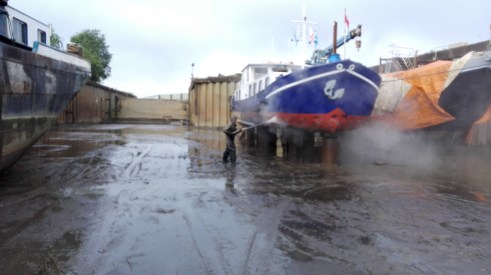
We glided slowly into the shipyard, followed soon afterwards by a massive 80-metre barge and we waited as the water was slowly pumped out to leave us high and dry on our concrete and wooden supports, ready for the hull to be power cleaned, surveyed with an ultrasound device and repainted.
IMG_20160613_093504
Power cleaning the hull of Eben Haezer

The good news was that I was able to stay on board, Pierre was to return to Schoten, and I would have the place to myself. The bad news was that I could not use the onboard toilet and shower, refused to use the shipyard’s unbelievably filthy amenities, and I would have the place to myself. A dirty industrial shipyard in a foreign place in a grey rainy week was not my idea of blessed isolation.

Nevertheless, time passed, I found decent food nearby and the necessary tasks on the boat got done… slowly. By this time, my return flight to Australia loomed closer – I had already postponed it by a week and further changes were nearly impossible. I willed the weather to stay clear long enough for cleaning and painting to be completed, which happened sometimes quickly and sometimes agonisingly slowly. I think it was partly due to the fact that the Euro16 football competition was underway and the shipyard’s predominantly Romanian workforce was occasionally distracted by their team’s exploits.
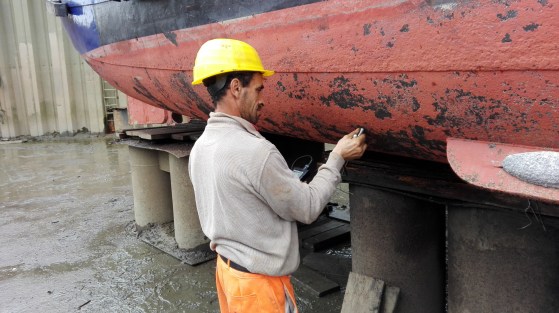
IMG_20160613_144029.jpg
Testing the hull thickness with ultrasound

The survey of the hull of Eben Haezer was a positive…. her steel was in excellent condition throughout with thicknesses well over the minimum required. I managed eventually to secure a written report to this effect from the shipyard management, which I knew would be an important consideration in securing insurance.
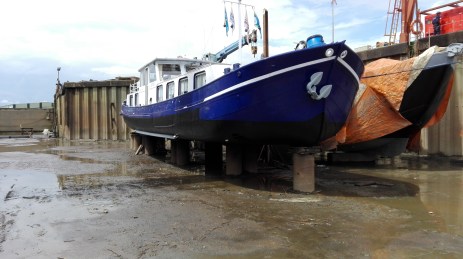
New_antifouling
Nice new coat of antifouling

I had got a bit of pressure from Patrick and Pierre over payment of their broker’s commission. My attitude was that if the sale collapsed because the survey revealed insurmountable problems, then the commission should be renegotiated. Their attitude was screw the survey, I had agreed to the purchase and they should be paid the full amount regardless. I managed to stall things using the vagaries of international transfers until I had an indication that all was well with the boat and the sale was certain to proceed.

International money transfers were an interesting diversion in several ways. I had agreed to pay Pierre, the previous owner, a deposit upon signing the contract of sale. Then I discovered I could only pay him the balance in a series of three transfers because my bank limited the total transfer allowable in any one transaction. Then when Pierre received the deposit he discovered his Belgian bank had deducted a transfer fee of 15 Euros. Quelle horreur! Or more accurately (because he is from Flanders) Hoe Vreselijk! He computed how much this meant he would lose in total and looked at me in dismay…. I had no choice. I pulled out 60 Euros in cash and told him it would cover the four transfers, each of which was for many thousands of Euros. And then I thought it was a good thing he was such a nice guy. And that in a few weeks I might never see him again.

OK, so I had completed the hurdles of purchase, deposit, survey, payment of commission and a schedule of payments for the balance owing on the boat. Within a few weeks I would be the owner of the boat. I had also paid the shipyard for the costs associated with hauling the boat out, cleaning, surveying and painting her. Downhill run from here, surely.

Not so fast. A boat in Europe, particularly one of this size, needs to be properly registered and insured. Patrick and Pierre had repeatedly assured me that they would assist with registration and insurance. But now that the sale had been completed, they were increasingly difficult to contact and time was fast running out. It was beginning to dawn on me that I might have to achieve these things on my own, despite knowing next to nothing about the processes required.

In the meantime, I had a plane to catch. I had to return to Australia and, with my wife Jane, pack up our business and our house before returning in a few weeks to embark on our first season of cruising.

Insurance was absolutely necessary, to take effect from midnight on the day we formally took ownership of the boat, which would be when we transferred the final instalment of her purchase price. On my return to Australia, I tried one more time to contact Patrick and Pierre to see if they would make good on their promise of assistance. No response.

With time rapidly running out,  I did some online research on companies that specialised in marine insurance, found what looked like a good one with Australian and European offices, sought a quote, sent them all the appropriate paperwork on the boat and her provenance, ownership and location, and then remitted payment for the policy they drew up in response.

So far so good. Perhaps Patrick and Pierre would help me with the registration when we landed back in Europe. Pierre had, after all, promised to pick us up at Antwerp Station and drive us to the boat in Schoten.

This seemed to us to be an extraordinarily kind gesture. It looked even better when Pierre detoured to a local supermarket and helped us stock up on groceries in readiness for our move on board Eben Haezer.

We felt a sense of gratitude and friendship as he helped us move our things on board before he said goodbye and walked further down the yacht club to where the other Pierre, the previous owner, had moved on board his own new boat.

That sense of gratitude and fondness was diminished a few days later when Pierre (the previous owner) told us with a wry and weary smile that Pierre (the broker) had really only come to Schoten to collect what he claimed was outstanding broker’s commission. This surprised us since Patrick and Pierre had assured us that only the buyer paid commission, not the vendor. Pierre (the previous owner) said they had claimed from him a commission of several thousand euros, in addition to the (supposedly exclusive) several thousand euros they charged me as the buyer.

Used boats, used cars….. dealers are dealers, we thought.

Over the next few weeks we learned just how much we had ceased to mean anything to them as they failed utterly to assist us as they had promised with the boat’s registration. In the end, we managed to achieve it ourselves, a process outlined in Aboard Abroad


Finding a boat

In which the long process of Looking for a boat finally bears fruit.

After viewing a number of boats in my first week in Europe and being just a bit disappointed by them, I was really looking forward to my trip to Verviers. I had no idea where the town was, other than somewhere in far eastern Belgium, but I was excited to meet the man who had promised to find me my new boat.

Patrick, a boat broker from southern France, had been sending me pictures and summaries of a number of boats for a few weeks, prior to my departure from Australia, and some of them looked really, really good. He seemed like a charming man, and knew his stuff. He spoke no English, and I spoke almost no French, but with the help of Google Translate our emails managed to communicate all that was necessary…. or most of it.

He planned to take me on a three-day trip to inspect a number of boats in Belgium and Holland. Where exactly this would take me, I had no idea, but Patrick would take care of everything.

So early one Sunday morning in late May 2016 I set off from Diksmuide, in far western Belgium (the Flemish-speaking part) where I had spent a few pleasant but disappointing days looking at private-vendor boats. I had booked my train tickets, I had booked my hotel in Verviers, and was set for the next part of my boat-finding adventure.

Well, almost. You see, Verviers is in Wallonia (the French-speaking part of Belgium). And, when their comrades in France called a snap strike, the Wallonian railway employees went out in sympathy. The railways in Flanders still worked fine, but that only got me as far as Leuven, about 100kms short of my destination.

“Le trafic des trains sera perturbé suite à une grève à partir de ce”

I didn’t find this out until I had already checked out of my B&B, lugged my suitcases to the station and checked the timetable on the platform. It was too late to pull out, but too early to call my Verviers contacts. So I boarded the train, thinking maybe the railway workers would decide to return to work by the time I got to Leuven. Not a great prospect, but my choices were limited.

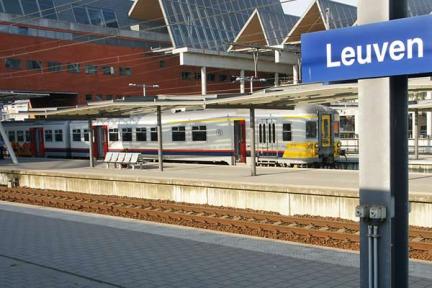
As the train sped eastwards, I constantly checked the onboard screen displaying upcoming destinations, for news that I might be carried to my ultimate goal…. to absolutely no avail. When I arrived in Leuven, the station platform and the train were almost deserted.

4-leuven
This is NOT Verviers!

My personal worries were distracted by a lone woman who did not budge from her seat, although I knew this train was going no further. I attempted in very poor French to inform her of this and was rewarded with a kind thank you in a clear, crisp English accent.

We exited the train together and repaired to a bar opposite the station, where we bought a couple of consolatory beers as she called her husband in Maastricht to advise that, instead of picking her up in Liege, he would have to divert to Leuven instead.

My own task loomed more challenging. I had no idea how to get to Verviers. I had no idea whether I could get a hotel room in Leuven. I had no idea whether my failure to arrive in Verviers would derail our boat-finding plans altogether. I was in a foreign country, on a tight schedule, with limited funds and due to meet an unknown man on an uncertain mission.

I dialled Patrick’s number, desperately trying in my mind to construct sentences in French to communicate my predicament. When he answered, I launched into what was most probably a load of gobbledygook, and I was almost pathetically relieved when he transferred his mobile phone to a new presence – an associate, Pierre who delighted me by revealing a passable knowledge of English.

No problem. Pierre and Patrick were completely unconcerned about the 200km round trip to pick me up and return to our hotel in Verviers. I hung up and ordered another delicious Belgian beer to celebrate and pass the time until their arrival.

A couple of hours later they pulled up in their little Peugeot festooned with the broker’s logos and emerged to shake my hand. Patrick was just as I had imagined – a tanned, self-possessed southerner with a shaved head capped by an impossibly broad black leather beret, a paunch revealing a love of good food and wine but the athletic frame of a former boxer. Although he hailed from Carcassone, in my imagination he was as much at home in the darker lanes of Marseilles as on a gleaming white cruiser off the Cote D’Azure. Pierre was shorter and more nervous, the big man’s consigliere, but cheerful, always ready to light another cigarette and chat, easily distracted but simultaneously constantly focused on the task at hand. Able to speak a kind of English, he was my conduit, my anchor and my safety blanket.

The sense of reassurance I gained through being rescued in Leuven by Patrick and Pierre wavered at times, but managed to survive the next three days, as they took me on a cross-country odyssey to places I would fail today to identify on a map. As they drove and chatted rapidly in French, across hundreds of kilometres of utterly mysterious roadways, guided constantly by the lady on their GPS (“au rond-point … tournez à gauche … à droite … continuez tout droit”), I sat in the back seat and resigned myself to my fate, trusting that they would (1) get to where we could view some boats and (2) get me back to a place where I could recognise a route to home.

We wound our way through northern Belgium and the southern Netherlands en route to five or six vessels that they thought were potential buys for me. I was grateful for their planning…. and for their forthright advice on the boats we viewed.

On one occasion, we stepped aboard a boat and off again in less than a minute. Patrick, despite listing the boat on his brokerage site, had not seen the boat before and it took only a brief glance for him to know it was not suitable for me or, probably, anyone else. He indicated to me, and pointedly so to the owner, the places where rust had progressed beyond minor damage; where rotten timbers in the superstructure needed immediate replacement; where windows had been sloppily fitted and were likely to admit rain and wind. I was embarrassed for the owners, in a way, but relieved that Patrick would not stoop to sell a lemon to me.

Another boat we saw was very beautiful and well kept, all wood and brass and heritage and Dutch neatness. I admired it but did not covet it. Patrick gently and discretely reinforced for me my opinion that, though a lovely vessel, she was not really suitable for living aboard, more appropriate for weekends away, which was indeed what she was used for by the family who owned her.

Other boats were similarly excellent eye candy and in all cases much loved by their owners but were, in one way or another, unsuitable. One beautiful “tjalk” had an open helm, exposed to the weather. One “klipper” was nearly right but in the end, again with the benefit of quiet advice from Patrick and Pierre, I thought was set up too much for a sedentary lifestyle, moored permanently at some well appointed yacht club rather than a months-long season of cruising rivers and canals, constantly on the move.

You might be thinking I was running out of options on this weird, apparently directionless foreign jaunt. But you’d be wrong. You see, there was one boat, in a place I can today not only identify on a map but describe to you in detail. It was in fact the first boat we’d looked at, after leaving our hotel in Verviers on day one. It was in Schoten Yacht Club, on the Dessel-Tournhout-Schoten Canal a few kilometres northeast of Antwerp. Her name was Eben Haezer.

She had pretty much everything I was looking for, yet lacked one ingredient of most boats in our price range: the need for work or fitting out before sailing off in her. Beautiful in her own way as you might expect of a steel Dutch barge built in 1916, she nevertheless had been thoroughly modernised and was exceedingly well-equipped.

Her hull was in excellent shape. Her fairly modern engine had recently been completely overhauled. She came with just about everything aboard required to cruise and live comfortably – fully equipped kitchen right down to crockery and cutlery, large domestic fridge/freezer, nearly new expensive mattress and bedding, washing machine and dryer, central heating and mobile evaporative cooling unit, excellent navigation and communication systems, all ropes and chains and gear for mooring and lock handling, excellent electrical systems, tools and supplies for maintenance, and more.

Having exhausted our alternative options in the subsequent couple of days, we returned to Schoten for a second look. This time I got out my phone and turned on Skype and the camera to take Jane, stuck back at home in Australia, on a remote tour of the boat. As I walked over and through the vessel, I pointed out all the positive features, and how they conformed to the criteria we had assembled and discussed exhaustively before I had left for Europe.

IMG_20160530_113719
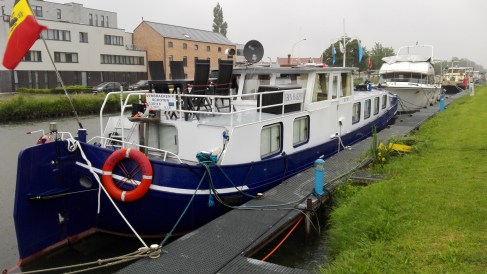
Eben Haezer at first sight

Jane’s responses were all positive and in the end, with both of us wound up like clock springs with nerves and anxiety, we managed to convince each other we had found what we were looking for. I indicated to Patrick and Pierre that we were “interested”, desperately trying to appear cool and contingent, since I had yet to negotiate a price.

The two Frenchmen pretty much responded as if they had expected this all along. They knew they had a sale and probably had done for a couple of days. We repaired to a local brasserie for a beer, a review of the trip, and some negotiations.

We discussed the various craft we had seen. We discussed Eben Haezer. We discussed the state of Belgian and Dutch roads. Finally we arrived at the point of making an offer. Much shrugging and pursing of lips on my part. More quickly than I had anticipated, Pierre said he would ring the owner and obtain an amended price. While he was on the phone, I pulled out my calculator and converted the price I was prepared to pay (in Euros) into Australian dollars. It was a significant sum, but much less than the asking price, and considerably lower still than the prices being asked for some of the other boats that we had viewed and that I had seen for sale elsewhere.

Pierre got off the phone and wrote a sum on a piece of paper. Slowly he pushed it towards me. I looked at it and blinked. I showed him my calculator. The two sums were exactly the same.

I suppose I could have prolonged things and tried to make a counter offer. But the price reduction was already significant, the list of inclusions had grown beyond my initial expectation, the list of items that needed work had failed to appear, and the sale could be completed in time for the current cruising season.

And so the deal was done. I ordered another beer for Patrick and myself – and a soda for designated driver Pierre – and we brought out the paperwork for the next stage…. Buying a boat.


Looking for a boat

As you can imagine, the process of buying a boat to live on and cruise the waterways of Europe is no easy thing. Unless you are fabulously wealthy, in which case you probably wouldn’t bother with canals…. too slow, too cramped and too far from Cannes, for a start.

For us, it began with a few things we didn’t want. New was out. Plastic was out. Wooden hulls were pretty much out. Too big and too small were definitely out.

From there, it became an agonising process of compromise and conceit. We wanted romantic but practicable, heritage with mod cons, atmosphere with ventilation, professional appointments at budget prices.

We had spent several years looking at hundreds of boats listed for sale – modern motor yachts, replica barges, converted workboats including tugs and rescue vessels, and many, many French peniches and a bewildering variety of Dutch barges, most of them built between 1890 and 1950.

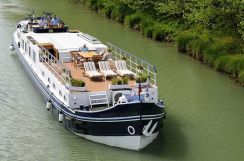
big barge
Too big!
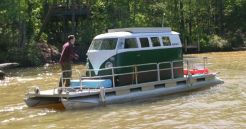
kombi
Errrm… no


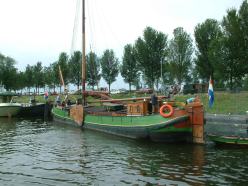
tjalk
Sweet heritage… but no thanks

The options seemed endless. How would we ever decide what we wanted? And how would we convert that into a list of actual, real boats that were for sale that we could consider? And how much did we want to spend?

We developed a spreadsheet which we used to compare the features of the many boats we had found online. I tracked down – through Google and the Kindle store – numerous blogs, diaries, books and online forums that had been written by people who had been there and done that, which I scoured for clues on the good and the bad, learning from other people’s mistakes and good fortune.

Every tale and every forum revealed useful information…. but also many biases, opinions and personal preferences that needed to be weighed and weighted. There is no universal formula for solving the riddle of what makes a good boat, and in the end it is an intensely personal choice. Nevertheless the research enabled us to identify most of what we wanted to avoid and much of what we wanted to find.The following is a partial list of the factors that influenced us:

  • less than 14 metres in length is too small for extended living aboard. I don’t know about you, but even for a couple used to being together for most of every day, a boat without the space to escape each other, even for a small bit of private time, just doesn’t appeal. Plus we cling to the idea that we might entertain guests from time to time and we want to be able to provide those guests with their own discrete space rather than camping on the lounge.
  • more than 20 metres in length imposes additional rules and regulations and costs. You need advanced training and licensing to operate a larger vessel, and even the traditionally tolerant French in recent years have been tightening the rules regarding additional structural modifications and safety equipment for larger boats, some of which makes the cost of purchasing or modifying a conforming boat beyond our budget. Besides, the idea of a boat longer than 20 metres gives the shivers to Jane in terms of handling and manouevring.
  • Draft and air draft – a hull draft of no more than about 1.2 metres and and air draft of no more than 3 metres, so we can navigate some of the smaller canal systems in France such as the Canal du Midi and the Canal de Nivernais.
  • materials – hull of steel or, if in good condition, iron. We pretty much detest fibreglass, and wood, though romantic, requires too much maintenance. Same goes for decks and superstructure, although a bit of wood on the wheelhouse is fine.
  • engine – the power needs to be sufficient to enable navigation against the current on fast flowing rivers and it needs to be of an age or condition to be as worry free as possible; we like a bow thruster because it is enormously convenient in manouevring a large vessel in tight spaces.
  • generator and electrics – we feel a generator is essential to be able to handle days and nights away from access to onshore power. Battery storage for house power needs to be adequate to last a couple of days in the wild; equipment like inverters, isolators, chargers, switches, wiring and so forth needs to be adequate, comprehensive and well-fitted. You would not believe the spaghetti trails of wiring, non-marine suitable switches and circuit boxes and underpowered (or non-existent) current control devices that many boats have collected over the years by a series of owners trying to do things on the cheap-and-quick. It’s electricity, folks! It needs to be adequate, reliable and SAFE.
  • living space – a kitchen that is not just a closet or a corner, with adequate food preparation space, storage and ventilation. A lounge that one can actually relax in, even if a section is given over to dining. A main cabin with a good bed and space to store and easily retrieve your clothes. A second cabin that can suffice for guests staying a few days without feeling they are stowaways. A bathroom that can accommodate a proper toilet and a separate shower without feeling like you are bathing in a tent or a packing box. And through all these spaces, lots of light and ventilation.
  • equipment – a full-sized fridge/freezer, not a bar fridge or, worse still, ice box. A washing machine – it is possible to get by with lugging our washing to a local laundromat and washing knickers in a basin, but this takes up valuable time for sightseeing, entertaining and boat maintenance. Electric anchor winch – these days the use of an anchor is an exceedingly rare requirement on the canals, primarily an emergency measure when your engine fails or you find yourself in the middle of nowhere after dark and you are unable to tie up to a pontoon or bank; even so, we would prefer to be able to retrieve the anchor without having to call on seven strong men for help.
  • heating and cooling –  our preference has always been for central heating fed by a diesel boiler. Cross-ventilation is a good thing in hot weather – you can always buy small fans or a mobile evaporative air conditioner, to cope with the worst of a French summer. Or just hang out in the shade of a nice tree.
  • communications/navigation – the minimum requirement for travelling almost anywhere in Europe on a boat of any size is two marine radios (one for communicating with shore, the other for communicating between boats). On rivers and canals there is no need for a full-blown marine radar system, but a GPS/mini-radar navigation set-up is invaluable.  Larger boats and commercials are required to have an Automatic Identification System (AIS) transponder onboard and it can be really useful for a vessel of reasonable size; there are a couple of really excellent AIS-based software packages that offer route planning/passage monitoring. A depth sounder is optional and probably only marginally useful for a flat-bottomed steel boat.
  • helm position – we have never been attracted to an exposed cockpit or helm position open to the elements, no matter how wonderful the rest of the boat is; we like a decent wheelhouse with a nice wheel and reasonable instrumentation, large windows and access to the deck on both sides.
  • deck – it’s great for at least part of the deck to be available for sitting/entertaining outside; cruising primarily in the summer we want to be able to take advantage of good weather to soak up sun or enjoy Europe’s seemingly endless sunsets. Plus space for storage of bicycles, operating a barbeque and hanging out the washing.

One thing we didn’t want was a “project”. We had read several stories of people buying a hull ready for conversion or gutting an interior and starting over, but that was certainly not for us. Fascinating as these stories were, and envious as we sometimes were of people who tailored their boats precisely to their specifications and taste, we knew this involved two ingredients we couldn’t afford or didn’t want – time and money.

We knew this meant making compromises, settling on something that was nearly but not completely everything we wanted and dreamed of. But that seemed good enough to us, so we spent months and months collecting dozens of online boat advertisements, sifting them and sorting them to try to find something that fitted our needs and desires, at an affordable price.

This entire process of looking for a boat had taken place in a kind of dreamworld. We maintained a rigorously practical approach to everything except how to make it work. We needed still to earn a living, we had family obligations, and we had finite financial means.

In early 2016, our circumstances had changed sufficiently to make our project a possibility. How much longer could we put it off, how much were we willing to countenance the possibility that it would end up merely as an unfulfilled dream, a coulda-been thing?

By May, this thought had become an independent force. We collected all the best available boats we could find into our database, made appointments with private sellers and a couple of boat brokers, booked airline tickets to Europe and temporarily shuttered our business.

Jane would stay in Australia. I would scout our selection of boats and, maybe or maybe not, return in a few weeks with ownership papers in my pocket. We were about to embark on the next stage… Finding a boat.

European Waterways

I come from a very dry country….. a very dry continent. I recall reading somewhere that the annual run off into the ocean from all the rivers of Australia is only a fraction of the run off from the Mississippi into the Gulf of Mexico. And our variability of river flows is much greater than in most other parts of the world, meaning many of our inland waterways change regularly from thirsty puddles and gurgling rock streams to raging torrents and massive floodplains.

Australian Rivers
Lots of rivers, not much water

Water storage and extraction, moreover, has always been directed to the purposes of irrigation and drinking water (and more latterly environmental flows), not for augmentation of river flows for the purposes of navigation. Not surprisingly, there has been no development of navigable canals on this continent.

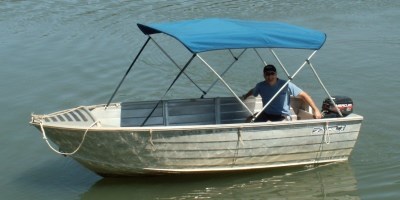
Because of that, and notwithstanding some exceptions – sections of the great Murray River and estuarine environments close to the coast – for the average Australian river traveller, the “tinnie” is king. Tinnie, as you may know, is Australian slang for an aluminium dinghy… possibly powered by an outboard, often by no more than a couple of oars.

tinnie4-1
The most common form of Australian water transport

Except for a brief period in the 19th century, when the Murray and the Darling Rivers were used to transport wool and agricultural supplies, Australian rivers have never developed as reliable, integrated systems of transport, travel and communication, beyond a very localised sense.

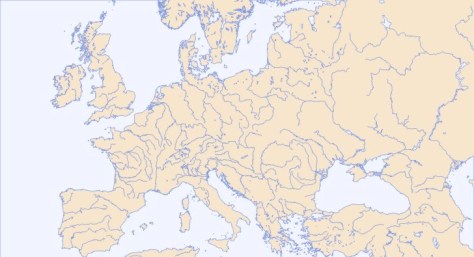
Europe, on the other hand, has a great many reliable, navigable rivers, from the mighty Volga to the Loire, from the Elbe to the Rhone. Eighteen of these rivers flow for more than 1,000 kilometres, there are hundreds of tributaries, a network of waterways flowing into the North Sea, the Baltic, the Caspian, the Black Sea, the Adriatic, the Mediterranean, the Atlantic.

europe rivers
Water, water everywhere

Most of these watercourses enjoy climates and catchments that ensure they have fairly consistent flows, with less than a quarter of the variability of natural flows endured by Australian rivers. They are major arteries and veins of transport and communication, the catalysts for agglomerations of major cities along trade routes as well as connectors of smaller settlements to those centres and to each other. They are sources of water for agricultural production and the means to get those agricultural products to market. They are significant borders and effective means of defence, marked by major military and strategic developments going back many centuries.

Canals

The earliest canals were built for irrigation, including some astounding work by the Assyrians as early as the 7th century BC, but followed only a couple of centuries later by the Persian ruler Darius with a military canal from the Nile to the Red Sea. The Romans did a lot of it, building canals in France, Germany, Italy, the Netherlands and Britain for military transport. And you would not be surprised to hear that the Chinese were active for a thousand years in this early period in building canals for navigation and transport.

After the fall of the Roman Empire, canal building didn’t really resurface until the 12th century. At that stage canals dealt with the fall in water level primarily through stanches, or “flash locks”, which meant you just surfed your craft over a weir on a surge of water released from a reservoir. Pretty difficult, you have to admit, to get the boat back up, which led to the development of locks.

Eventually, the mitre lock was developed, enabling an expansion of canal building in the 17th century, including some quite remarkable feats of engineering which can still be seen today. The Canal de Briare was completed in 1642, connecting the Loire to the Loing (and hence the Seine and Paris). The Canal du Midi was completed in 1692 linking the Bay of Biscay to the Mediterranean.

One of the key features of these “summit” canals was that they rose on one side and fell on the other, requiring complex works to store and release water at their apexes.

Over the next century there was a burst of development of canals in France and the Netherlands, as well as in Germany.

In the 19th century the French took the lead in expanding Europe’s network of canals. The Canal Saint Quentin linked the English Channel and the North Sea with the Belgian-Dutch Schelde-Lys systems via Paris, the Oise and the Seine. The Canal de Centre connected the English Channel with the Mediterranean via the Loire. The Canal du Rhone au Rhin created a north-south route; and the Sambre-Oise canal connected the French system to the Belgian system via the Meuse River.

The effect of these developments was a doubling of the traffic carried on the inland waterways of France between the close of the 19th century and the beginning of World War II.

The Belgians also developed their canals after they achieved independence, as their mining, textile and industrial operations advanced in the 19th century, as did Scandinavia and Russia.

The coming of the modern railroad system did not really dent the usefulness of the canals in Europe, as it did in the US and Britain, because in Europe the canal networks served to connect the great rivers which were already an efficient and economical means of international transport.

Of course, as anyone who has endured a night in a cheap hotel by a railway line or ventured onto a European motorway would know, the bulk of freight today is carried by rail and road. Nevertheless, a surprising amount of goods is still transported by river and canal, sometimes by massive vessels capable of carrying thousands of tonnes.

Fortunately for recreational boaters (or plaisanciers), most of their encounters will be with far smaller craft, though still dauntingly large when they loom around a bend or approach head on in the middle of what seems an impossibly narrow canal.

The preservation of the canal system in Europe is only partially due to its continued use by a massively reduced level of cargo traffic. More important, perhaps, is the rise of tourism, which has led to a proliferation of private craft travelling the waterways, as well as an increasing number of “hotel barges”.

These three elements – the vestiges of commercial traffic, the rise of hotel barge cruising and the increased numbers of private pleasure craft – have kept the canal systems of Europe alive and functioning.

In France there are nearly 100 navigable waterways across more than 8,000 kilometres; in the Netherlands, nearly 300 waterways across nearly 4,000 kilometres; Belgium, with dozens of waterways across more than 2,000 kilometres; Germany, also with dozens of courses across several thousand kilometres.

You could travel for years, decades even, without more than a modest amount of backtracking, to see all that there is to offer in this system. And it is all – or nearly all – interconnected.

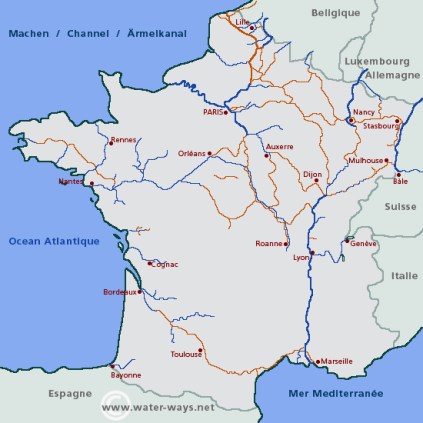
The canals of France

french canals

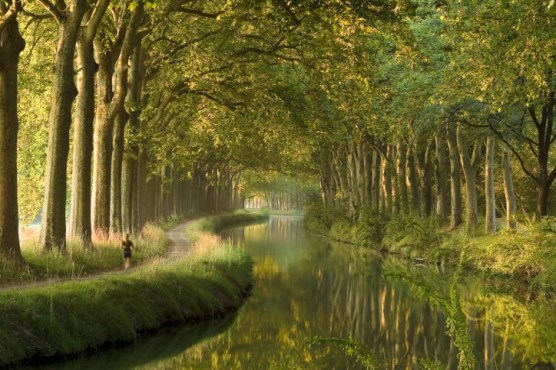
For many people thinking about canal cruising in Europe, France occupies a special place, romantically, aesthetically and practically. Not for nothing is it where most if not all of the major hotel barges and hire boat operators are located, and where almost all of the popular books about barging are set.

french canal scene

In one sense, it’s a little bit unfair and restrictive, because the waterways of Belgium, Holland and Germany have unique charms and great beauty. In another sense, though, there are cultural and historical reasons why this might be so.

After being a great innovator in the 17th and 18th centuries, with the development of “summit” canals requiring clever engineering and innovative lock and pound developments, France lost ground to an extent in the 19th century as river and canal navigation developed elsewhere in Europe

France, having become enamoured of its cleverness and success in developing summit canals and mitre locks, built more of them while being late to adopt the lower cost efficiencies of improving their major river systems and sea ports.

But the French did not ignore their rivers: throughout the 19th century and into the early 20th, much “canalisation”of non-navigable or unreliable stretches of several rivers was undertaken. Today, large sections of rivers such as the Saone, the Meuse, the Marne, the Yonne, the Seine and others have been effectively canalised, through bank stabilisation, weirs, in-channel locks, dredging and diversion works.

As it happened, the French system was normalised in the late 19th century to conform to a standard that was focused almost completely on local, regional and intra-national trade. This system, known as the Freycinet standard (after the public works minister who developed it) was introduced in 1879 and declared by law that all locks, bridges and other structures should conform to a strict set of dimensions.

Locks were to be 39 x 5.2 metres with a depth of 2.2 metres; bridges were to provide a minimum of 3.7 metres clearance. This standard was applied throughout the late 19th and early 20th century and beyond; by 2001 5,800 kilometres of France’s 8,500 kilometres of waterways conformed to it.

So effective was this system that it spawned the development of the unique class of vessel known as the peniche, a cargo vessel designed to  meet the Freycinet standard.

Many of these vessels can be found in France today in various states of disrepair or repair; most of the hotel barges operating on the French canals have been rescued and refurbished to high standards of luxury from this class of boat.

peniche

More tellingly, though, the Freycinet system means that two thirds of France’s waterways are capable of catering for vessels carrying no more than about 350 tonnes fully laden; yet these waterways also carry less than a quarter of the nation’s water borne traffic.

So what? Well, it means that the vast majority of canals in France, which is a very large country with a great many waterways, are closed to very large ships and carry only a smallish proportion of the total amount of shipping. Good news for skippers of pleasure craft!

There are literally thousands of kilometres of watery lanes and back roads in France, rather than superhighways, to explore the delights of cruising slowly and without purpose or pressure, and to discover small places and unexpected delights.

The downside of this – there has to be a downside, right? – is the lock. There are over 2,000 in France, compared with fewer than 200 in the Netherlands. And every lock needs to be entered, tied up in, operated and exited. Lots of work, lots of stress, lots of profanities murmured or shouted, lots of amused onlookers, and in the end inevitably, lots of painting of bruised hulls and stroking of bruised egos.

2016-09-23-15-32-23-e1491794941624.jpg
Careful, it bites!

And yet there is a design and a philosophy and a process even to this that needs to be understood and yielded to.

In the first place, a day dominated by carefully approaching, entering, waiting in and cautiously exiting locks is by necessity a slow, relaxed passage. Secondly, a day of locks almost always results in much human interaction…. with other boaters, lock keepers or bystanders. This almost never can be other than a good thing, even at its worst.

Barging the canals of France is necessarily slow. It often requires or stimulates unscheduled stops or longer stays than you anticipated. And it necessarily entails much interaction with the people along the way. Is this not how we should always prefer to travel?

Tales of days aboard an old boat