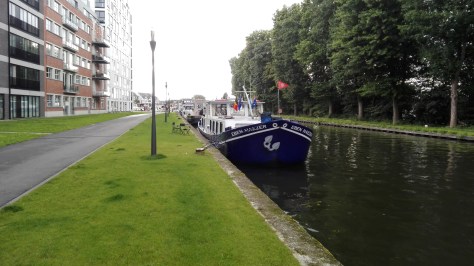
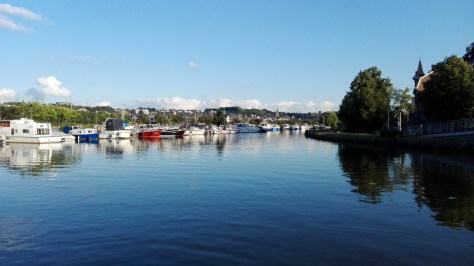
Charleville-Mézières is the capital of the Ardennes region. We arrived there on 25 August after a short trip from Bogny-sur-Meuse (3 hours, 17.5kms, 3 locks) and took up a mooring at a quay beside the camping park Camping du Mont Olympe, an attractive, treed area just across the Meuse from the main city centre. One crazy aspect is that a hundred metres further along there is a beautifully constructed modern harbour with quays and pontoons and really excellent facilities, but it is virtually empty, because it also has a footbridge across the entrance that prevents anything other than small boats getting through!
Originally two towns (Charleville and Mézières) on opposite banks of the river, the city is now a conurbation linked by bridges. Charleville was founded in the early 17th century by the decidedly odd Charles Gonzaga, 8th Duke of Mantua, Duke of Montferrat, Duke of Nevers, Duke of Rethel and Prince of Arche and Charleville. Charles commissioned the architect Clément Métezeau to construct the Place Ducale, one of the finest squares in France, between 1612 and 1628. The grand square is surrounded by 27 sumptuous Louis XIII-style pavilions, which today house chic shops, cafes, restaurants and offices. It’s a great gathering place and a spot to sip a cafe or apéritif and watch the world.
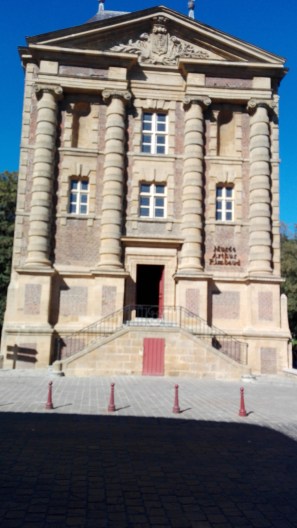
Charleville-Mézières has two significant claims to fame: it is considered the world capital of puppetry, with a major biennial festival of puppet theatre and the headquarters of the International Association of Puppetry and the International Institute of Puppetry. The latter houses a remarkable automaton puppeteer which stages an automated puppet show every hour during daytime, featuring scenes from Ardennes folk tales of the four sons of Aymon (also known as the story of Renaud Montauban). The city is also famous as the birthplace of the poet Arthur Rimbaud and there is an interesting, minimalist museum devoted to him in an old water mill on the river opposite our mooring.
While in Charleville-Mézières we befriended an English couple, Brett and Sandy who lived year-round on their lovely big old barge Rival, exploring the waterways from their base in Bruges. Sandy had taken up a hobby of turning used Nestlé coffee pods into earrings and necklaces which, whatever one’s aesthetic opinion, is certainly better than landfill!
We spent some time with Brett and Sandy, shopping, drinking coffee in the Place Ducale and, one evening, joining them for dinner at the swanky restaurant Le Manoir du Mont Olympe, above the park and mooring quay. The company was excellent, the terrace pleasant, the service efficient and the food quite good – scallops in lobster bisque, duck parmentier in a white comté gratin, beef carpaccio, and a substantial wine list – but in our opinion the place was over-priced.
We also ran into another English group we had met before in Fumay, on their sleek, expensive Linssen motor yacht. The most memorable feature of this group was their aged but friendly black labrador, who was the first point of attention for the skipper and crew at each port…. the poor fellow was nearly crippled in the hind legs and had to be (gently) heaved onto shore first thing at each stop.
On the subject of nature’s call, and knowing that this group had probably gone past the same human sludge we avoided at Monthermé, and knowing their swanky yacht would have holding tanks, we asked the skipper how he solved that problem. He responded that it wasn’t a problem, he just waited to empty until he found someone he didn’t like. I guessed this was an example of his dry, sarcastic British humour, but I’m still not quite sure…..
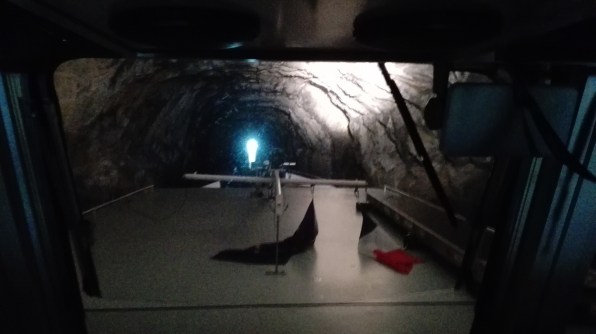
From Givet south to Charleville-Mézières, the Meuse flows through a valley in the Ardennes, a hilly, heavily forested region. It winds and meanders its way through some beautiful scenery, with steep hills, thick forests and rocky cliffs popular with climbers. On 22 August we left Givet, travelling 24kms and 6 locks upstream, and stopped for a couple of days at Fumay, a small town on a knobby peninsula formed by the sinuous curves of the river. Before we could enjoy much scenery, however, we had to cope with our first tunnel, at Ham-sur-Meuse – a mere baby at 565 metres long, but daunting nevertheless.
The quayside port at Fumay was quite pleasant, with a semi-permanent fast food van very popular with locals. It was also handy to a small but very fine wine ‘cave’.
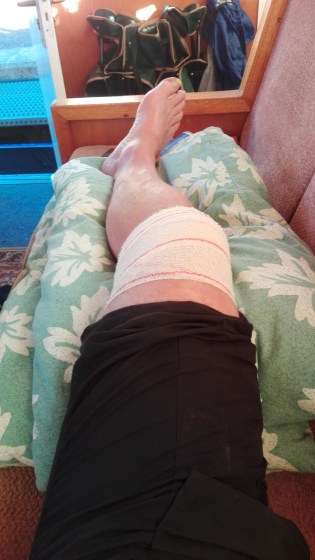
Although I obtained some excellent supplies at the cave, I had not consumed any when I suffered my first on-board accident, barely two weeks into our cruise. In making some adjustments to the engine, I had left the hatch in the wheelhouse floor open and, on reaching across to flick a switch I completely forgot about the hole and fell straight down it, injuring my knee and hip, although as far as I could tell without any breaks. I thanked the stars and promised to be more careful in future.
The next day I struggled up the hill to the village pharmacy and bought a firm elastic bandage to support my injury. We also visited a lovely boulangerie whose ovens were virtually on the street. The French really do live in close harmony with le pain…. as I was, in a different sense!
On 24 August we left Fumay to continue up the Meuse, intending to stop at a renowned beauty spot, the village of Monthermé. For 6 hours, 31kms and 7 locks, we enjoyed some wonderful scenery, with droolworthy riverside properties and thickly forested river bends.
We had read much about the beauty of Monthermé and were looking forward to stopping there for a couple of days. About a kilometre, and a bend, before we arrived, however, we noticed a stench and a brown, foamy excrescence on the river, which we quickly identified as of human origin and which could only have come from upstream… that is, the next village, or Monthermé. As we rounded the bend, still marvelling at the natural beauty of the river, we discovered the source of the problem. There were a large number of boats moored at the port in Monthermé and, in addition, a newly created camping-car park had attracted at least a score of shiny white campervans in close formation, all with their noses almost bumping up against the quay. We decided immediately to continue on another 4 kilometres to the upstream village of Bogny-sur-Meuse.
The thing is, France does not have many pump-out points for boats, in fact almost none, even though many boats cruising through France (especially those from countries with stricter regimes, like Britain, Germany and the Netherlands) have fitted blackwater holding tanks. Obviously a real problem can occur when several boats, having collected a load in their tanks, decide all together to empty those tanks in the same place. Yuk!
In the event, Bogny, although undistingished, was pleasant enough, with a good pontoon mooring and very few neighbours. We passed a comfortable evening there before heading south towards the regional capital of Charleville-Mézières.
20 August 2016, the eleventh day of our cruise, was to be the day we crossed from Belgium into France. We had enjoyed Belgium more than we anticipated, and we look forward to getting back there on a future cruise. But today, we were excited to be entering the country of our original inspiration, the land of apparently endless rivers and canals, villages, markets, great food and wine.
So we farewelled the attractive mooring at Anseremme and headed 15kms (2 locks) upstream to the poste frontière just beyond Hastière.
We tied up to the big quay and headed over to the border control office. I prayed that my rudimentary French would stand up to the rigours of (1) showing my ship’s papers and skipper’s credentials and (2) buying the necessary vignettes for our sojourn in France.
The latter are certificates, to be displayed prominently, permitting passage and usage of the waterways in France, which are controlled by the government agency Voies Navigable de France (VNF). You can buy them for one day, seven days, a month (Loisir) or a year (Liberté) on a sliding scale according to length of boat. Given how far we were into the season, we preferred to buy consecutive month-long vignettes for August, September and October as the best price option. My rudimentary French proved adequate to the task of explaining this to the very nice VNF officers, who had initially wanted to charge us for a full year, and we left the border office armed with three different coloured papers and a plastic sheath to display our vignettes from our wheelhouse windscreen.
Casting off and cruising away from the poste frontière we headed another 4 kms (1 lock) to the town of Givet, where we tied up at the quayside opposite the Port de Plaisance. Givet is an attractive town although without a wealth of sights and museums to keep you there for long. It has an old, large but relatively undistinguished fortress, but it has some delightful flower-filled streetscapes, a pleasant scale for a spot of flaneurie and some decent brasseries and restaurants.
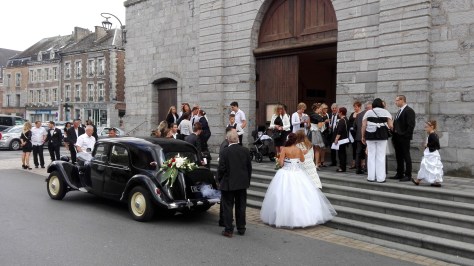
We also managed to catch a wedding while we were there…. nice car!!
On August 18 we departed Namur and cruised our way for five hours along 28kms (6 locks) of calm, picturesque, winding Meuse River, to the swish surroundings of Anseremme. We moored on a long pontoon facing a row of very swanky houses and ate dinner that evening at the nearby Anseremme Yacht Club, a small marina off the river, home to some very expensive small boats.
We had cruised straight past the city of Dinant, because its docksides were undergoing major rebuilding, and we knew that it was an easy cycle back along the riverside from our picturesque, quiet mooring at Anseremme.
Dinant was worth a couple of days exploring, for sure. Hemmed in by steep limestone hills and cliffs of the Meuse valley, the city developed in a long thin riverside strip. Riding a cable car to the top of the Citadel de Dinant gives some fabulous views over the city and along the river. The citadel dates from the 11th century, with major modifications installed in the early 19th century.
The citadel also played a significant role in WWI when it was overrun by Saxon troops of the German army. French troops put up stiff resistance (a young Charles de Gaulle was among the wounded). The Saxons, blaming the citizens, committed the first massacre of civilians by Germans in the First World War when, on 23 August 1914, 674 inhabitants were summarily executed and the town was set alight, destroying hundreds of homes and other buildings.
On a brighter note, Dinant is the birthplace of of Adolphe Sax, inventor of the saxophone. It is also the home of a peculiar confection, the couque de Dinant, made with flour and honey into a firm dough, shaped in wooden moulds with patterns of animals, flowers, landscapes and human scenes, and baked at high temperatures into a hard, durable large biscuit. To be completely honest, we somehow missed the opportunity to sample it. But it looked impressive.
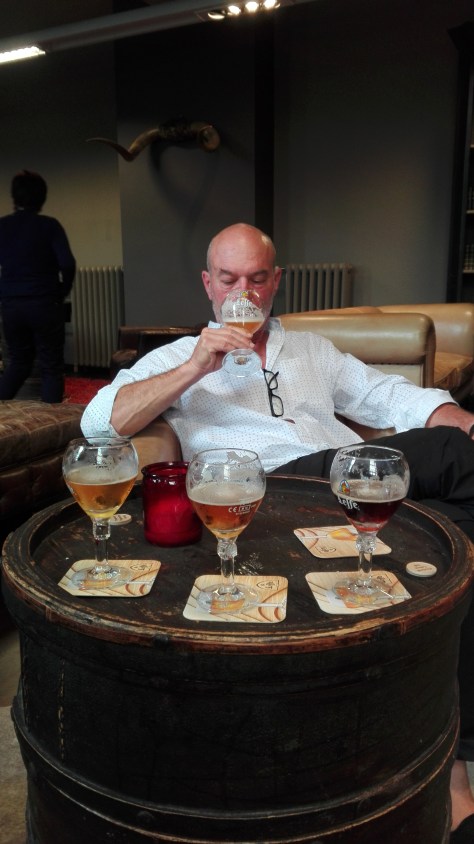
Much more enticing to our palate was the Maison Leffe, a charming historic edifice housing a museum and tasting-house dedicated to Leffe beer, which originated in the nearby Abbaye de Leffe, First produced by the monks and abbots in the 13th century, the brand is now owned under license by the global conglomerate Annheuser-Busch, but the values and taste of the old beer persist… it is one of the best ales I have ever tasted. There are about a dozen varieties in the range, but I am an avowed fan of good old Leffe Blonde, and Eben Haezer is almost never dry of it.
August 15 brought us a relatively easy day of slow travel, 27kms and 3 locks, to the city of Namur. There are two marinas here: the first, called Port de Plaisance Henri Hallet, is close to the city centre but is really only suitable for smaller vessels; the second, a little upstream and located in a gorgeous park setting, is called Port de Plaisance d’Amee, which is where we headed. Right by the mooring pontoons we discovered a lovely park with ever-active petanque courts; the next few days were filled with the muffled click-clack of boules.
Namur is a major commercial and industrial centre, and the capital of Wallonia. Located on a couple of major trade routes, it has a long history of being invaded, traded and governed by a variety of rulers, including the French, the Spanish, the Dutch and the Austrians, before becoming Belgian after independence in 1830 and then the capital of the federal region of Wallonia within Belgium. The city is best known for its chateau and citadel, the latter primarily the work of Louis XIV’s ubiquitous military engineer, Vauban.
Mooring at the Port de Plaisance was free, while power and water was accessed with jetons (tokens), purchased at the capitainerie. One token, worth €2, gave four hours of electricity, so it could cost up to €12 a day, or less if you used the power just to charge your boat’s auxiliary batteries.
During our three days at Namur we befriended Pierre, a retired Wallonian teacher, who lived on his boat with his wife Nicole, who still worked in Brussels and joined us on our last evening. Pierre was a great source of information and patient assistance with our French language skills, as well as being great company. On our final day we bought a couple of coquelettes at the local market and, using our small gas kettle BBQ, managed to roast them to a surprisingly good result, sharing them with with Pierre and Nicole, who contributed some delicious salads and a cheese plate.
While in Namur we decided to take the opportunity to refuel, having heard that there was a man who would deliver to the dock. With the help of Pierre and the capitain, we located our man, paid him the cash to purchase the fuel and waited for him to arrive, presumably in a van. We were amazed, though, to see him pull up an hour later on a bicycle, towing a purpose-built trailer loaded with eight jerry cans filled with 240 litres of diesel. As he unloaded each can we hauled them on board and poured the fuel manually into our fuel inlet, losing only a litre or two in spills but not thoroughly enjoying the smell on our hands, shoes and deck and more than a little concerned at the small but discernible slick that formed on the waterline. The cost of the fuel, including delivery, was as good as we might have achieved at a specialist dockside fuel outlet elsewhere, but we resolved to buy a small electric-powered fuel pump at the next opportunity, especially as we knew we would have cause to do the same transfer from jerry cans to fuel tank in the future.
Bidding farewell to Visé on 14 August, we headed for the Meuse and the industrial region of Liège and Huy. Signs of massive industry lie on both sides of the river here, reminders of the role the region played in the sillon industriel of Belgium, the 1000 square kilometre ‘furrow’ of industry stretching from Verviers in the east to Mons in the west, passing through Liège, Huy, Namur and Charleroi.
It also meant dealing with a fairly heavy amount of river traffic from very, very big commercial barges travellng very, very fast (compared to our sedate speed of 10-11kph).
Although we didn’t stop in Liège, we were glad to pass through and glimpse a city with a fascinating history and legacy. In the 14th century, the city established a unique guild-based form of democracy, the spirit of which survived incorporation into the Holy Roman Empire and the Hapsburg rule of prince-bishops. In 1789 the city erupted into revolution at the same time as the French Revolution in Paris. In the early 19th century Liège developed into a major industrial city, one of continental Europe’s first large-scale steel-making centres. In 1950 the city’s unions led the general strike which forced the abdication of King Leopold III for alleged collaboration with the Nazis. And again in the General Strike of 1960-61 which, although originally aimed against government austerity measures, eventually led to the rise of Wallonian identity and the formation of a federal structure in Belgium.
It’s done it tough since the 1970s with the decline of its industrial wealth but it’s good to see that in recent years Liège has experienced some recovery from late 20th-century deindustrialisation, with the emergence of new advanced-tech and high-tech industries. The inner city district of Le Carré with its pubs and vibrant nightlife, and the Sunday Batte market along the banks of the river, are just a couple of reasons we look forward to the opportunity to return to Liège and stay a while.
Passing through the upstream city of Huy, also an industrial centre, we arrived at the Port Fluvial de Plaisance de Statte, just beyond the centre of the city, at 5.45pm after 7.5 hours and 41kms of steady travel. The port is a small and rather tight harbour off the river, protected by high stone walls and a narrow entrance, and we nervously edged Eben Haezer through the space and alongside the quay – not daring to take her further into the mass of smaller but more expensive plastic boats moored on pontoons.
The port capitaine gave us a friendly wave, indicating all was OK . A moment later, however, an agitated man advanced along the pontoon opposite us and gesticulated, indicating we should move further back along the stone wall to allow space for a boat arriving later…. a manouevre which would have made it impossible for us to get off the boat. The capitaine ignored the self-appointed admiral of the port, and we decided to do the same. As it happened, the boat we were supposed to make room for entered the port about an hour later, driven by what appeared to be a very calm pre-pubescent skateboarder and populated by an assortment of jewellery-adorned grandparents, and easily found a spot in a smaller space further within the harbour. We clung to our spot that had cost us €10 including power and water, and spent an enjoyable evening.
Finally, the day arrived when we would manouevre our 38 tonnes of old boat away from her mooring in Schoten and head off towards the canals and rivers of France. On 10 August 2016, we woke early, trying to calm our nerves and telling ourselves everything would be fine, just take it slowly, it’s only a boat, what could go wrong? Everything, something, our quivering lesser selves whispered to us, only to be immediately dismissed as we busied ourselves with the mundanities of leaving port.
We went through the routine that was to become a daily ritual for us, whenever we were preparing to get under way. Check and tighten the grease pump for the prop shaft packing box. Check the fuel, the oil, the water. Check the battery charge. Disconnect the shore power lead, turn off the battery charger and inverter, flip the switches for source of power from shore to alternator. Turn on the VHF radios and AIS. Turn on the laptop and boot up the navigation software.
Then it was time. Time to turn the engine on, throw off the mooring ropes and…. steam away! The first lock was about a kilometre away, then the second another kilometre after that. How would we go? We were blessed that morning with the generous, experienced, calm presence of our friend Roland, who threw his bicycle on board and volunteered to travel with us for the first couple of locks. Marvellous reassurance to fraying nerves, I can tell you.
We were travelling along the Kanaal Dessel-Turnhout-Schoten, a relatively quiet waterway that would take us through Belgium’s north east towards the big waterways of Zuid Willemsvaart and the Albertkanaal towards the River Meuse, which would in turn take us south towards France.
With Roland’s steadying oversight we managed the first couple of locks with surprising ease, before farewelling him on his bicycle back to Schoten, as we continued on our independent way. The day was overcast but quite pleasant, and we soaked up the utterly new sensation of slow progress along a quiet, narrow waterway. In the canal our maximum speed was 8kph, so there was plenty of time to enjoy the rural views.
On our aft flagpole we flew a massive Dutch flag that Pierre, the previous owner had presented us with. From our forward masts we flew, in what we hoped followed proper protocols, an Australian flag, a European Union flag and, on the far starboard side, the flag of the country through which we were passing, in this case Belgium.
After 7.5 hours, several locks and 34 kilometres, we pulled in to the quay at Turnhout at a little after 4.00pm, somewhat weary but immensely satisfied at having made the first day’s journey (and finishing it without crashing into the quay or anything else!)
The capitain appeared from somewhere, collected our €8, pointed out the power and water points, and disappeared again quickly, a model of Flemish discretion. We located the pleasant Brasserie Klaverhof, overlooking the canal, and had a typical large Belgian dinner accompanied, as always, by masses of ‘frites’ (fries) and good beer.
The next day, August 11, saw us leave the Kanaal at Dessel and our next intended stopover at Bocholt. The morning was quite pleasant, passing through a fairly straight stretch but with attractive rural surrounds.
In the early afternoon we turned left (east) onto the Bocholt-Herentals Kanaal. As we did so, I spied an empty stone quay and, with no other traffic about, decided we would try a few mooring procedures, just for practice. In the next half hour I managed to use the entire width of the waterway, positioned the boat around most of the compass, and learned what I imagined was the prime reason sailors swear so much. It was not an enjoyable exercise, but I consoled myself in the knowledge that I had managed not to crash or scratch the boat and that I could hardly get any worse.
About 5.30pm we arrived at what we hoped would be our next stop at Bochholt. We had rung ahead to the port captain and advised our arrival and, admittedly after some language barriers threatened, we believed all was OK. What presented itself to us, however, was far from promising. The supposed port was tiny, with a small wooden shed at one end, unattended and forlorn. The size of the jetties were clearly not going to accommodate our vessel so, after a fruitless conversation, across languages which refused to meet, with a gentleman on the shore who turned out to know nothing and may have been merely a fisherman or a local on his evening constitutional, we consulted our chart and decided to continue another half-hour to Bree. We found there a slightly desolate but accommodating mooring in a nondescript location, but we were glad of the finish to a long day (8 hours, 54kms) and the chance to rest before hitting the big water the next day.
So it was that on our third day, August 12, we enjoyed our last moments of quiet rural cruising before we entered the massive Albert Kanaal, a commercial artery that cuts eastern Belgium in half and links Antwerp with Liège and the Meuse River.
We had originally intended to turn off the Albertkanaal and head into Maastricht, an attractive city that in 2016 was celebrating the 25th anniversary of the eponymously-named Treaty that founded the European Union and the euro. As believers in the European project we were keen to visit the city to celebrate, but Maastricht is in the Netherlands, not Belgium, and we still did not have our ship’s papers, so we diverted instead to the delightful small Belgian harbour of Visé, which we reached at just after 4.00pm, after 7.5 hours and another 54kms.
Entering the marina there, through a small lock, on only our third day in charge of our big new boat, was an interesting experience. We travelled ultra slowly through the marina, trying to spot a place big enough for us…. at this stage our preferred space would be about three times our length, to assist in a slow gentle glide into position. No such luck. We eventually spied a place right at the end of the marina, nicely located, so we thought, close to a willow, so we headed to it and glided in with minimum fuss and cuss. We soon found, however that it just would not do. Firstly, it was prohibitively far from the nearest water and power points; but secondly and more importantly it proved to be home to an enormous flock of noisy, pooey geese. Who would most likely prove aggressively unwilling to share their home with the likes of us.
There was nothing for it but to cast off and return back up the course of the marina, searching for a better spot. As we did so, we were slow and quiet but our repeated manouevrings nevertheless managed to alienate us from the several resident fishermen. C’est la vie. We eventually managed to find a space just big enough to poke ourselves into and even managed to enter it and secure ourselves along the quay without hitting it or anyone else!
Visé was a delightful spot to spend the next couple of days. At about €15-18 per night, depending on length, it was not exactly cheap but it provided excellent facilities including water and power, showers and toilets, and a pleasant yacht club brasserie… where we managed to make an unusual new friend!
Shopping in the nearby town was more than adequate, including an excellent boulangerie patisserie and, should we have needed it, a classy linen shop just by the Hotel de Ville.
We returned from Scotland in late July and continued to get ready to embark on our watery adventure. We now had nearly everything sorted – skipper and radio operators licenses, new marine radios and Ship Station IDs/licences, boat insurance, and so forth. On board, we had inherited most of what we needed in the way of furniture and equipment, and what we didn’t have or didn’t like we acquired or replaced easily enough.
We enjoyed fantastic assistance from many people, including the previous owner, the wife of the yacht club president, and new friends we made among the small community of boaties in the yacht club. Foremost among these was Roland, an amiable Frenchman who had lived and worked in Belgium for many years as a professional boatman and now lived with his Belgian wife Myriam on a beautiful big boat moored right behind us.
Roland didn’t speak English at all and our French was still pretty poor, but we were able nevertheless to communicate on a range of subjects, technical and philosophical, with the aid of hand gestures, google translate and occasional help from Myriam, who spoke passable English. Roland found various spare bits and pieces for us to use on Eben Haezer, including an old ladder and some plywood and checkerplate we used to make quite a nice “passarelle” gangway. Pierre, the previous owner, several times drove us to chandleries around northern Antwerp to buy our new radios, rope, fenders, and other boaty bits. Roland and Myriam also provided wonderful friendship and entertainment.
We were still waiting on the arrival of our ship’s papers from the Netherlands. We had been in Schoten for a month and were getting decidedly itchy feet so, after consulting with a few allegedly knowledgeable locals, we decided we may as well leave and let the papers catch up with us later. They would be delivered electronically in any case, and we thought that as long as we stayed within the borders of Belgium we should be OK. In final preparation, we bought a couple of bicycles and commissioned a local printer to produce shiny new letters for our boat hull, with her name, home port and registration number. We didn’t know what that number was yet, so we just got him to print a bunch of numerals we could stick on later….
We had already booked and paid a deposit for a winter berth in Roanne in France, and we knew we needed to leave very soon to make it there by the end of the season. So, with a sense of excitement and trepidation, we set August 10 as our date of departure……
We plotted a course east towards the Meuse River, then south towards the French border. Apart from being the “scenic route”, it had the decided advantage of giving us a few days of quiet cruising along rural canal ways, rather than beginning our maritime life in the massive locks and heavy commercial traffic that we would have met if we had gone directly south via Brussels.
We checked our equipment and supplies, rechecked our charts, breathed deeply, and got ready for a whole new experience.
If you have the money, and sufficient recklessness, it’s not hard to buy a large boat to live on in Europe. But if you want to take that boat along the waterways, without risk of accident, arrest, or financial disaster, there are a few steps worth considering.
First up, it is very helpful to be or to become proficient in manouevring and being in charge of a large hunk of unwieldy metal. Plus it is a legal requirement in most places to be certified as a skipper.
We now owned… and as of July 2016 were living on… our beautiful piece of maritime history and pleasure. But we were not certified to take her anywhere, or to operate the twin radios which were a compulsory part of ship’s equipment.
And to be honest, we had no idea what would happen when we tried to handle this very large and heavy boat. We were just a tad terrified, although determined to confront our terror.
There are a couple of legal-type necessities involved. First of all, the boat needs to be registered appropriately to travel through the waterways of Europe; theoretically that could mean under the flag of almost any country, although in practice your options are limited. Secondly, the boat needs to be equipped with two marine VHF radios (one to communicate with official channels such as locks, the other to communicate with other vesssels), and these radios need to be properly registered as Ship Stations with their own unique IDs.
I had no idea how to go about these processes, in English let alone another language. The brokers had promised to assist but, once all the contracts – and money – had been exchanged, they faded completely from the scene.
I hit the internet and found several companies who offered the necessary registration assistance, for what seemed to me reasonable prices. I chose a Dutch firm, Yacht Registration Holland, since for reasons explained below I had decided to revert the boat’s registration to the Netherlands, her country of origin.
I sent off the necessary documents of ship specifications and ownership, and settled back to wait…. and wait….
In practice, there were only really three options for country of registration for Eben Haezer. We could not register her in France, Belgium, Germany or most other European countries since their laws permitted only citizens or permanent residents to do so.
The first option was to register her as an Australian ship, since that was the owners’ country. But that would have taken weeks if not months of to and fro correspondence between Europe and Australia, and we were eager to get moving asap. In any case, she was an inland vessel in Europe and would never get near Australia, so it seemed a bit pointless, really.
The second option was to put her on the British Small Ships Register, a relatively easy process (given Jane’s British citizenship) that would have added her to the sizeable fleet of British-registered boats cruising the waterways of Europe. But it would have meant flying the Union Jack or Red Ensign, which for me, personally, and especially after the Brexit vote of 2016, did not hold great appeal to an Aussie in Europe.
The third and best option was to enter her in a modified short form on the Dutch cadaster. The Netherlands permitted boats and owners from any country; their registry was recognised internationally; the costs and renewals were easy; and we were comfortable flying the Dutch flag on what, after all, is a Dutch boat. And so that’s the way we went.
The same company that achieved our ship registration also handled the registration of the Ship Station for our marine VHF radios and the Automatic Identification System (AIS) which we had on board.
The AIS is a marvellous bit of kit. Every vessel over a certain length is supposed to have it, enabling the ship’s position to be tracked in real time and logged in an international database. With a laptop and the right software (such as PC-Navigo), you can also use it in course planning and tracking – watching your vessel’s progress in real time along your predetermined course – as well as “seeing” other vessels lying or approaching nearby.
This last feature is wonderful for seeing the approach of other large vessels – especially commercial barges – as you try to navigate safely on narrow waterways, and even on larger rivers. You can see the name, size and type of vessel and their speed. And you can exercise caution or avoidance as you see fit. Plus it shows you exactly where you are and how fast you are going in relation to where you are heading. All very reassuring.
There were two final pieces to fit in the jigsaw before sailing away – a skipper’s certificate and a VHF radio operator certification. The skipper qualification required a boat operator license that was recognised in Europe with an additional certification for inland waterways. The first part, if you didn’t have it already, required a practical test on an actual boat; the second part was a theory exam with a high pass threshhold. Back to the internet to find options that didn’t involve sitting for tests in French, Dutch or Flemish….
There was a lovely chap in the Netherlands who could handle all of this for us, on his boat, or he could come to us in Belgium and do it all on our own boat. Sounded great, and we lined him up. But then the Dutch holidays intervened and, with time rapidly running out, we found it impossible to get hold of him. Back to the internet ….
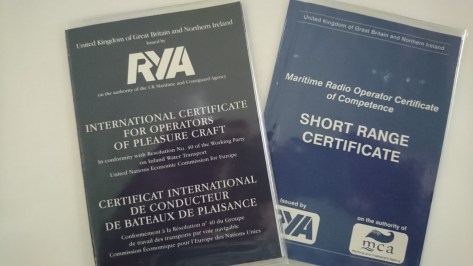
We found a boating school …. in Scotland! INDISkills, based on the Forth and Clyde Canal, east of Glasgow, could deliver everything we needed, and right now. We would qualify for an International Certificate for Operators of Pleasure Craft, with certification for Inland Waterways of Europe, as well as a Maritime Radio Operator (Short Range) Certificate of Competence.
So from Schoten in Belgium we scooted off to Scotland for a week…. better yet, we were able to live on board the trainer’s boat – a lovely old English narrowboat – and turn an obligation into a pleasant floating holiday. Chrisy, our instructor/assessor, was delightful and her boat INDI was fabulous to stay on for a few days and to learn the ropes.
We describe elsewhere (Looking for a boat; Finding a boat; Buying a boat) the process of finding and buying the right boat for us to live on and cruise the European waterways. It was a nerve-wracking experience but it worked for us and we now have a vessel that is sound, comfortable, reliable and eminently resaleable.
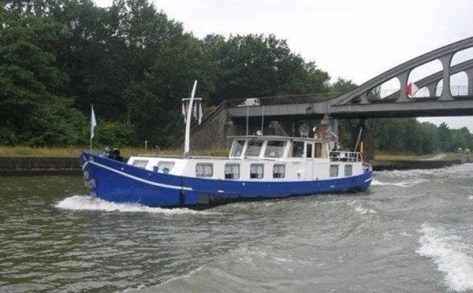
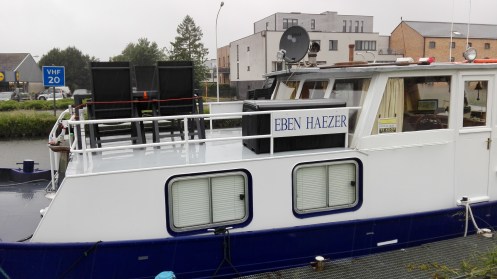
Eben Haezer* is classed as a “Klipperaak””, distinguished from many other styles of Dutch barge by her upswept bow and high stern, with a graceful curve along her gunwale.
She was built in 1916 in the shipyard of Worst Brothers (later Worst and Dutmer) in Meppel, a Dutch shipyard that originated in the late 18th century. She was first registered on 28/06/1917 in the nearby city of Zwartsluis, then again in 1943 in Groningen in the northern Netherlands, presumably when she first had an engine installed to replace her original sailing rig. Her latest registration before we purchased her was in 2006 in Brussels, when her papers were transferred to the Belgian registry.
Her hull and superstructure are steel. She is surveyed at 18.54 metres in length, 3.86 metres wide and with a water draft of 0.90 metres. Her air draft is 2.80 metres and her total maximum displacement is 37.38 tonnes.
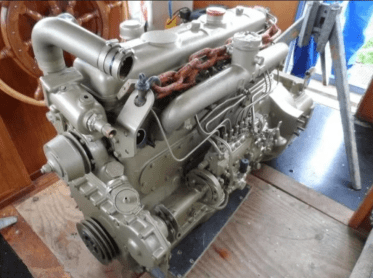
She is fitted with a 1973 DAF 575 diesel engine, delivering 77kW or 103 horsespower, driven through a 3:1 reduction via a driveshaft to a three-blade bronze screw propellor. The engine is located midships, below the wheelhouse, and is cooled along the hull via a closed system (no raw water intake). The engine was removed, completely reconditioned and replaced in 2013, since when she has operated for no more than 320 hours. Fuel capacity is 600 litres in a steel tank.
The engine being replaced after reconditioning
She is also fitted with a hydraulic (not electric) bowthruster driven off the main engine.
A 7kvA Lister diesel generator is located in the bow, fed by a 500-litre steel fuel tank for “red” diesel*, which also supplies a Kubola boiler in the main engine room. The boiler feeds a closed central heating system, with eight radiators located throughout the boat.
Hot water is provided via an electric immersion-coil boiler in the bathroom. Total water capacity is 1100 litres in a rigid plastic cylinder in the aft well.
Electrics are 12v/24v/220v. 220-volt power is supplied by the generator or by shore power connection. Two batteries provide 24v to the main engine; a single battery provides 12v to the generator; and 4 x 200amp hour batteries provide house power for lights, cooking and appliances. There is a double solar panel on the wheelhouse roof providing trickle charge via a regulator to the house batteries. The system is completed by a Mastervolt 3200 inverter, a Mastervolt isolator and a Mastervolt dual battery charger.
This seems a pretty good system, well-fitted, to my layperson’s eyes… but I am the first to admit I have a great deal to learn about it and how to make it work best for us. Certainly I would like to upgrade the solar power capacity, and to examine fitting more power-efficient lighting and power points throughout.
The greatest drain on electric power comes from the hot water heater and the four-burner electric cooktop. The former is easily dealt with since it operates efficiently while under way, with power fed by the engine alternator. While on shore power, we use it only when not using other significant drags on power (e.g. cooking or heating).
The question of cooking is interesting. When I first saw the electric systems (four-burner stove top and combi convection-micro oven) my first thought was to replace them as soon as possible with gas. I prefer cooking on a gas flame, and I knew that electric cooktops sucked a helluva lot of power.
But I kept coming across professional boatmen (Eben Haezer’s previous owner was one of them) residing on their own live-aboard vessels, none of whom would countenance having gas on board. For them it was a safety issue. Gas is heavier than air and, if there is any leak, no matter how insignificant, it will sink and collect in the bilge, presenting an unacceptable risk.
You might ask, as others have, why then do so many live-aboard boats have gas? It’s a fair question, and I’m not arguing one way or another. The risk of an explosion is most likely very low (otherwise we’d see more news reports of accidents) but, on the other hand, the consequences are pretty dire.
So for the time being I’m comfortable to stick with our current set up. If I need to, I can switch on the generator and for a few drops of red diesel have all the power I need for cooking as well as running other circuits. Plus, for much of our cruising season, we can and we adore cooking outside with one or both of our barbeques (one gas, one charcoal).
Accommodation on Eben Haezer is pretty damn comfortable, I have to say. Not luxurious, but everything a middle aged couple and their occasional guests might desire.
Amidships is the wheelhouse providing an excellent helm position, as well a comfortable lounge seat and room for a small dining table. Jane and I spend much of our time here, even when we are not underway, since it’s a great space with large windows for reading, relaxing and eating with a view on the outside world.
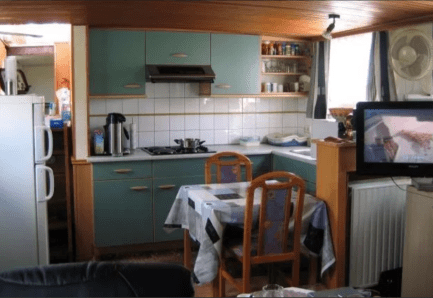
Forward down a few steps you enter the open-space kitchen (galley!) and lounge area. The galley is equipped with a four-burner cooktop, extractor hood, sink, benchtop combination oven (convection-microwave) and plenty of bench space for food prep and small appliances such as toaster, coffee grinder/espresso machine and kettle, as well as lots of cupboard space above and below.
It also has a full-size upside-down fridge/freezer that runs on 220v and I have to say is quite magnificent. I cannot imagine living full-time on a boat (or in a house) with a tiny bar fridge, even though we shop most days and don’t really have a need to store huge amounts of perishable food.
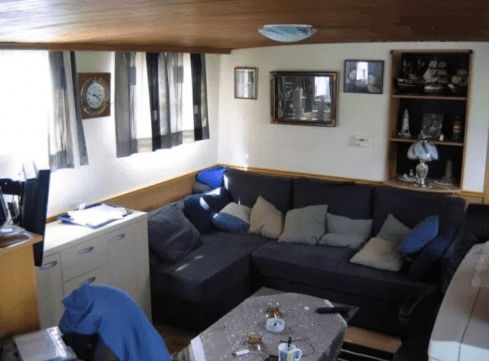
The lounge is separated from the galley by a small dining table, and includes a large sofa with pull-out bed, a coffee table, and a couple of cupboard units for storage. There are two separate central heating radiators in the lounge and they are more than enough.
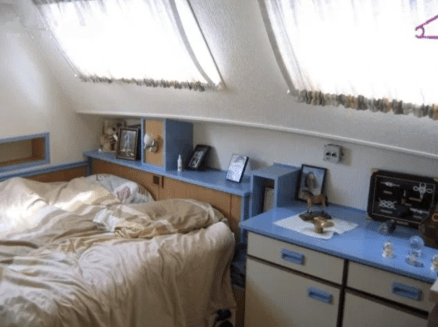
Moving forward from the lounge is the door to the main cabin, with a large double bed on one side, lots of storage for clothes and personal effects, and large windows to give plenty of light. The mattress on the bed was gifted to us nearly new by the previous owner and is utterly magical. Apparently it cost a small fortune and it shows. I have never had such an extended period of restful sleep as the months we spent on Eben Haezer in 2016.
Hey skipper! That bed needs making
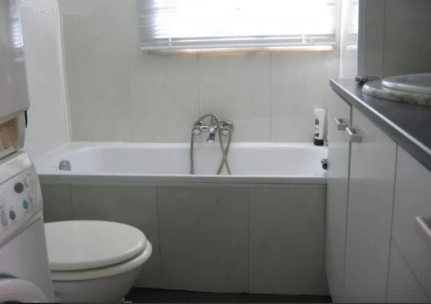
Back in the wheelhouse and moving aft, down a few steps is the passageway to the rear guest cabin. Before you get there is the door to the bathroom, which is equipped with a vast vanity counter and basin, a macerating full-flush marine toilet and a bath with handheld shower. The bathroom also holds a front loading washer and a dehumidifying dryer.
The helm position in the wheelhouse includes a lovely old wooden steering wheel, operated by mechanical cable and chain mechanism. The wheelhouse has large windows providing an excellent viewing platform, and an expansive counter area for maps, reference books, computers, binoculars, hats, sunglasses and cold or hot drinks.
Overhead is a console with an AIS (Automatic Identification System) transponder, a Furuno mini radar unit and GPS positioning unit, two marine radios and a car radio with twin speakers. By coupling the Furuno and AIS systems with a laptop computer running PC-Navigo software, we are able to plot our routes, monitor our progress in real time and receive advance warning of approaching large craft fitted with the same systems (compulsory for all craft over 25 metres). It’s not necessary but it’s very reassuring.
On deck, there is a large entertaining area astern of the wheelhouse, sufficient for a table and six chairs, as well as a storage box. Behind that and down three steps is the rear deck with room for our barbeques and two bicycles, as well as the hatch for the rear storage well.
On the forward deck there is the anchor winch with an electric motor, and the hatch to the bow storage-well, plus the raised forward deck over the lounge and main cabin, which supports the mast and provides a large flat area for lying in the sun or storing items such as our passarelle* and boathooks and such.
Much of the finishing inside Eben Haezer – walls, floors, trims cabinets and so forth – features modern materials. One might rue this if you were looking for atmospherics and a heritage feeling, and we may over time attempt to re-introduce a bit of old-time charm. But the huge advantage this Dutch-Belgian passion for clean modernity delivers is an absence of the need to constantly repair and retouch.
We wanted a boat to cruise on, not work on. And Eben Haezer delivers that, while also feeling cosy, comfortable and welcoming.
* Eben Haezer, the name of our boat, is a Biblical reference, shared by a number of boats large and small in Belgium and Holland. Translated as “stone of help”, in the Books of Samuel it was a place that witnessed major battles between the Philistines and the Israelites. The Philistines won the first battle and captured the Ark of the Covenant; the Israelites won the second, after Samuel had offered a sacrifice, and erected a stone in memorial which he named Eben-Ezer. The location of this place is uncertain but has been often placed at Aphek (now Antipatris or more recently Tel Afek) in central Israel. Our boat was originally given this name and has carried it ever since; we believe in maintaining that continuity.
*Red diesel costs about 50-60% of the price for normal diesel. It is reserved for use on farms, in machinery, generators and boilers. There are potential heavy fines for trying to use it in boat’s main engine, and boaters would be well advised to avoid trying to cheat the system.
*A passarelle is literally a footbridge. On a boat it is a small apparatus for getting from the boat to the shore when there is a gap, such as when you are moored against a sloping bank when it might be hard to jump or clamber from the deck to the shore. Our passarelle is a strong ladder with an attached piece of marine ply. Simple but effective.




















 Scraping Through France