Summary of our first season

We started our premier season in Schoten, Belgium and ended it in Épinal, France. We arrived in Schoten in early July; our cruise lasted from August 8 until September 27; we left Épinal and returned to Australia on 6/7 November.

We travelled on the following waterways:

  • Kanaal Dessel-Turnhout-Schoten
  • Kanaal Bocholt-Herendals
  • Zuid-Willemsvaert
  • Kanaal Briegden-Neerhaven
  • Albertkanaal
  • Canal de Visé-Harcourt
  • Canal de Monsin
  • La Meuse et son Canal
  • Canal de la Marne au Rhin (Ouest)
  • La Moselle et son Canal
  • Canal des Vosges
  • Distance covered – 640 kilometres
  • Locks – 142
  • Tunnels – 4
  • Days of travel – 26
  • Days of rest – 24
  • Average hours on travel days – 5.25
  • Average daily distance – 24.6
  • Average speed – 5.5 kilometres per hour
  • Fuel consumption – 450 litres @ 3.4 litres per hour
  • Cost of fuel – total €600 @ €1.33/litre (inc. delivery)
  • Cost of mooring at Schoten Yacht Club (33 days) – €16 per day, including water and electricity
  • Cost of mooring at Epinal (40 days) – €5 per day, including water and electricity
  • Cost of mooring while cruising (50 days) – varied from free (with or without facilities) to €16 per day, including water and electricity
  • Total cost of mooring – €1000 @ €8 per day
  • Cost of winter mooring (without facilities) – €100 per month, payable on return
  • Cost of meals eaten at cafes and restaurants – €12-€40 per head (exc. drinks)
  • Estimated cost of meals for two people, eating out 4-5 times/week – €2600 @ €144/week
  • Estimated cost of wine and other drinks – €800  @ €44/week)
  • Estimated cost of groceries – €1800 @ €100/week
  • Total cost of mooring, fuel, food and drink – €6800 @ €1700/month
  • Cost of maintenance, repairs spares and upgrades – €3000

includes 4 deep-cycle batteries + 2 engine batteries + dual charger + battery monitor + labour to fit these; paint and painting equipment; hand tools and small electrical tools

  • Marine insurance – €900
  • Training and certification (2 people) – €1300
  • Cost of household items and upgrades – €2000

includes coffee machine/grinder, kettle/toaster, TV/satellite decoder, printer, replacement furniture, kitchen/tableware, manchester, 2 bicycles, 2 BBQs, 2 heaters, decor, other sundry items


End of our first season

After our side excursion to Plombières-les-Bains and Remiremont, we had about a fortnight before we were due on a plane back to Australia. Plenty of time to prepare Eben Haezer for the winter and secure her to withstand six months or so alone, empty and more or less unattended.

Thanks primarily to lots of advice and practical example from Knud and Erica, who had prepared their own boat Linquenda and departed a couple of weeks prior, we had a pretty good idea of what we needed to do.

The first job was to prepare the central heating system to withstand the harshness of a Lorraine winter, with temperatures well below zero, snow, and a frozen canal. Because Eben Haezer had previously been lived on year-round, the heating system was not “winterised” and so her boiler and pipes and radiators were filled with plain water. We needed to replace that with a mix of water and an appropriate form of anti-freeze.

A lovely chap from the marine workshop at Corre, further down the Canal des Vosges, was doing some work on our new American friend Ron’s big tjalk, and we were able to get him to help us, including supply of the correct anti-freeze and a demonstration of how to pour it into the system (to be honest, before his help, we didn’t even know where the inlet for the system was located!)

The process involved a complicated series of operations to release water from the system, replace it with the anti-freeze solution, and re-pressurise the system. While we were doing this we also decided to replace some of the older fittings – thermostatic valves and so forth. We spent several days on it in the end, as we discovered new leakage points each time we re-pressurised, necessitating a new round of pressure release and refill. We hope that we now know all we need to know about marine central heating systems!

We spent a bit of time touching up paintwork inside and out, washing curtains, cleaning rugs and carpets and stowing things in winter storage. Our bilges had thankfully stayed bone dry throughout the season, but I did a bit of cleaning in and around the engine room and generator room. There was still work I wanted to do (or, rather, commission a skilled person to do) on the electrical system, but decided it could wait until our return.

We bought extension leads and rigged them up so that while we were gone our friends who were staying in the port over winter could plug them into the power supply a couple of times a month, or when it got especially cold, to operate our battery charger. Other than the charger connection, when we left the boat we disconnected the battery banks from their circuits to prevent unnecessary drain from them.

The other last-moment task was to drain all water from the boat’s plumbing systems – the hot water boiler, the toilet cistern, the inlet and outlet pipes. As far as it was possible, we needed to remove all water from the system to avoid damage from frozen pipes and mechanisms. This involved connecting a bicycle inner tube to the main inlet, then one by one opening taps as I pumped air into the system with a small compressor until the taps released nothing but air. For the drainage system, I simply poured a standard anti-freeze down the sinks, bath and toilet.

We were now ready to leave Eben Haezer at her berth in Épinal and make the journey home for the southern summer.

On our last evening, we took Ron and Fredi to dinner at the Capitainerie, to thank them for all the help and companionship they’d provided us since our arrival. They couldn’t help themselves, though: the next day, Fredi cooked us all a magnificent breakfast, packed a lunch for Jane and me to enjoy on the train, and drove us to the railway station. Such friendships and generosity are a major part of what makes us keen to return next year.

And so it was that on Sunday 6 November, 2016 we locked the doors and hatches on Eben Haezer, humped our bags onto the train at Épinal for the short trip to Nancy, then the even shorter bus trip from there to the Lorraine TGV station, and then a very, very fast train ride to Paris-CDG-Roissypole.

Our plane was booked for the following day; we decided to spend our last night in France at a hotel close to the airport terminal. The citizen M hotel was a great choice – great value, handy to the railway station as well as to the terminal, very chic and modern and quiet, It was a great way to rest before our long journey home.

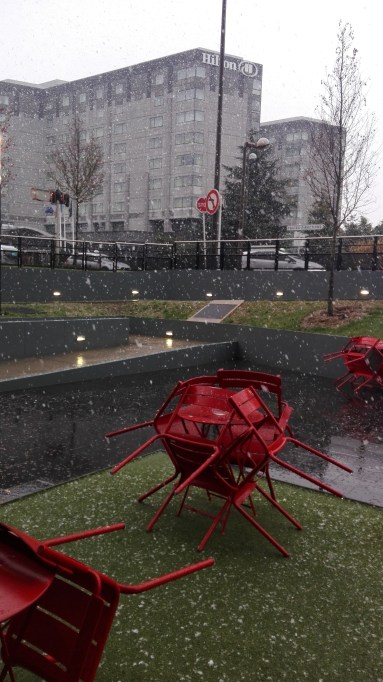
The day of our departure decided to put on a little farewell for us, with a touch of wet snow and  cold winds.

Paris CDG - Departure in snow6

We didn’t care; we were headed for an Australian summer…….

Side trip – Plombières-les-Bains and Remiremont

Deep into the third week of our thoroughly delightful stay in Épinal, we thought it high time we got out a bit wider and explored the region round the city. But how to do it? Well, our new best friend, Ron on his big old tjalk, had a car. And his port neighbour and close mate, Fredi had returned to Switzerland for a couple of weeks on family business, so Ron was alone and at a loose end. We suggested a day excursion and he leapt at it.

We set off on 20 October for the towns of Plombières-les Bains and Remiremont, about half an hour’s drive south. Plombières is best known as a spa town, famous for its hot springs; Remiremont, a dozen kilometres to the east, is notable as an abbatial centre and for its community of noble nuns. Both promised oodles of interesting sights, interesting histories and, we hoped, some fine refreshments.

We made Remiremont our first stop in the morning, because we hoped we might later find a better range of lunch choices in the spa town rather than the town of nuns.

Remiremont is situated on the Moselle upstream of Épinal, near its confluence with the Moselotte, in the foothills of the Vosges mountains. An abbey was originally founded there in the 7th century but by the 9th century it had become a community of Benedictine nuns. Over time they became less and less wedded to the severity of convent life and by the 13th century they were an order of secular canonesses; entry was restricted to those who could prove 200 years of noble descent. They acquired extraordinary power and privilege, including the protection of the Dukes of Lorraine, the Kings of France, the Holy Roman Emperor, and the Pope; their abbess was bestowed the title of Imperial Princess.

The canonesses lived independently within the abbey with their own circle of friends and servants. They each received a share of the abbey’s considerable income to dispose of as they wished, and could leave to visit family, sometimes for months at a time. In  fact, they were only formally required to live in the convent for three months in a year and, even then, they mostly occupied elegant townhouses surrounding the church, some of which which can still be seen today. By the 17th century they were styling themselves as countesses and hosting balls, concerts and other entertainments.

The abbatial church was consecrated in 1051 but dates primarily from the 13th century. It is in a marvellous state of repair and betrays some fine ornamentation and decoration.

The townhouses of the cannonesses/countesses surrounding the church are fine buildings, where it is easy to imagine the elegant, elevated social life these singular women enjoyed.

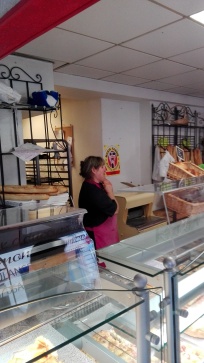
Perhaps only fitting, given the relics of all these powerful women, that it was in Remiremont we came across our first female boulanger in France. She was a little shy, but her shop displays implied a baker of considerable skill.

Remiremont22.jpg

We proceeded to Plombières, to experience the pleasures of a hot springs spa town. Right from the start, I think, it is important to say that the town has a fascinating history and a somewhat less stellar present existence.

One approaches the town from the heights. descending into a tight valley formed by the diminutive L’Augronne River. The town is laid out in a narrow strip along the riverside at the base of the valley, and the broad, long approach along the tree-lined Avenue de Remiremont holds strong promise of prosperity and amenity. Parks and gardens and the forested hillsides lend an attractive setting.

The hot springs that surround and flow through the town were enjoyed by the Romans and over the centuries it became quite a popular spa town, visited by the likes of Voltaire, Montaigne, the dukes of Lorraine, Berlioz, Lamartine and assorted members of the Bonaparte clan including Napoleons I and III and Josephine.

The town remains proud of these visitors and temporary residents and displays little plaques on the handsome town houses they once occupied.

Plombières was also a favourite place of the lay canonesses of the Abbey of Remiremont who, when they could tear themselves away from the rigours of social devotion in that place, could partake of the waters here.

Plombières was the scene for the clandestine meeting in 1858 between Napoleon III and Camillo Benso, Conte di Cavour and Chief Minister of Piedmont, leading to the “Plombières Agreement” that is considered the precursor to the unification of Italy.

It must have been quite a place in its heyday, with baths, spas, hotels and chic townhouses with their balconies overlooking the main squares, a centre for pleasure, gossip and the warm enjoyment of one’s place in society.

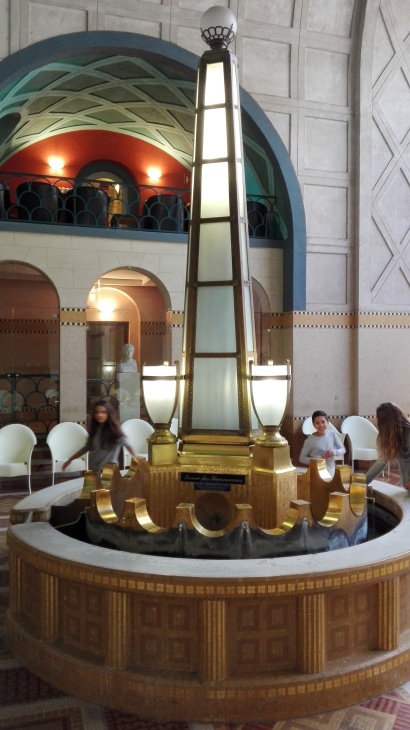
Even today, though, one can enjoy the waters, regardless of one’s social position. At the facility below, a spa with treatment rooms and a fountain of assorted mineral waters, we witnessed an elderly local, nonchalantly entering the room, armed with a couple of plastic containers, and calmly filling them with the life-giving fluids that still flow continuously from below ground. The fountain boasts four different outlets, each of which claims to provide a slightly different balance of minerals and their associated benefits. Our lady seemed either to know exactly which variety she favoured or didn’t care, because she went straight to one tap, filled her containers, nodded in our direction and went on her way.

Plombieres side trip34

It has to be said that Plombières does not buzz any more with the feel of a place patronised and valued by the elites. It has a lovely historic aura but also the slightly seedy feel of a place that has already experienced most of the better things that are its due.

We repaired with Ron to the place we had identified as the best place for lunch, on the way passing a crumbling pile that in the 19th century must have been a lively, luxurious hotel but was now a sad ghost surrounded by hurricane fencing. We arrived at our destination and entered the quietest casino I have ever seen. Small as it was, it still seemed cavernous because of the absence of gamblers.

At the rear, though, was a very pleasant restaurant located by the river and set, for some reason, in an old railway carriage, sumptuously appointed. The luxurious setting didn’t deter Jane and Ron, however, who each ordered a massive open burger and fries. I had a very acceptable boeuf bourgignon. We enjoyed it all and escaped without too much financial damage.

And so ended, with a pleasant drive back to Épinal, our side trip with Ron. We were glad of the excursion, and even gladder to have enjoyed it with him.

Now we were back to the serious business of getting ready to leave the boat and return to Australia.

Épinal

As mentioned in our last post, we were immensely relieved to arrive in Épinal, a haven from the winds, close-spaced locks and tensions of the past week of travel on the Canal des Vosges. How relieved, and how happy we would come to be in Épinal, would only gradually be revealed in the coming days and weeks.

The Port itself is well-situated, well-equipped and well-serviced. A broad basin at a dead end of the canal embranchement, it has a long stone wall on one side and a long low stone quay on the other, facing a broad, flat park. It affords ample opportunity for mooring of large and small boats and ready access to power and water, plus a capitainerie with cafe, toilets and showers. There is a resident capitaine, the dapper Pierre, who lives on his boat in the Port, walks his friendly little dog and collects the mooring fees each day, armed with a ready smile and a keen eye for beauty. The fees are astoundingly cheap, being a mere €5 per day for a boat of our size.

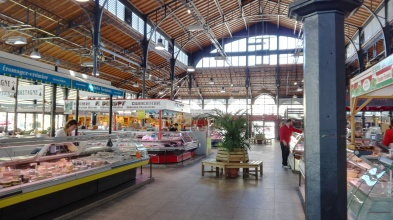
The city is prosperous, with a multitude of shops, big-box stores, restaurants, cafes, boulangeries, patisseries and epiceries. There is a marvellous covered market three days a week.

hdr

It’s an attractive city, on the banks of the Moselle, with a handsome central square (the Place des Vosges) lined by cafes and boutiques.

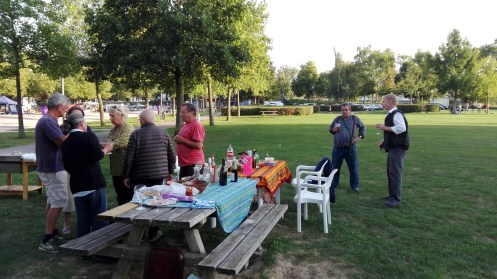
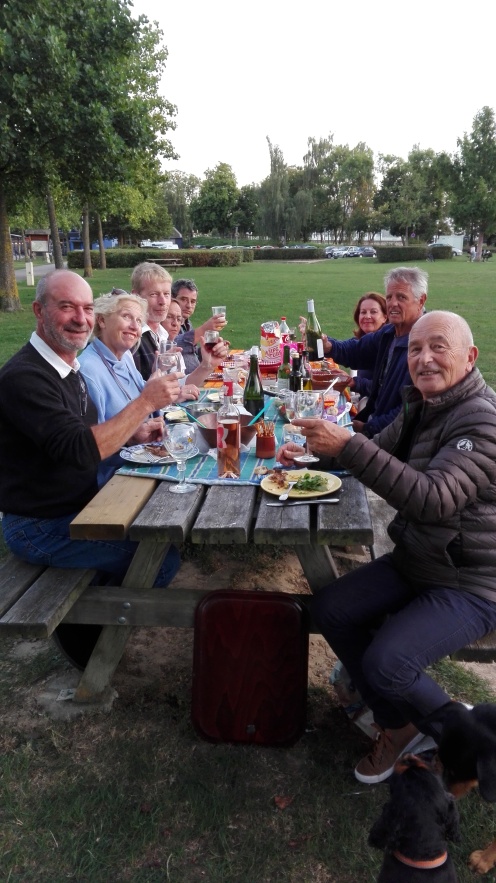
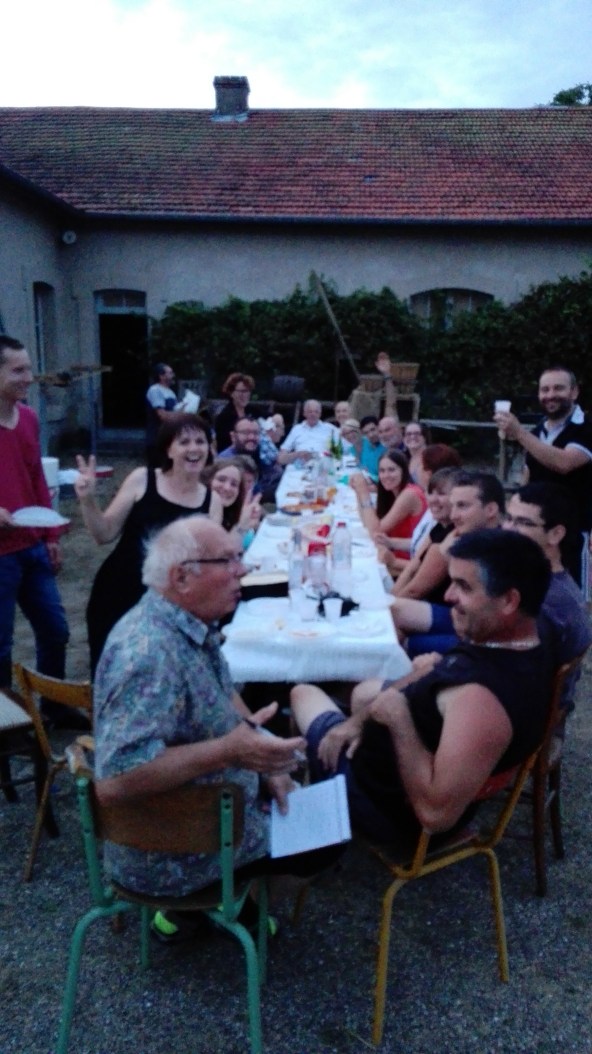
We fell in love with the place very quickly. We were aided in this by the rapid forming of friendships that happened within 24 hours of our arrival. A BBQ was organised on our second day, where we met and fell in love with some of our fellow boaters, including Knud and Erica (Australia), Fredi and his dog Willi (Switzerland) and Ron (US). These people became very special to us over the next few weeks and proved to be generous, open, interesting and helpful companions.

Day 50 - Epinal BBQDay 50 - Epinal BBQ5

Two of the most helpful among our new friends were Knud and Erika. It turned out they are from Albury, less than 2 hours from us; also, that their son is a baker, just like us. Pretty extraordinary, the way you meet people on the other side of the world with connections to your life back home.

They are also extraordinarily generous, open people, happy to share their experiences of cruising in France and Europe for the past 14 years. Knud in particular is forthright, honest and kindhearted in his advice, and he it was that persuaded us that we should abandon any thought of plodding on to Roanne, our planned winter port.

It was already the end of September, and we knew that the Canal de Roanne would likely close by early November. It was a long way to go to get there. And Knud bluntly reminded us that the wind we had experienced for the five days or so before we arrived in Épinal would persist for the rest of our trip, not to mention rapidly-dipping temperatures. No, he said, you are not going any further, you are staying here. He was pretty persusasive. And we were pretty persuadable.

Knud also proved to be a wonderful source of advice and practical demonstration of setting up one’s boat – electrics, hydraulics, spares, winterising – which we were able to call on and emulate or adapt when the time came for us to prepare Eben Haezer for hibernation and our return to Australia at the end of the season.

Fredi and Ron also turned out to be great companions – friendly, generous and honest. They each had large boats they were cruising basically single-handed, though frequently with friends or family to assist. Each of them also had a car, and they were pretty keen shoppers, so it was easy most days to persuade them to go for a drive with us to pick up various bits and pieces from hardware stores and electrical or plumbing specialists, always with a detour to the supermarché for a load of wine/beer on the way back!

Speaking of hardware stores, we were amused by the difference between the sausage sizzle stalls we were used to outside Australian outlets like Bunnings, and the food stalls we found at the Épinal equivalents… fresh crêpes with a beer were definitely out of our home zone!

Food generally in Épinal was fabulous… nothing fancy, and we didn’t eat out terribly often… but with a fabulous fresh food market every couple of days, an excellent supermarket only a pleasant bike-ride-through-the-park away, and a great boulangerie around the corner, we enjoyed wonderful simple meals. Lunch generally was salad with cheeses, pâtés, terrines and, occasionally a tourte Lorraine or pâté Lorrain. And always baguettes, of course. Dinners were kinda similar to what we cooked at home, with French variations, and always with lovely fresh ingredients.

Among the many fabulous offerings at the Épinal market, fresh wild mushrooms were prominent. Whether it was a bag of fat, juicy, dirt-covered cèpes (porcini) or a mixed bag like the one below which we used for a delicious risotto one night, they were all outstanding. For the most part, the mushrooms were wild-picked in forests and fields by licensed mushroom-gatherers, and many pharmacies in France are specially licensed to identify and certify them as suitable for consumption. The other lovely discovery at the market was milk. It is surprisingly difficult to buy fresh milk in French supermarkets, which sell masses of UHT and tiny amounts of the real thing. We were delighted to find a cheese seller/dairyman at the marché who, when we asked, undertook to bring us lait cru (raw milk, i.e. unpasteurised) to us, packaged in sealed plastic bags. It was divine!

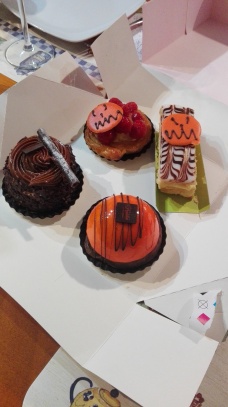
Sometimes, we couldn’t help ourselves, we just went for a bit of indulgence.

Epinal cakes

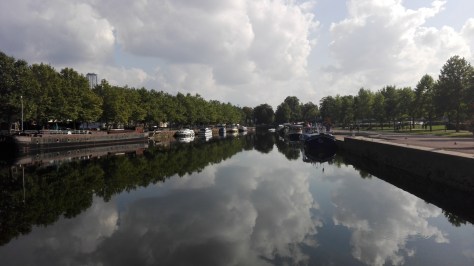
There was always something to see just outside our window in the Port, whether it was the advance of autumn reflected in the colour of the trees, groups of valiant citizens doing their morning exercises, kayakers going through their watery routines, or more unusual events like the pink run/walk for charity that took place one cool day.

We knew that our time in Épinal was drawing to a close as September became October and November threatened, but we were determined to make the most of every day. We prepped the boat for winter, made minor repairs and all manner of other chores, but we also made time to explore the region and visit other towns and villages – which we’ll cover in a separate post.

Canal des Vosges and the Moselle

Having sorted our electrical problems at Toul, thanks to Duncan Flack from Lorraine Marine, and having celebrated with a slap up dinner at the wonderful restaurant Table à Victor, we were ready to resume our journey on my 60th birthday on 21 September. We had thoroughly enjoyed our extended stay at Port de France but it was time to move on.

This day’s trip would see us on three different waterways in the course of one day: the Canal de la Marne au Rhin (Ouest) as we left Toul, turning onto the Moselle shortly afterwards, then turning off the Moselle onto the Canal des Vosges which runs along the river.

Our journey to Richardménil  took us through 9 locks, a distance of 30kms. It took us 6.5 hours, which included a stop for lunch in the écluse (lock) at Villey-le-Sec. On most canals in France where the locks are still operated by éclusiers (lock-keepers), there is always a break for lunch between midday and 1.00pm. The trick is to try to plan your day’s travel to arrive at a lock just before midday, so you can get through before the break. On this day, still new to the magic of it all, we arrived at the lock at five minutes past midday. Désolée! Déjeuner….

No mind, we arrived at Richardménil just before 4.00pm and found ourselves alone at the very nice halte nautique… power but no water in a very attractive, peaceful setting. The village is located a short walk from the canal and, after tying up and turning on power, then relaxing with a birthday drink as the afternoon sun shone dappled through the trees lining the canal, we decided to explore it a little.

Imagine our surprise when we found that, though the village contained not very much else, it did possess a fine restaurant, Au Bon Accueil. We had already celebrated my birthday the night before in Toul, anticipating a simple home meal tonight. Now it looked like I would get a second celebration! And a truly marvellous meal it turned out to be…

After two pleasant days at Richardménil we departed on 23 September, bound for Roville-devant-Bayon, a wild mooring some 18kms, 8 locks and 4.5 hours further up the canal. This time, the rule that states a lunchtime break is mandatory was proven by its exception, as we were able to negotiate two locks between 11.55 and 12.40, enabling us to arrive at Roville shortly after 2.00pm.

We were glad of the early finish, because Roville was a decidedly beautiful place and, the more time we had to enjoy the beauty and serenity, the better. This was our first truly wild mooring, with no bollards or other fittings to tie up to, so we got to use our mooring stakes for the first time. We had had these stakes made for us by a guy we met at the yacht club in Schoten and, although simple, they weren’t super cheap. Essentially, they were pieces of angle iron, with a flat plate welded on the top and a pointed end cut at the other end, finished with a dipped, rust-proof paint coat. There were four of them, and the recommended technique was to hammer them into the ground in pairs, at cross-angles, to reduce the chance of them being accidentally dislodged or pulled out. The technique, dutifully followed on this occasion, was proved the next morning at breakfast when a Swiss yacht screamed by without slowing down, causing a ferocious wash and much tightening and yanking of the mooring ropes, but no threat of dislodgement.

We were a bit sorry that morning, after the Swiss disruption, to leave Roville, because it was such a beautiful, serene spot, and our new batteries had retained sufficient charge for us to survive a bit longer without access to shore power…. but we had set ourselves a timetable in order to make it to our winter mooring, so we reluctantly packed up and moved on.

24 September saw us cruise just over 3 hours, 7 locks and 13kms into the town of Charmes. We experienced quite a bit of wind on the canal, as we had done on the trip out of Toul, and of course Sod’s Law meant it was worst just when we were entering or leaving locks, blowing us around a bit and detracting from our enjoyment of the day.

When we arrived at the port de plaisance in Charmes, we found there was only a limited length of the canal that had been prepared for mooring with concrete banking. Nevertheless, there was plenty of room for us so we drifted slowly alongside and prepared to tie up behind a German cruiser. We had found in similar situations that boat people on shore would, more often than not, come to help by offering to take a thrown rope to tie around a bollard. Not on this occasion; the German couple merely moved their chairs to take advantage of the shifting sun which, judging from their leathery skins, had been their favourite pasttime for many years. Comme ci, comme ça, pas de probleme.

We were bemused a little later when a lovely old Swiss vessel arrived, with by now very little room left at the end of the concrete embankment. It would have been easy for the Germans to move their boat closer to us; instead, as soon as they saw the other boat approaching, they moved more quickly than we had seen them do so far…. straight inside their boat and down below, not to be seen again for another half-hour. The Swiss managed to tie up with their stern extending beyond the quay, but it didn’t seem to bother them so we just shrugged and went off to explore the town.

It has to be said that Charmes does not contain much of the name in its physical character, having been extensively destroyed in both WWI and WWII. It’s maybe in that fact that most of its charm lies; with nearly 5,000 inhabitants its mere survival, its persistence and refusal to just die, is its saving grace. Being thus charitable, we did some shopping and prepared to move on the next day….

Our next stop was Thaon-les-Vosges, a journey of 17kms and 11 locks, which took us 5 hours and once again saw us battered a bit by blustery winds. We were glad to pull into the halte nautique at Thaon, a simple affair with no services but located next to an attractive park with pathways, fountains and pavilions.

There was a major petanque festival under way, but very different to the serious affair we had witnessed at Commercy a fortnight prior. At 2.00pm there was no sight of actual games underway, because the competitors were still seated at their long tables enjoying lunch. Eventually they drifted back to the competition and for the next few hours we enjoyed the click-clack and tut-tuts and words of encouragement and disparagement that form the sound backdrop to a large boules event. One of the highlights was the music of guitar and harmonious voices that surrounded the arena where a large group of Pacific Islanders (French Polynesians?) were playing.

Day 47 - Thaon3.jpg

That evening, after an exploration of the village, we decided to eat out at a pizzeria near the mooring, having checked in its window that it would be open. To our dismay, with a light drizzle setting in shortly after we set off, we found that the restaurant was not, in fact, open. We tramped off, awning to awning, down the main street and found a little kebaberie, Alp Kebab, a few hundred metres further on. Wonderful fresh kebabs, crisp french fries, happiness. We managed to devour the chips in between rain showers on our way back to the boat, where we finished off the kebabs and licked our fingers with damp satisfaction.

The next morning, 26 September, we noted at breakfast the passing of three huge sand barges, immense peniches with their wheelhouses re-sited to the front, laden low in the water with gravel they had taken on board a couple of kilometres back down the canal towards Igney. We had no idea where they were headed but decided to delay our departure until they had a chance to get several locks ahead of us. We knew the locks could only take one of them at a time, so we decided to give them a couple of hours to clear away.

About 10.30 we set off on our journey to Épinal, 8kms, 5 locks and a pont-canal over the Moselle River. Once again, we we were hit by winds, making manouevring through the locks difficult and tense. The most tense moment arrived when we met the sand barges coming back, obviously having unloaded their cargo not far up the canal and now returning for another load. The first two barges, no problem; we just waited for them to exit the locks and we scooted straight in, going the opposite way (although the incessant wind made waiting for them to exit the locks a delicate operation).

The scary moment came when we rose up the final lock, only to see the third sand barge waiting impatiently on the other side, eager to get in and on his way. He was positioned very close to the lock, his engines idling. As we exited the lock, battling the wind and trying to squeeze into the narrow space he had left us, he gunned his engines and headed straight for the lock, forcing us to make an even more radical manouevre to avoid a scraping either on him or the canal side. Hairy indeed!

The thing is, there’s no point getting upset with these guys. They work this section of the canal, five or six days a week, every week of the year, for a living. Plaisanciers like us might pass this way once or twice, maybe a handful of times in a decade of cruising., for pleasure. They deserve the right of way. But respect and consideration should ideally travel both ways, right?

Less than two kilometres further on we turned left onto the Embrachement d’Épinal, a short deviation off the main canal leading to the city of the same name. This canal is very shallow and suffers from a lack of ready replenishment of its water levels; there are frequent advices and closures to craft with more than a minimum draught. On this day, we found it shallow and narrow but no problem as long as we stuck to the centre of the canal, though we noticed the very obvious sucking effect on the banks that we effected with our displacement as we passed along.

To be honest, whatever caution was necessary because of water depth was more than offset by the relief from the wind that the river valley and its hilled, densely wooded canal banks provided. Through the short few kilometres to Épinal, the forested environment was enchanting.

Finally, we exited the canal into a broad basin, stone-fenced on one side and with a long low stone quay facing a broad-lawned park on the other. It was a relief to arrive and it was with enormous pleasure that we tied up and set about preparing for an extended stay.

Day 49 - Epinal3


Nancy

Though not strictly a part of the Moselle, lying rather on the banks of the Meurthe, Nancy is only a few kilometres from where the latter joins the Moselle and so we’ve included it in this little section. Besides, our itinerary lay to the south and so we actually did not cruise to Nancy, instead catching the train from Toul, which is most certainly a town on the Moselle.

We decided to visit Nancy when we were detained in Toul waiting for new batteries and battery charger to arrive and be fitted in Eben Haezer. It was an easy 24-minute train journey from the station near our mooring.

Though not the largest city in the region, and only about 20th-largest in France in population, Nancy is nevertheless the largest city we had visited since leaving Schoten/Antwerp. Its size and character as a major city revealed itself immediately we emerged from the railway station, where we were gently accosted and beseeched by people young and old cadging cigarettes and money “for coffee”. Pas de probleme, we thought, but the trick is deciding who to give to and who might merely be seeking cash for a bit of meth or another drug.

The area around the railway  station is the newest part of central Nancy, with some striking examples of modern architecture. The rest of the city is easily reached on foot, encompassing the old quarter, the Vieille Ville – Léopold, dating from the Middle Ages, and the “new town” of Charles III – Centre Ville, dating from the 16th-18th centuries, closer to the railway station.

Sights in the older quarter include the Ducal Palace, built in the 15th century, extended in the 18th, and now home to the Musée Lorrain. Nearby is the the triumphal arch of the Porte Désilles, built in 1782-84 partly as a memorial to the citizens of Nancy who died in the American Revolutionary War. Also here is the 14th-century Porte de la Craffe, a picturesque old gate with twin turrets that is the remaining relic of the city’s medieval fortifications; and the Arc Héré, built by Duke Stanislas in 1753-55, leading from Place Stanislas to Place de la Carrière, a fine boulevarde.

Nancy has its share of fine churches, including the Nancy Cathedral – Cathédrale Notre-Dame-de-l’Annonciation et Saint-Sigisbert (18th century); Eglise Notre-Dame-de Bonsecours (18th century); Église des Cordeliers de Nancy (15th century); and the neo-Gothic Basilique Saint-Epvre de Nancy (19th century).

Undoubtedly, though, the crowning architectural glory of Nancy is its Place Stanislas, built by Stanislas I, twice-deposed King of Poland, the last Duke of Lorraine and the father-in-law of Louis XV. Built in 1752-55, designed by the royal architect Emmanuel Héré de Corny, the square was a major project of urban planning, designed to link, on the one hand, the ducal seat of government (Palais du Gouvernement) with the seat of city government (Hôtel de Ville); and, on the other hand, the old medieval quarter with the “new town” to its south.

In 1983 the square and its offshoots Place de la Carrière and Place d’Alliance were listed as a UNESCO World Heritage Site (presumably after the city ceased to use it as a car park, which it had done since 1958). A major restoration was undertaken in 2004/5, bringing it back to its former glory and, it has to be said, the results are stunning.

In the late 19th/early 20th century, Nancy was a major centre of art nouveau, via its École de Nancy, a movement started by the glassmaster and furniture maker Émile Gallé. Still today chic shops in the city sell furniture, glassware and pieces of decorative art from the major artists of the time, and the architectural traces are found through the city in stained-glass windows and lacework on doors and balconies.

All in all we spent a thoroughly enjoyable day exploring Nancy, before catching a train for the short journey back to our boat in the port at Toul. We had little chance to enjoy the chic shops, boutiques, boulangeries, patisseries, cafes, brasseries and restaurants on offer (in any case, it was a Sunday), but what we saw of them encourages us to dream of a longer return visit soon.

Toul

As mentioned in our previous post, we had arrived in Toul on 14 September expecting to spend a few days there. Events conspired to keep us there for a few days more than we anticipated, but we regretted none of them.

Early on, the city was part of the Holy Roman Empire but by the 16th century it had been annexed by France, a fact recognised by the Treaty of Westphalia in 1648. Toul’s most striking features at first sight are its stone ramparts, yet another example of the work of Louis XIV’s ubiquitous military engineer, Vauban, in the late 17th century.

Day 35 - Toul

The Port de France, where we moored is located between the railway station and the old city, which is a typical walled town hemmed in by its ramparts and with lovely old streets radiating from its generous central circus. A small city of some 16,000, it enjoys what you would expect in the way of shopping, with smart boulangeries/patissseries, boucheries and fromageries, boutiques and specialty shops. Every Wednesday and Friday there is an excellent outdoor marché in the centre ville, with a range of food stalls as well as clothes and bric à brac.


Toul was blessed with several excellent boulangeries but foremost among them is Battavoine avec deux thes, opposite the port which, along with its satellite Maison Battavoin alongside the port, kept us in constant supply of baguettes, breads, custard flans, tourtes de Lorraine and other delicious goodies.

We also found an excellent bike dealer in the town centre who was able to fix Jane’s bicycle, which had suffered a flat tyre and for which we had back in Belgium bought an entirely unsuitable spare inner tube. The nice man there also adjusted the brakes, seat and handlebar settings for us, making it almost like a new bike.

To be honest, the restaurants and brasseries of Toul  are nothing to shout about, with one or two exceptions which we will get to later. But it is possible to find a nice place in the town centre to grab a coffee and a snack and spend some lazy time watching the world pass by.

Two businesses right across the road from the port proved to be fantastic finds for us. The first was the Dépôt Vente de Toulois, a second-hand store selling an extraordinary range of pre-loved stuff. Everything from bistro chairs to banjos, from bathroom vanities to violins. Every visit was a delight and a torture in finding new things we wanted but couldn’t have.

When we bought Eben Haezer we inherited, along with all sorts of useful stuff, a truly massive, heavy, unwieldy “captain’s chair”, which took up most of the wheelhouse, was never particularly comfortable or useful, and had outlived its welcome as far as we were concerned. At the Dépôt we discovered a sweet little bistro stool which seemed to us perfectly suited to the role. We bought it for not very much, and negotiated with the lovely man at the Dépôt to sell him the captain’s chair for a song, a fraction of its true value, but with the added bonus that he would pick up the 40-kilo monster himself from the dock. A great bargain, in our minds. And probably his, as far as we knew.

The other delight was our discovery of Domaine de l’Ambroisie, a wine producer/cellar hidden down a laneway opposite the port. This was our first experience of a genuine domaine, as opposed to a “cave” or wine dealer, since we had arrived in France, and we loved it.

It was great to speak to the young winemakers, and to hear them boast about the quality of their wines, the terroir which they considered the equal of Champagne, the methode they used to make their vintages. Their prices were great so we bought a few boxes of white, sparkling and rosé, à Lorraine. In the event, they proved to be perfectly respectable and good value, but not outstanding. But it was a great buying experience and interaction with the producers.

So far, so wonderful. But there is another attractive aspect of Toul.  A short 2kms up the canal there is a second port, operated by Lorraine Marine, under the management of Duncan Flack, a bit of a legend, and a native English-speaker to boot. Duncan’s port offers a very acceptable winter mooring, but it also offers a wide range of services for boaters needing attention to their seemingly endless series of problems.

Our particular problem had manifested back in Anseremme on the Meuse, when we became aware that the house batteries were not recharging as they should, and the engine batteries were also a bit low in the morning when we wanted to get cruising. It got worse one day when we were actually unable to get enough current to start the engine and had to run the generator for a while to pump some charge back in to them.

We arranged with Duncan to come and have a look. He ascertained pretty quickly that (1) our house batteries were old and basically stuffed, and (2) our battery isolator was not working.

The point of the isolator is that it allows current to flow in only one direction, i.e. from the house batteries to the engine batteries and not the other way. In our case, the house batteries were losing charge (or not recharging), and were raiding the engine battery for current. The solution was to buy new batteries (ouch!) and physically disconnect the isolator. We also decided to buy a new Victron dual battery charger which, when we had access to shore power, would fully charge the house batteries as well as trickle charging the engine starter batteries.

At the end of a few days, Duncan had fitted four lovely but expensive new house batteries, giving us a boosted capacity of 420 amp hours (at 24 volts), connected the engine alternator to the engine batteries alone, bypassing the house batteries (a temporary but foolproof fix) and connected a new intelligent battery monitor to our wheelhouse control panel. We were significantly poorer, but immeasurably happier.

As if the efficient and effective attentions of Duncan F were not enough, Toul had two further delights for us. The first was its proximity to Nancy, less than half an hour away by frequent train service – but more of that in a separate post. The second was the opportunity to celebrate my 60th birthday in a truly memorable restaurant.

In fact, we were to leave Toul on September 21, the day of my birthday anniversary. Not knowing what lay ahead, we decided to take advantage of our location the night before and booked dinner in the best restaurant in town – La Table à Victor, right across from the port. Victor apparently refers to Victor Hugo (may have had something to do with its address, on Avenue Victor Hugo!)… one can only hope that the author might regularly have eaten as well as we did at the place named for him.

The restaurant’s decor was truly amazing and set the scene for a magnificent dinner. Jane had scallops followed by chicken, I think. I definitely know I had a beef dish cooked for 15 hours, followed by a miraculous souffle “mirabelle”, an impossibly light concoction flavoured delicately with Lorraine’s famous yellow plums, the mirabelles. It was the best meal by far we had enjoyed together in France (and Europe for that matter), it was staggeringly good value, and it was a fabulous way to celebrate entering my seventh decade on this little blue planet.

Last Days on the Meuse

As the canalised sections of the river increased, the river itself was becoming more and more a narrow, rocky, meandering stream running alongside the canal sections. The Meuse had carried us all the way from Visé in Belgium, and perhaps one day would carry us nearly to the North Sea if we ever had the opportunity to follow it down into the Netherlands.

And so it was that on 7 September we left Verdun and travelled the next week into Toul along the Canal de la Meuse, following the river but not in it, the natural, meandering course of the river mostly never than a few metres away.

Our first stop, after a short cruise of 3 hours (13.5kms, 5 locks) was in the small village of Dieue-sur-Meuse. There is not a lot to Dieue, but at least it still has an operating boulangerie, even though it can no longer support a boucherie.

One interesting feature we discovered in Dieue was the Rogation Cross in a road leading out from the village centre – a small but fascinating glimpse into the life of little communities like this. The cross marked the beginning of a series of processions traditionally held on the three days before Ascension Day, beseeching God to protect the crops. It harks back to an earlier pagan tradition, the Robigalia, at which a dog was sacrificed to propitiate Robigus, the deity of agricultural disease. In areas like this, with few buildings and no churches but large wheat crops and the ever-present threat of rust, such crosses were frequently erected, for prayer, fasting and abstinence, in the hope of attracting the benevolence of their god. Presumably of considerable significance for a religious people for whom wheat, in the not-too-distant past, provided 70% of the calories in their diet.
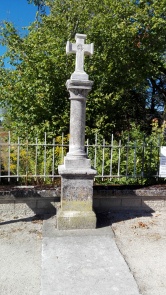
Day 29 - Dieue3.jpg

The following day, 8 September, we cruised 24kms (5 hours, 4 locks) from Dieue-sur-Meuse into Saint-Mihiel. A larger town of some 5,000 inhabitants, Saint-Mihiel has some points of interest, and provided an incident of major interest to first-season novices like us.

Occupied for most of WWI by the Germans, the town was liberated by US-French forceS in September 1918, marking the first major entry into the war by a US-led force, under the command of General “Black Jack” Pershing.

Somewhat earlier, a Benedictine abbey had been created in Saint-Mihiel in the early 8th century, only dissolved (like so many others) in the Revolution. The abbey is best known for its library, which is still on the same site, purpose-built in 1775 and which preserves some 9,000 volumes, dating back to the 9th century.

Saint-Mihiel is also known as the home of the 16th-century sculptor Ligier Richier, whose marvellous works in wood and finely-grained, locally-quarried limestone can be seen in the abbey church and the Eglise Saint-Etienne. He was lost to Saint-Mihiel when his conversion to Protestanism forced him into exile in Geneva.

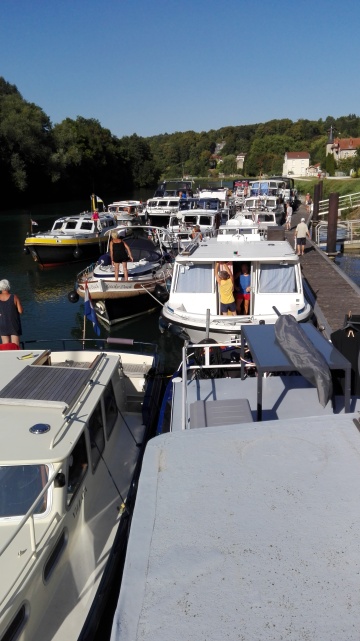
The most famous aspect of Saint-Mihiel for us, however, will forever be known to us and our friends as The Dutch Armada. When we arrived at the small, modern, neat pontoon in the port de plaisance right below the town, we were forced by the presence of other boats to moor right at the end of the pontoon, in fact with half our boat protruding precariously beyond it, pointing straight towards shallow water under the town’s bridge.

Some hours after we had triple-checked that everything would be OK for our brief stay, a series of small to medium craft of various styles began arriving, cruising up and down, looking  for spots to tie up, the faces of each new arrival looking increasingly concerned and confused as they realised how little mooring space there was for an ever-increasing flotilla.

A few of them gave up and cruised back down river a few hundred metres to an alternative mooring without services. The others took to rafting up outside each other and to the boats already moored to the pontoon. Because of our precarious position we made it clear that we were prepared to permit only one boat to moor up against us. More and more boats continued to arrive. We advised the skippers that, when the leader of their expedition arrived, we wished to meet him and discuss the situation, which we felt was highly inconvenient as well as dangerous.
Day 30 - St-Mihiel4

Finally, the Armada’s leader arrived, bounded off his boat to the shore, barefoot, naked from the waist up and swaggering like an admiral who had already consumed more than his daily ‘ration’. “I understand you want to see me,” he said. I took him a short distance away, to have a private word. I explained the situation as I saw it…. the sheer number of boats was placing a dangerous load on the pontoon, and the small town could ill-afford to repair any damage. Some craft had simply rafted up to small boats already tied up with only small ropes, without securing additional lines to the pontoon, posing a risk of boats breaking loose. The number of boats travelling together, on a canal with locks and limited capacity, posed a cause of great inconvenience not only to lock-keepers but to other craft wishing to proceed in an orderly, timely manner. At moorings with power, such a large number of boats would inevitably overload the power supply, even if all boats could plug in to the limited number of points. I asked if he had thought of the fleet breaking up into smaller packs, perhaps only joining together in larger cities.

The admiral’s response was dismissive, contemptuous and arrogant, so I decided to give him a little Aussie logic. Raising my voice just enough to be heard by his imprisoned fellow-travellers, I gave him to understand that I thought he may be displaying something akin to thoughtlessness, arrogance and recklessness. I might have mentioned that his competence as a leader was under considerable doubt, and there may have been something in there about giving his country and its citizens a bad name abroad. I pointed out to him that several people in his fleet seemed to me to be confused and worried by the situation but were receiving no guidance or relief. I suggested he talk to his group to seek a solution to a problem that was obvious to all except his good self.

These were the first harsh words I had used to strangers since we arrived in Europe, certainly on the water, and it left me a little shaken. With Jane, I retreated somewhat abashed on a tour of the town, calming my nerves but still shaking my head at the stupidity and thoughtlessness of this expeditionary invasion. We returned to Eben Haezer and took a low profile.

Late in the afternoon, we became aware that the invaders had convened a meeting on the grass beside the pontoon. We tried to look uninterested, and couldn’t hear what was being said, but it was obvious that there was a lot of animated and concerned discussion going on. The Admiral, still casually semi-naked, looked on from the edge of the group but didn’t appear to be playing a leading role in the discussion.

An elderly couple who had rafted up to us proved to be the most lovely people, and we felt sorry for them as they struggled from their boat across our deck to make it to land, and vice versa. We later learned from them that the group had changed its plans and would now try to avoid smaller places, mooring wherever possible only in larger towns. At least that was something!

The next morning, the Dutch Armada took their leave, departing in a series of four or five craft at a time, to arrive at the upstream locks in a staggered fashion. Our elderly neighbours were among the last to leave and we wished them bon voyage and best of luck. Nearly two hours later we made our own departure, not really knowing what might confront us at our next stop but with our fingers firmly crossed and our minds trying to focus on good thoughts.

After 4 hours, 21kms and 5 locks, we pulled into Commercy and – joy, oh joy! – discovered a completely empty pontoon to tie up to. Obviously the Dutch Armada had decided to continue on, to our immense relief.

The port de plaisance at Commercy is delightful, set on the edge of town in a picturesque location, with water and power available via jetons (tokens). We spent three very pleasant days there, 9-12 September, and thoroughly enjoyed our stay.
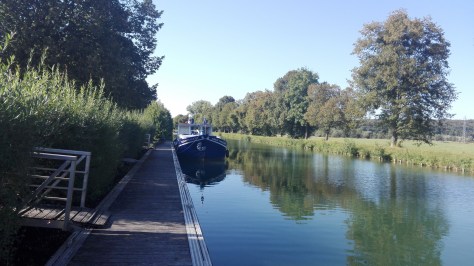
Day 31 - Commercy2

Commercy is quite an attractive town, well-kept with interesting architecture, good shops and a market. It is best known as a residence of the last Duke of Lorraine, King Stanislaw I of Poland and, of course, also as the birthplace of the madeleine.

It is also home to people who take their petanque VERY VERY seriously. Next to our mooring there is a complex with a couple of dozen petanque courts, as well as a modern and well-equipped indoor arena, the walls of which are covered in trophies. On our last day, a petanque festival took place, with a crowd of several hundred, at least 12-16 games being played simultaneously, and a marvellous atmosphere of joyous competition. They were serous about it, though…. no time off, even for a quick lunch, although the fast food vans and beer/wine stall did a brisk business.

Right next to the petanque complex is a very well set-up velodrome, although we saw no evidence of its being used while we were there.

The main architectural feature of the town is the Chateau de Commercy, originally built in the early 18th century and massively enlarged by King Stanislaw I in the 1740s. After his death in 1766 the complex fell into disrepair and was heavily damaged in WWII by a fire that broke out when it was being used by American forces. The city of Commercy acquired the Chateau in 1957 and embarked on a program of restoration lasting until 1977. Designated a Monument historique in 1960, it is currently occupied by the town hall, municipal offices and library, and presents an imposing courtyard and facade.
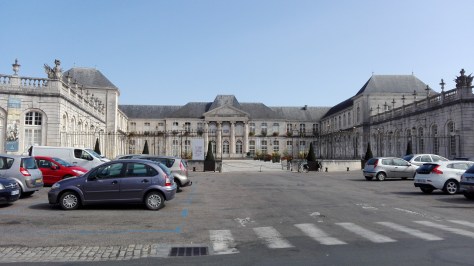
Day 32 - Commercy18

It was during the time of King Stanislaw, according to the most common legend, that Commercy’s most famous product, the gateau Madeleine, was invented. The story goes that Madeleine Paulmier, one of Stanislaw’s chefs, perfected the recipe and its shell-like moulded shape; Louis XV, who happened to be Stanislaw’s son-in-law, was charmed by the little cakes and named them after the cook. He and his wife Maria took them back to Paris and the court at Versailles from where they became enormously popular in the following centuries, to the point where they were famously used by Proust in his monumental work À la recherche du temps perdu, to illustrate his theme of involuntary memory. In any event, they are delicious little creations, and we bought a box of them to enjoy on our cruising.

The other wonderful thing about Commercy is a firm in town that will deliver fuel – both red and white diesel – in a tanker truck to your dockside and pump it into your tanks, for not much more than the best lowest price you might find at a service centre. Really efficient and friendly, notwithstanding our piss-poor attempts at French and their non-existent skills in English.

Our next day of cruising, 12 September, saw us leave the Canal de la Meuse behind and enter the western end of the Canal de la Marne au Rhin (Ouest). After 3.5 hours, 15.5kms and 5 locks, we arrived in the small village of Pagny-sur-Meuse, which marks the point where we would leave the southward (upriver) course of the Meuse behind and head west towards Toul and the Moselle.

Pagny is another of the villages and small towns in this stretch of waterway that offer a neat, modern pontoon to moor at, without services, but pleasant enough for a short stay. Once again, as at Commercy, we had the mooring to ourselves. The village has a boulangerie, a couple of small brasseries/pizzerias and a lot of flowers!

But by far the outstanding feature of Pagny is Le Relais Favorite, a bar/restaurant/grill in the Total Service Centre, between the village and the N4 motorway, only a short walk from our mooring. This marvellous establishment is one of the restaurants les routiers one can find throughout France, unpretentious but reliable and cheap restaurants that cater for truckers and travellers. For €12 each we got a five-course meal, including soup de jour, massive entrée buffet, a choice of plat (main course), a dessert buffet and a cheese plate, plus a bottomless carafe of wine!

We can only dream of such motorway layovers in Australia…..

The following day we set off for the city of Toul, only 14kms away but with 12 locks and a short tunnel to deal with. The tunnel (souterain de Foug) was only 867m long, with pretty good clearance at sides and top, and we navigated it without trauma. The locks, though there were many of them, were all going downhill (much easier than uphill) and fairly shallow, so they were also accomplished with a minimum of fuss, even though they just seemed to keep on coming, one after the other….

We arrived in the Port de France in Toul, immediately after the last lock, and glided ever so slowly, scanning the quays and pontoons for a space sufficient for a boat of our size. Eventually, just as we were despairing, we spied a spot against the main quay. Only trouble was, it required a 90º turn, then a fairly tight manoeuvre through a crowd of craft and another 90º turn at the last moment to come alongside the quay, with very little space fore and aft. I took a deep breath, slowed Eben Haezer even further, and went for it.

Many modern, smaller boats than ours have bow and stern thrusters; even those with only bow thrusters seem to be able to use them to make their craft go virtually sideways. Our boat is fitted with hydraulic bow thrusters – a great convenience, to be sure, but not permitting the kind of fast and tight manoeuvres granted to the smaller, lighter craft. The advantage is that our bow thrusters do not drain the electrical supply and never give out; the disadvantage is that they depend on engine power which, when you are trying to go very, very slowly, means there isn’t a great deal of power to drive them. So you plan, aim, plan, aim and glide, very slowly.

As it happened, I must have entered some kind of dream space, a zone of concentration and calm, because we managed to execute a perfect set of turns and glides to come alongside the quay and drift without fuss or incident to where we could tie up. High fives and inner elation all round.
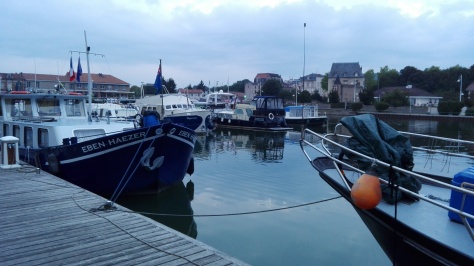
Day 41 - Toul

Toul is a marvellous place, with a well-run port, excellent port capitaine and much to see, do and enjoy in the city. We stayed days longer than we had intended, but enjoyed every moment and we look forward to returning soon. We’ll cover our experiences of Toul in a separate post.
Verdun

On 4 September we slipped out of Consevoye and, with great anticipation, made our way 4.5 hours (24kms, 4 locks) to the iconic town of Verdun.

War and its effects, human and physical, are everywhere to be seen along this section of the Meuse.

We had formed a grim but clearly imagined view of our visit to Verdun. It’s a town that holds a very special place in every French heart, especially in this, the 100th anniversary of the gruesome but heroic scenes that unfolded in the First World War. Grim might be the wrong word yet, as we pulled alongside the stone quay in the city centre, we had already unconsciously adopted a solemn, reverential mood as we moored in a place that has seen more than its share of horrors.

The city itself has a sombre but not unattractive tone in its architecture, dominated by stone and serious-looking edifices along the canal/riverfront. This atmosphere was accentuated by the overcast conditions on our day of arrival, which lent added solemnity to our thoughts.

The name of the city is a latinised version of a word meaning ‘fort’, and it seems Verdun has always played a strategic role. In the 17th century a large citadel was built on the site of a former abbey, significantly strengthened in the 17th century by the famous French military engineer Vauban. The Prussians held the city briefly in 1792 and again in 1870, after which an extraordinary ring of 28 fortifications ringing the city was built.

These fortifications, or many of them, played a major role in the event Verdun is most famous for…. the Battle of Verdun between February and December 1916, the longest, costliest and nearly the most deadly in the entire First World War, possibly ever.

The day after our arrival we caught a hop-on-hop-off shuttle bus into the hills above Verdun to try to get close to the scenes of destruction that still evoke these horrors 100 year later.

A few statistics help to put the carnage into context. By 1916, WWI had become a war of attrition, and the Germans chose Verdun as a place where they hoped to wear down the French through massive destruction when national prestige could not permit retreat.There was no real aim to gain territory for strategic purposes; it was more about harvesting a killing field.

In an area not much greater than 20 square kilometres, both sides launched some 30 million rounds of heavy artillery in 6 months. One strategically identified hill absorbed so much bombardment, it was reduced in height by 27 metres. Seven villages were  destroyed, utterly and forever wiped from the landscape. Most deaths occurred through artillery bombardment, not through direct combat; bodies that had been buried were repeatedly uncovered and pulverised by fresh bombardments.

Both sides suffered some 1 million casualties, including perhaps 300,000 deaths, very many of whom were not recovered but could only be listed as missing. At times at the height of battle there were 10,000 or more deaths and injuries every day, for weeks.

We visited the Douamont Ossuary, site of one of the largest war cemeteries in France, with more than 16,000 graves. More gruesome still is the ossuary itself in the basement of the building, which you can glimpse through small windows, where the bones of at least 130,000 unidentified soldiers are interred. More are discovered and placed there even today, 100 years later, whenever roadworks or building excavation uncovers yet more bones in the killing fields of Verdun.

On a more direct level, we also visited one of the seven destroyed villages, Fleury-devant-Douamont, where today the sun-dappled groves of trees strive to camouflage the scene of total destruction suffered in battle. Fleury was desperately fought over, changing hands 16 times in little more than a month at the height of the battle. We wandered the pathways, reading the plaques which marked where once had stood a house, a bakery, a butcher’s shop, a small farm. Now all that remained were craters. And memories of people’s destroyed lives.

In the end, the Germans failed to destroy the French Army and its spirit at Verdun. Due to the policy of high rotation adopted by the French command, more than 70% of soldiers in the French Army in 1917 served there, embedding memories of their experiences in millions of French soldiers and millions more of their family members. Fundamentally, for the French, Verdun became the embodiment, the representative memory of WWI.

More positively, in recent years, Verdun has come to represent more than war and death. In the 1960s it started to become a symbol and place of Franco-German reconciliation, culminating in a moving visit in 1984 by Chancellor Helmut Kohl, who stood hand in hand with Francois Mitterand in driving rain at Douamont to remember common sacrifice.And Verdun’s 18th-century Episcopal Palace has become the World Centre for Peace, Liberty and the Rights of Man, which focuses on peace and harmony generally but with a special emphasis on Franco-German relations.

I should mention here that while we were in Fleury and Douamont, many of the visitors we shared these places with were small groups of young Germans, each with a guide explaining places and events. Clearly, there is a desire to understand how such things came to pass and, I like to think, not just because so many tens of thousands of their relatives and countrymen are buried in these hills.

Towards Verdun

After an enjoyable three days in Charleville-Mézières, we left the city on 28 August, bound for Sedan and the limit of navigation of the Meuse River. South of Sedan the Meuse becomes a canal which follows the river bed but with many canalised sections.

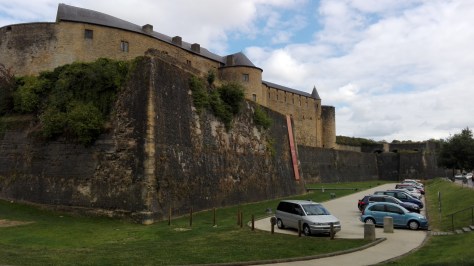
We arrived in Sedan after 5.5 hours and the final 28 kms (6 locks) of the navigable river. To be honest, there is nothing especially remarkable about the city of Sedan, save the fortress Chateau de Sedan, which is reputedly the largest medieval castle in France, dating from the early 15th century with numerous additions and fortifications over the centuries. The chateau certainly is massive. It’s worth a couple of hours but frankly there is little else in the city to detain you for more than a day or two.

Day 20 - Sedan

Rather ironically, for a town with such a massive fortress castle, is that it was the scene of not one but three humiliating military defeats for France in the space of 70 years. In 1870 during the Franco-Prussian War it saw the French Army beaten and Emperor Napoleon III taken captive along with 100,000 of his troops, leading to the Siege of Paris and the formation of the Third Republic and the Government of National Defence. In WWI the town was captured early and occcupied for four years, during which Crown Prince Wilhelm victoriously paraded his troops through the town to mark the annexation of Alsace-Lorraine. Then in WWII a decisive battle in May 1940 resulted in swift victory for the Germans, the effective destruction of the French Army’s capacity and the quick advance of the Germans to the Channel… and the famous evacuation of the Allied forces at Dunkirk.

Poor old Sedan!

On 30 August we left Sedan and travelled along the Canal de la Meuse for 3 hours and 16 kms (2 locks) to the village of Mouzon. The main feature of this rather pretty village is the wonderful Abbatiale Notre-Dame de Mouzon, a church originally established by the Abbey of Mouzon in the 9th century, and which prospered on account of the relics it held of Saint Victor and Saint Anulf, which encouraged strong pilgrim traffic. It was enlarged in the 13th and 14th centuries and again in the 17th and 18th centuries and was saved from the destruction that befell much of the Abbey itself in the Revolution. Our visit to the church was curtailed by a funeral in progress but we nevertheless saw much that was impressive.

The other notable presence in Mouzon is a marvellous little restaurant, Les Échevins. This charming establishment is located in one of the 17th-century “Spanish houses” on Rue Charles de Gaulle. Run by Julie and Damien Hacquard with utter lack of pretension, the atmosphere is remarkable and the food really excellent, at great value.

The following day on 31 August we left Mouzon and travelled 25kms (3 locks, 4 hours) to the village of Stenay. What we found was challenging. The small port, which is in a narrow dead-end channel off the main canal, is quite well formed and equipped, but seemed utterly full and, though we were told there was possibly a spot further up, we were unwilling to risk it, so we rafted up outside another large boat close to the narrow entrance. It was of little consequence to us since we planned to leave the next morning; but the manoevring in and the reversing out were testing for a first-season skipper and crew.

Day 22 - Stenay

On 1 September we slipped our ropes from our host boat,  reversed with maximum care and caution out of the side channel, and travelled on to Dun-sur-Meuse, an easy 2.5 hours (13kms, 3 locks) along the canal.

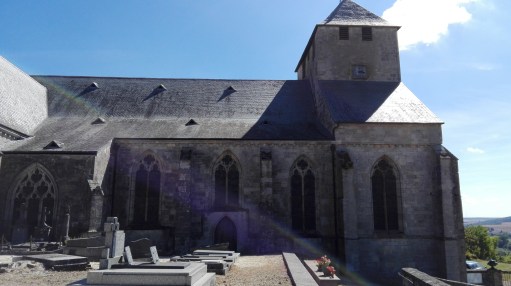
There’s not a lot to the small village of Dun-sur-Meuse and its 750 inhabitants. It has a pleasant well-formed pontoon-based halte plaisance and is not unattractive in its way. Its main attraction is the remarkable 14th-century Eglise de Dun-sur-Meuse high on a hill (Haut-Dun) overlooking the village and river, surrounded by walls of the original 11th-century citadel that enclose a cemetery and a collection of ancient houses, some of which have been renovated and clearly provide a superior quality of domicile. Sadly, much of the upper village was destroyed in WWI.

Day 23 - Dun-sur-Meuse6

We actually made two departures from Dun-sur Meuse, the first on 2 September which was aborted after two hours when there was a major lock malfunction, necessitating a return to Dun and a second departure the day following. So it was on 3 September we arrived in the village of Consevoye, 17kms, 5 locks and 3.5 hours up the canal.

The mooring at Consevoye turned out to be up a narrow and short side channel from the canal, at an acute angle, requiring a delicate reverse manouevre which we achieved – very slowly – like old hands.Which we were… this was now our 17th operational day in nearly a month of cruising!

Consenvoye is a village of less than 300 inhabitants, but is pretty and charming, despite its lack of shopping and infrastructure. In WWI it fell to the Germans early and was always behind the German lines. Its inhabitants were expelled and on their return four years later they found most of their homes had been destroyed.

For us, it was delightfully quiet, yet welcoming, and we enjoyed  a lovely, simple dinner at the auberge by the rivulet.

Not all was quiet in Consenvoye, however. Not long after we arrived, we heard the strains of a woman’s voice singing an aria, echoing across the canal. Was it coming from the silo/warehouse nearby? We couldn’t tell but it was captivating. After a while our curiosity demanded exploration, so we set off into the village to find the source of the magical sound. What we found was not a woman, but a small group of people in a courtyard, one of whom was operating a sound desk with pre-recorded music, the courtyard littered with what looked like props from a movie set.

Day 25 - Consevoye

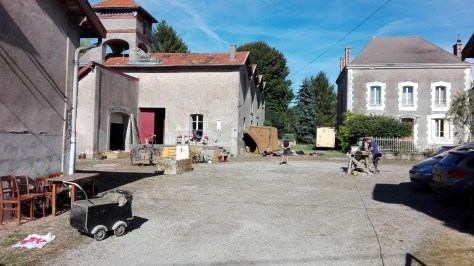
We looked on, and finally gained the courage to ask what it was about. In fact, it was a rehearsal for an upcoming community performance, marking the anniversary of the sacking of the village by the Germans in WWI. They invited us back later that evening for a full dress rehearsal. So, after dinner at the auberge, we returned to the courtyard a little after 8.00pm to see what we might see. Alas, no performance, no dress rehearsal, because the cast were still doing what the French do best…. enjoying a communal feast! They toasted us and made us feel completely welcome in their happy crowd. It was a magical moment.

Day 25 - Consevoye10

Tales of days aboard an old boat