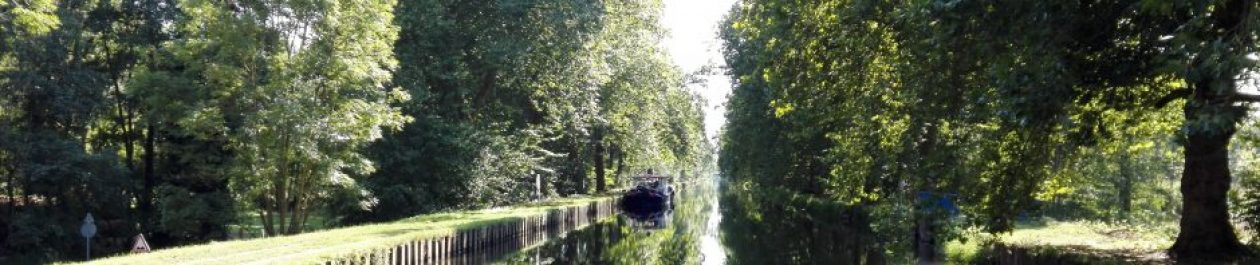
You’ve probably read and seen so much about Paris that t seems a little like there’s not much we can add. And there’s so much to this magical city that whatever we do have to add could only ever be snapshots of highlights. But it was our first visit, we were as excited as little kids, and we want to share our experiences with you. So bear with us!
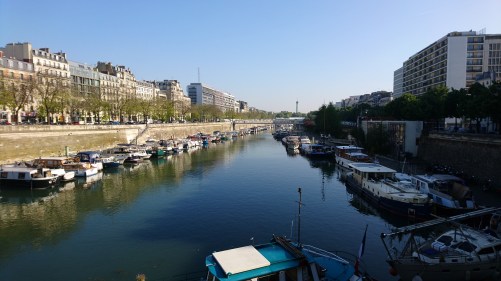
If you are going to spend a couple of weeks or three in Paris, there’s probably not a much better way to do it than on a boat, moored in the Port de l’Arsenal. It’s very central (inner 11th Arrondissement, right by the Place de la Bastille and a few paces from a handy Metro station; it’s one of the cheapest options around (it cost us around €42 per night, at the height of High Season, with power water and showers/laundry included and, of course, we had the option to cook at home rather than eat out every meal); and it’s a safe, open, picturesque and sunny spot (with gates closed at sundown, keyed access, and 24-hour security guards with dogs). We loved it.
With one or two exceptions (e.g. Le Louvre) we didn’t visit iconic tourist facilities like the Eiffel Tower and Notre Dame. Life is too short to queue for 3 hours or more in the middle of a hot summer. We might try those at another time in low season if we ever have the chance.
We will try to give some flavour to our visit to Paris by sorting it into themes rather than chronology. There was just so much we could never do it justice, but some things really stood out for us.
Famous Districts
The Marais was only a few minutes walk from our mooring; we checked out this chic area on our first full day in Paris. Full of tourists, beggars walkers, cafes and shops. Its pre-Revolution houses and narrow streets retain much of what Paris looked like before Napoleon III and Haussman got their hands on it and bulldozed broad boulevards everywhere. It’s also a noted Jewish neighbourhood, with a museum, jewellers and some fabulous Israeli and Eastern European restaurants.


Montmartre was naturally a must-see and it was well worth the walk up (we declined to take the funicular). Of course, it’s no longer a haven of artists and bohemians, who have long been replaced by tourists, hawkers, instant portrait artists and souvenir shops. But there is, along its narrow hilly streets, much of interest still. We enjoyed the Musée de Montmartre at 12 Rue Cortot, where Renoir, Toulouse Lautrec and Suzanne Valadon lived and worked, and the nearby Bateau-Lavoire, home at times to Picasso, Modigliani and others (sadly, after a 1970 fire, all that remains is the shopfront). We thought the Basilique Sacre-Coeur was striking enough on the summit of the butte, but really, it is only a recent construction (1875-1914), its architecture is somewhat pedestrian neo-Romano-Byzantine, and its spirit a bit too nationalist and authoritarian for our tastes. It marked the beginning of the end for Montmartre as an artists’ village and the district’s incorporation under the control of the City. So a bit meh, for us, despite it being the second most-visited monument in Paris.


Despite a degree of gentrification and tourist invasion, Saint-Germain-des-Prés is a wonderful district for a visit, especially if you plan to drink, dance, or eat. The centre of the Parisian “Left Bank” tradition of non-conformism and musical and intellectual foment, Saint-Germain’s narrow streets and alleys survived Napoleon III’s modernisations, lying between Hausmann’s Boulevard Saint-Germain and the riverside, as a dense complex of narrow streets filled with bars, clubs, restaurants, tiny hotels and bookshops… which has kept the invasion of tourist-tat vendors and souvenir shops to a minimum. Nevertheless, on any given night the streets are utterly crowded. We ate the best falafel ever, anywhere, at Maoz Vegetarian on the narrow rue Saint-André-des-Arts – where you help yourself to as much salads and condiments to top your falafel as you wish. Our bellies thus filled made it easier to reject the enthusiastic urgings of the doormen at almost every other restaurant in the district to come in and try their unique bounty. Maybe next time…..


Butte-aux-Cailles was a district not so famous, and one we would probably never have visited, if we hadn’t been encouraged to by Guy, with whom we became friends in Paris, and who accompanied us to show us around. Located in the 13th Arrondissement, with a decidedly village-like atmosphere, it reminded us of Paddington in Sydney in the 1970s, before gentrification really took off. and workers could be found in small houses and apartment blocks next to larger, grander terraces, in this case often with lovely art deco influences. It’s obviously a pretty hip place, with a lot of street art and curated graffiti.


Markets
Paris is blessed with a multitude of markets for food and bric-a-brac, although surprisingly not as many as we had thought before arriving, given the size of the city and the confirmed French love for good, fresh food and cheap bargains. Les Puces at Porte de Clignancourt are deservedly noted as the largest antique/bric-a-brac markets in the world… but we were not drawn magnetically, because the prices are not brilliant, we live on a boat (not much space for collections), and we would do battle with maybe 150,000 other buyers/gawkers for the privilege. We knew we could find more than enough little gems at regional brocante markets elsewhere on our travels. One advantage of our mooring location, however, was its proximity to the two best fresh food markets in Paris – the Marché Bastille (Thursday and Sunday) and the Marché Aligre (Tuesday-Saturday). During our time in Paris we basically lived off what we could buy at these two markets, and they are guaranteed marvellous experiences into the bargain. Nous les aimons!
The Marché Bastille is open air in the park space between the two arms of Boulevard Richard Lenoir running north from the Place de la Bastille. Maybe 60 or more stalls, including multiple fruit and veg, seafood, meats, cheeses, breads, and cooked foods such as BBQ chicken, paella, stews, gozleme and such. Yum.


Our favourite and most frequently visited market was the Marché Aligre, in the 12th Arr. Every day except Monday we could tow our little shopping trolleys here to source some of the best, freshest food possible. Not just a multitude of stalls taking over the rue d’Aligre, but also numerous permanent shops behind them selling all kinds of scrumptious. Then we could enjoy a surprisingly excellent coffee and unsurpringly good pastry in one of several cafés before towing our loads back home.


Gardens, Parks and Squares
Paris is blessed with a multitude of squares and parks large and small, but four stood out for us, places that we went back to again and again for their beauty and ambience, their use by all members of the community young and old, and their sense that one was sharing the communal spaces that Parisians cherished and enjoyed.
We discovered Place des Vosges early on, close to our mooring as we walked through it to reach the Marais and looked forward to walking it again on our way back. The oldest planned square in Paris, and originally named the Place Royale, it was the playground of nobility and the rich in the 17th and 18th centuries. Illustrious residents of the houses surrounding the square have included Cardinal Richileu, the renowned French orator Bishop Bossuet and the writer Victor Hugo. It is now enjoyed by families, couples and people on their way home from work.


The Tuileries is a classic of Parisian open space, yet when we were there it was surprisingly uncrowded… despite the adjacent Place de la Concorde (leading to the Champs Elysee) being jam-packed. The Tuileries has seen a back-and-forth between playground for royalty and parkland for the public for centuries but for most of the past 200 years it has been public space, and was for a long time a favourite area for Parisians to stroll and seek cheap small-scale fairground entertainment. When we were there a small section was occupied by a ferris wheel, sideshow rides and galleries for the summer vacances. It’s also seen the installation of significant sculptures and statuary over the years.


The Jardin du Luxembourg is a magnificent, multi-layered space that we visited on several occasions and were never bored or disappointed. Over its 23 hectares it includes orchards and an apiary, lawns, tree-lined promenades, magnificent beds of flowers, a basin pond with model sailboats, the Luxembourg Palace and the Medici Fountain (1620), as well as tennis, basketball and pétanque courts, covered areas for playing chess and draughts, a band rotunda, a puppet theatre and a carousel. It was also the site of the execution by firing squad of a number of insurgents during the Commune de Paris in 1875.


We were introduced to the Parc des Buttes Chaumont by our Australian friend Sandy, who spent a night with us on his way through from Berlin to Barcelona. This 25-hectare park is in north-east Paris in the 19th Arr., created by Napoleon III in 1867. Before that it had not enjoyed a charmed life, being a site for the execution and display of the corpses of criminals, a refuse dump, a sewage dump and a horse abattoir, as well as a gypsum and limestone quarry. Now it contains a lake, a grotto, a miniature mountain with cliffs topped with a Tivoli-like Roman temple, grassy slopes and picturesque winding paths. On the day we were there it was obviously a place to enjoy the sunshine for a large number of Parisians… and very few tourists.


Streetscapes and Life
There is an old term for people who walk the streets of Paris, detached, observing life – le flâneur. It has a raft of connotations and maybe it didn’t apply to us, but perhaps in some ways. In any case, we were in the city long enough to enjoy some interesting and often unexpected discoveries and observations.
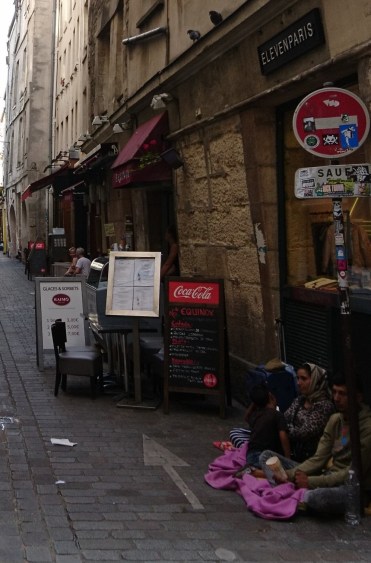
One thing we did notice… and definitely noticed changes even in the three months between our first brief visit in May 2017 and our return in August…. was the prevalence of refugees and poor migrants on streets and in parks. Often from Eastern Europe but also many from Syria and elsewhere in the Middle East, refugees were everywhere to be seen. In the Jardin Villemin between Gare de l’Est and Gare du Nord, for example, in May we saw nothing but people enjoying their lunch in the spring sunshine. By August, there were numerous small groups of men, clearly refugees, waiting for their papers to be processed. And in every district where crowds or tourists gathered, one frequently came across a family group squatting on the pavement, listless, patient, hopeful of a few coins. And always with their young children. It was an unsettling experience.
Other things we came across were much less sombre, and often humorous. We could not explain, for example, the pastry cutter shaped like a map of Australia, nor the kangaroo mascots with French lifesavers we came across in side-street shops.


And always examples of the whimsy and quirks of a great city…. be it someone who ignored the sign and put the bike up, not down, or an old man determined to bring a smile to every man, woman and child with his music and eccentricity.


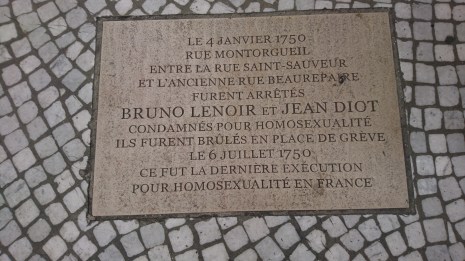
Sometimes, to bring you back to the sombre and meditative, you would come across a memorial or reminder of harsher days… like a memorial stone in rue Montorgueil in the 2nd Arr., marking the arrest and burning at the stake in 1750 of Bruno Lenoir and Jean Diot, the last execution in France for homosexuality. Paris today is vastly different!
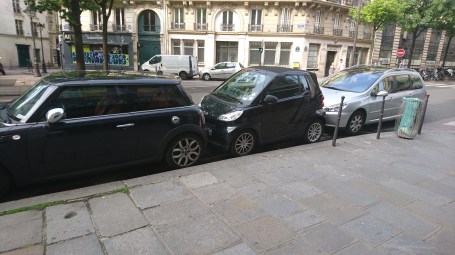
Parisian driving accords to a unique style… parking is similarly distinguished. We had no idea how this car got in or would get out!
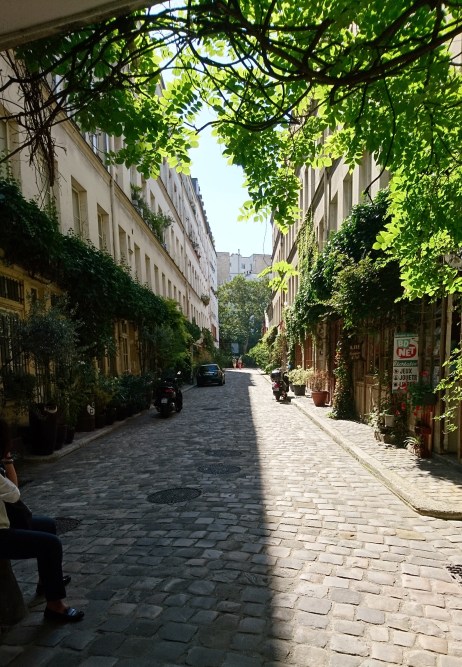
Always, though, in this marvellous city, no matter how busy or crowded or noisy or commercial or tourist-mad the spot you are in, there is, around the corner, a vista that will calm and please the eye and the soul.
Boulangeries and Patisseries
Being bakers in our Australian lives, we made our visit to Paris a bit of a pilgrimage. Paris, after all, takes its bread and pastries VERY seriously; there are some 6,000 boulangeries and patisseries in the city, and it was only two years ago that a 1790 law was finally repealed that had made it compulsory for half of Parisian bakeries to stay open while the other half took holidays in July, and vice versa in August.
We managed to narrow our targets down to a dozen bakeries, two dozen patisseries and a handful of chocolate-makers. It made our 21 days in Paris a busy time!
Most boulangeries also make pastries – typically viennoiserie (think croissants, and danish), and simple tarts, rather than more complex creations – but we basically divided our visits into those who mainly did bread, and those who mainly or exclusively did pastries and cakes. The other thing to note is that when it comes to bread, the typical boulangerie’s overwhelming majority of sales is the baguette, although they will generally also offer a smaller selection of other varieties such as wholemeal, grain, rye and levain breads.
The internet is full of articles and blogs on the “best bakeries in Paris” so we won’t try to repeat that here, maybe just a few pictures of some of our favourites (scroll over the pics for their names):


There were a couple of boulangeries where we were lucky enough to meet the baker/owner, oddly enough both of them female, in a country where there are surpringly few female boulangers (boulangeuses?). The first was Ten Belles, a modern bakery/cafe in a residential neighbourhood near Canal Saint-Martin in the 10th Arr., founded by Alice Quillet. Alice was born in Paris but has some British heritage; she honed her skills at illustrious bakeries like Tartine in San Francisco and Mirabelle in Copenhagen. This heritage shows in her breads, which are hearty, sturdy levains, often laden with grains and very different from the usual Parisian fare. Plus she does decidedly un-French things like pies and breakfasts with toast and jam alongside ther more usual pastries. She gave us a warm welcome when we visited and introduced us to her lieutenant Mathilde. We are already looking forward to our next chance to visit.


The other highlight – THE highpoint – of our Parisian bread odyssey was meeting Veronique Mauclerc at her bakery in the 19th Arr., between La Villette and the Parc des Buttes-Chaumont. Veronique welcomed us like old friends, and her tiny bakery with its woodfired oven and small range of rustic traditional breads reminded us very much of our own operation back in Australia. She had just sold her bakery, after 30 years in the business, to the legendary Parisian bakery concern of Poilâne, and she invited us back in a week to celebrate her last bake and join in her closing-down party.


Many Parisian specialty patisseries are like little boutiques, with much emphasis on visual presentation. And some of the creations were truly stunning to look at, as well as indulgently delicious to taste. Our favourites, different in their own ways from each other, included the following:
Carl Marletti


Cyril Lignac


Hugo&Victor


Maison Mulot


Pierre Hermé


Popelini


Sadaharu Aoki


Stohrer


Jacques Genin


Un Dimanche à Paris


Whew!
Cafés and Restaurants
Still on the subject of food…… of course, Paris is famous for its restaurants and cafés, bistrots and brasseries. It’s probably one of the best large cities in the world to get a meal across a wide variety of cuisines, at just about any hour of the day, at reasonable prices. The first thought for many people is probably of classic French foods, but there are hundreds of restaurants offering Mediterranean, Middle Eastern, Afro-Caribbean, Asian and Indian cuisines, and more. Eating in Paris is not an “event”, nor merely sustenance; it is an essential part of civic and social life, to be shared and enjoyed to the fullest extent possible. Parisians do not eat in a car, and only very rarely on the move, from their hands . And there is no such thing as a 15-minute lunch. “Fast food” is almost unknown and, where you do encounter an American-style chain, it is a lonely and alien experience.
My first meal in Paris, back in May, had been at the opulent and ridiculously over-staffed Terminus Nord, opposite the Gare du Nord and was quintessentially Parisian.


Our last meal in Paris was equally French/Parisian, at Le Soufflé, in the 1st Arr. near Place Vendôme which, as its name implies, is a concept restaurant of long tradition that does nothing but soufflés, across all three courses.


In between these, though, we experienced a variety of meals including wonderful tagines at the little Moroccan La Kabylie off the Place de la Bastille; divine falafel and zakouskis with perfect Israeli gherkins at Chez Marianne in the Pletzl district of the Marais; equally good but even more generous falafel in flat bread at Maõz Vegetarian in Saint-Germain-des-Prés; Mediterranean delicacies at Da Rosa in Saint-Germain; and Portuguese custard tarts (pasteis de nata) at Comme a Lisbon near Saint-Paul in the 4th Arr.


Nor did we ignore our between-meals needs, with visits to the luxurious Angelina on the Rue de Rivoli and Ladurée on the Champs Élysée (both crowded but totally worth it!) plus the much simpler but equally delightful Lebanese ice-creamery Glace Bachir in the Marais.


You may not believe us when we tell you after all this food that we left Paris… indeed, we left France… lighter than when we arrived!
Museums and Galleries
We are not going to post any pictures here, because we don’t know when we could stop. Paris has so many magnificent galleries and museums that you could easily spend a couple of months without reaching the end of the treasures and delights they contain. There was so much we did not get to, but we did manage to spend many hours in the Louvre (3 visits), the Musée de Cluny, the Musée de l’ Orangerie, the Musée d’Orsay, the Musée Nationale d’Art Moderne (in the Pompidou Centre), and the Musée des Arts Decoratif as well as the Musée de Montmartre, Sainte-Chapelle and the Palais de Justice. We visited Notre Dame but did not go in (too many people!)
Our visits to most of these places was made enormously easier and cheaper by purchasing a Paris Pass. Available at various levels and durations, these passes not only provide hefty discounts against the door price of the museums and galleries but they permit accelerated access, which was especially useful at places like the Louvre, where casual visitors without passes might have to queue for hours to get in.
Time with Friends
We were lucky during our stay in Paris to enjoy a visit from one of our dear Australian friends, the globetrotting Sandy Smith, on his way through from Berlin to Barcelona. We met him at the Gare de l’Est and strolled up to Panifica bakery/cafe at the foot of Montmartre for some lunch, before heading out to the Parc des Buttes-Chaumont, which Sandy insisted we should not miss. Sandy had made tentative plans to stay overnight with a friend in Paris but we insisted he stay with us on Eben Haezer, especially since it was only a short walk the next day to his train at the Gare de Lyon. He readily agreed and his friends Guy and Marcel joined us that evening for dinner on board. It was wonderful to catch up with our old friend, to entertain, and enjoy some great company. A few days later, Guy arranged to guide us to the Buttes-des-Cailles district in Paris, which we would never have discovered on our own and was a revelation (see section on Famous Districts above). Sandy also tried to give me some lessons in selfies, which didn’t immediately take hold, as some of the shots below readily indicate.


And so it came to our time to leave Paris on 3 September, after three wonderful weeks. We would now head back up the Seine and the Yonne towards our winter port at Saint-Florentin on the Canal de Bourgogne, with only a couple of weeks or so before we were due to return to Australia for the southern Summer.
It took us nine days to navigate our way back from Paris to Saint-Florentin, including a stop for a few days at the lovely port of Sens on the Yonne. We then had another 11 days to organise the boat and our affairs before leaving for Paris-CDG on the fast train for our flight back to Australia. The time flew as we busied ourselves with maintenance, painting, cleaning and winterising Eben Haezer, and applying for my carte de séjour in the regional prefecture office in Auxerre. All too soon it came time for Vincent, the wonderful capitain of the port de plaisance to deliver us to the railway station at Saint-Florentin-Vergigny. Our second season had come to a close.






 Scraping Through France