If you have the money, and sufficient recklessness, it’s not hard to buy a large boat to live on in Europe. But if you want to take that boat along the waterways, without risk of accident, arrest, or financial disaster, there are a few steps worth considering.
First up, it is very helpful to be or to become proficient in manouevring and being in charge of a large hunk of unwieldy metal. Plus it is a legal requirement in most places to be certified as a skipper.
We now owned… and as of July 2016 were living on… our beautiful piece of maritime history and pleasure. But we were not certified to take her anywhere, or to operate the twin radios which were a compulsory part of ship’s equipment.
And to be honest, we had no idea what would happen when we tried to handle this very large and heavy boat. We were just a tad terrified, although determined to confront our terror.
There are a couple of legal-type necessities involved. First of all, the boat needs to be registered appropriately to travel through the waterways of Europe; theoretically that could mean under the flag of almost any country, although in practice your options are limited. Secondly, the boat needs to be equipped with two marine VHF radios (one to communicate with official channels such as locks, the other to communicate with other vesssels), and these radios need to be properly registered as Ship Stations with their own unique IDs.
I had no idea how to go about these processes, in English let alone another language. The brokers had promised to assist but, once all the contracts – and money – had been exchanged, they faded completely from the scene.
I hit the internet and found several companies who offered the necessary registration assistance, for what seemed to me reasonable prices. I chose a Dutch firm, Yacht Registration Holland, since for reasons explained below I had decided to revert the boat’s registration to the Netherlands, her country of origin.
I sent off the necessary documents of ship specifications and ownership, and settled back to wait…. and wait….
In practice, there were only really three options for country of registration for Eben Haezer. We could not register her in France, Belgium, Germany or most other European countries since their laws permitted only citizens or permanent residents to do so.
The first option was to register her as an Australian ship, since that was the owners’ country. But that would have taken weeks if not months of to and fro correspondence between Europe and Australia, and we were eager to get moving asap. In any case, she was an inland vessel in Europe and would never get near Australia, so it seemed a bit pointless, really.
The second option was to put her on the British Small Ships Register, a relatively easy process (given Jane’s British citizenship) that would have added her to the sizeable fleet of British-registered boats cruising the waterways of Europe. But it would have meant flying the Union Jack or Red Ensign, which for me, personally, and especially after the Brexit vote of 2016, did not hold great appeal to an Aussie in Europe.
The third and best option was to enter her in a modified short form on the Dutch cadaster. The Netherlands permitted boats and owners from any country; their registry was recognised internationally; the costs and renewals were easy; and we were comfortable flying the Dutch flag on what, after all, is a Dutch boat. And so that’s the way we went.
The same company that achieved our ship registration also handled the registration of the Ship Station for our marine VHF radios and the Automatic Identification System (AIS) which we had on board.
The AIS is a marvellous bit of kit. Every vessel over a certain length is supposed to have it, enabling the ship’s position to be tracked in real time and logged in an international database. With a laptop and the right software (such as PC-Navigo), you can also use it in course planning and tracking – watching your vessel’s progress in real time along your predetermined course – as well as “seeing” other vessels lying or approaching nearby.
This last feature is wonderful for seeing the approach of other large vessels – especially commercial barges – as you try to navigate safely on narrow waterways, and even on larger rivers. You can see the name, size and type of vessel and their speed. And you can exercise caution or avoidance as you see fit. Plus it shows you exactly where you are and how fast you are going in relation to where you are heading. All very reassuring.
There were two final pieces to fit in the jigsaw before sailing away – a skipper’s certificate and a VHF radio operator certification. The skipper qualification required a boat operator license that was recognised in Europe with an additional certification for inland waterways. The first part, if you didn’t have it already, required a practical test on an actual boat; the second part was a theory exam with a high pass threshhold. Back to the internet to find options that didn’t involve sitting for tests in French, Dutch or Flemish….
There was a lovely chap in the Netherlands who could handle all of this for us, on his boat, or he could come to us in Belgium and do it all on our own boat. Sounded great, and we lined him up. But then the Dutch holidays intervened and, with time rapidly running out, we found it impossible to get hold of him. Back to the internet ….
We found a boating school …. in Scotland! INDISkills, based on the Forth and Clyde Canal, east of Glasgow, could deliver everything we needed, and right now. We would qualify for an International Certificate for Operators of Pleasure Craft, with certification for Inland Waterways of Europe, as well as a Maritime Radio Operator (Short Range) Certificate of Competence.
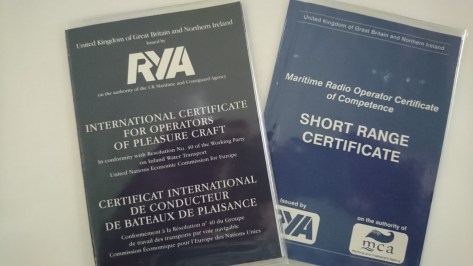
So from Schoten in Belgium we scooted off to Scotland for a week…. better yet, we were able to live on board the trainer’s boat – a lovely old English narrowboat – and turn an obligation into a pleasant floating holiday. Chrisy, our instructor/assessor, was delightful and her boat INDI was fabulous to stay on for a few days and to learn the ropes.


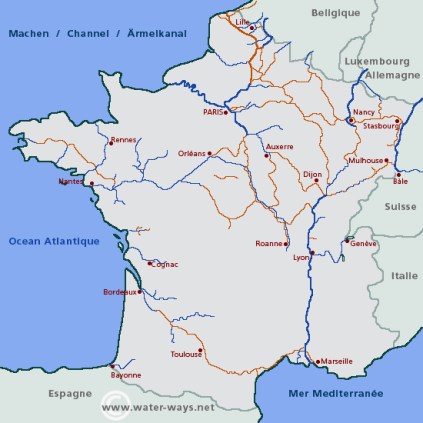
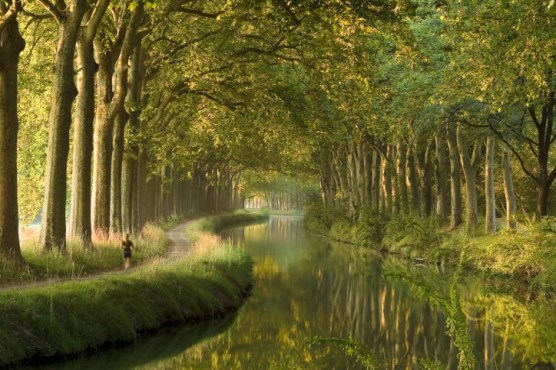

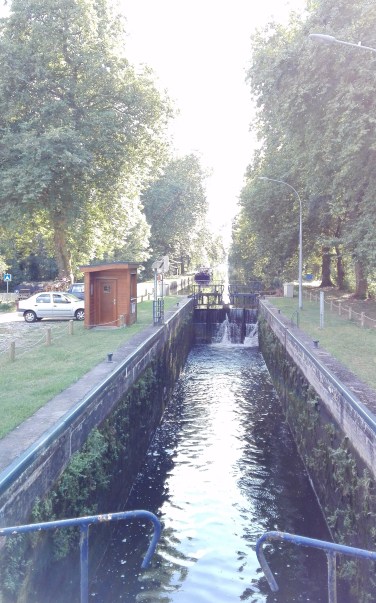
 Scraping Through France