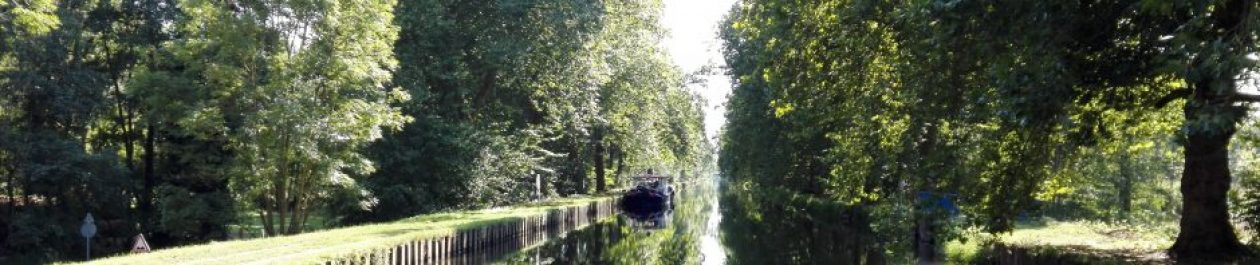
After the rigours of the transition from the Seine to the Marne were soothed away by our pleasant stay in Lagny, we continued up the river towards our rendezvous with a bit of bubbly. Our next stop was in the town of Meaux, still only 50 kilometres from Paris, at the end of a slow, relaxing cruise upstream along the meandering Marne. We arrived as the only boat in the port, and it was clear why: the mooring pontoons were undergoing major repairs after the January floods and the gangways from the pontoons to the shore had been removed! No problem – we pulled out our DIY passarelle and voilà, connection made. Power and water, no mooring fee, and a lovely city to explore.


Meaux is most famous for its variety of brie… which is truly delicious…. and also for its mustard, one of the great alternatives to Dijon. It is full of beguiling, narrow streets, many of which have been pedestrianised, hosting all the major brands, plus lots of boulangeries, patisseries, chocolateries, epiceries and restaurants and cafes. On our first evening we stuffed ourselves silly with a magnificent meal at the Chinese resto just across from our mooring.


The city is dominated by its Gothic Cathédrale Saint-Etienne and the episcopal palace and gardens behind it. It was interesting to see all the statues of saints and angels, decapitated during the French Revolution. Apart from the magnificent 17-century organ, the cathedral is best known for its association with Bossuet, bishop of Meaux 1681-1704, known as l’aigle de Meaux and reputedly one of history’s greatest orators and rhetoricians .


After a couple of days in Meaux, a delightful morning cruise up the river brought us to a very different place, the small village of Mary. Nothing much there, except calm, peace and an excellent restaurant, the Quai des Brumes, right by the mooring.


Another easy meandering morning cruise delivered us to La Ferté-sous-Jouarre, where we moored in a lovely secluded channel behind an island in the river. It was peaceful, but sobering to see the markers on the pontoon pylons showing how high the water had been during the floods of February – only 4 months previous!


La Ferté boasted a fine Hotel de Ville and, even better, a café that made excellent coffee using beans roasted on site – a rare find anywhere in France, in our experience.


We gave our new electric bikes their first real workout with a 3km uphill ride to the Abbaye Notre Dame de Jouarre. The abbey was first established by Saint Columban in the 7th century, then devastated and rebuilt in the 11th century, again during the Hundred Years War, and yet again in the Revolution. Today it hosts a community of 33 Benedictine nuns; the church is a suitably austere affair, without ornamentation, and the whole place and its gentle sisters give off an air of calm, serene contemplation, but not removed from the outside world. When not engaged in prayer and contemplation and good works, the sisters seem to be well occupied in producing rather kitsch pieces of ceramic figurines of children and saints.


As we moved on up the river from La Ferté, the hills on either side of the canal gradually gave more evidence that we were moving deeper into Champagne, with vineyards shyly revealing themselves then combining into vistas of vines stretching into the distance on both sides. We pulled into the town of Château-Thierry after a long day, having decided not to stop at Nanteuil or Nogent d’Artaud further downstream.
Château-Thierry is a sweet town with a handsome Hotel de Ville, a distinctive art déco cinema and a fascinating ruined château of the 12th/16th centuries. It was also the home of the 17-century fabulist storyteller, Jean de la Fontaine whose most popular and best-loved tale of the grasshopper and the ant (la cigale et la fourmi) is celebrated with whimsical statues about town.


Especially in this Centenary year of the Second Battle of the Marne, reminders of WWI were never far away in Château-Thierry, from the American monument on Hill 204 above the town, to a small ceremony of remembrance one afternoon at the Jean Moulin Resistance memorial just by our boat.


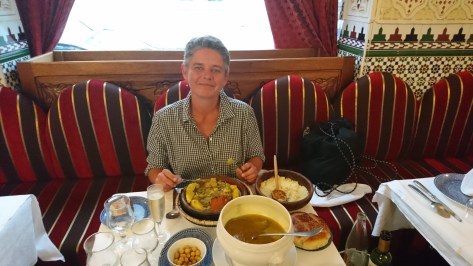
Château-Thierry also offers a couple of lovely restaurants; we chose the Moroccan Palais de Marrakech in the town square and were not disappointed!
After a thoroughly enjoyable couple of days we set off for our next stop, the town of Dormans. By this time we were really in the thick of Champagne country. We postponed our thirst, though, and took a visit to the lovely old 14th-century Château de Dormans and its delightful gardens, and the adjacent Great War Memorial built on the orders of Maréchal Foch to commemorate the victories in the battles of the Marne. Impressive, sombre, but a little too glorious, we thought…. It was refreshing to come back down the hill and see some locals playing pétanque in the grounds of the château.


The next day we pulled out our bikes and went for a delightful cycle along the banks of the Marne, to the villages of Verneuil and Vincelles. We came across Champagne Jacques Copin and managed to score a tasting and a bottle of their Polyphénoles 2006, a fabulous drop from a very good year. The deep red roses around Verneuil’s little 12th-century church were stunning!


In Dormans we enjoyed two other delights, both surprises and both unplanned. The first was when I got a flat tyre on my bike when we were visiting the château, which meant walking the bike back to the village… where we found a bicycle and lawnmower service shop in the centre of town, 5 minutes before closing. The lovely man let me in, threw my bike on his repair cradle, and replaced the inner tube in about 3 minutes, then refused to charge me more than the cost of the tube itself.
The second delight was out discovery of the restaurant Sylvain Suty, where we had a magnificent four-course meal for a bargain price, complete with the most extravagant cheese chariot and dessert chariot.


The next day’s cruise was delightful, and the mooring we found at Damery was fantastic. The village is crawling with champagne houses! We picked out J. de Telmont and were treated to a wonderful tasting by Lucille, our knowledgeable and friendly hostess. We scored a 2006 vintage and an excellent ratafia, which we enjoyed from our rear deck as we took in the magical slow dying of the light across the river.


The following day we cycled along the river from Damery to Cumières, then up the hill to Hautvillers, which styles itself as the berceaux, or cradle, of Champagne, because of Dom Perignon who lived and worked at the village’s Abbaye de Saint-Pierre in the late 17th century. In fact, he was not responsible for discovering or developing Champagne, despite claims by many, including the well-known Champagne house of Moët et Chandon, which now owns the Abbaye (closed to the public but undergoing expensive renovations) as well as extensive vineyards in the surrounding hills. It’s quite a touristy town, but still attractive, with fabulous views back down to the Marne River.


On our way back to the boat we met a man in Cumières who gave us a bag of fresh cherries and introduced us to his extensive collection of geraniums, including one whose leaves he claimed were an excellent mosquito repellent. We enjoyed lunch at a lovely little cafe, run by an old couple with serious mobility issues. Essentially, you ordered your meal and collected each of the three courses from a laminate-top table, ladling the stew course into your bowl and collecting a thick cut of bread to go with it, then returning for cheese and/or pudding which you selected from the table and served onto your own plate. La Paillotte (The Hut) has adopted the motto à la bonne franquette, which basically means “homely and unpretentious”. The steady stream of cyclists who stopped in seemed to agree, and the river views and ambience were priceless.


We cruised up the river to Mareuil-sur-Ay, where we had decided to base ourselves rather than in the centre of Épernay (the self-proclaimed capitale de Champagne), whose port seemed a bit pokey and outrageously expensive. We were unable to connect to the services at Mareuil, but never mind, it was a pleasant stop and the village was filled with champagne houses, while Épernay was an easy, level 7km ride away.
Our first stop in Épernay was the Avenue de Champagne, where the major houses have their HQs. They date mostly from the mid-late 19th century; it’s a bit like what I imagine LA aimed for with Rodeo Drive, but with class and history. Surprisingly, with the exception of Moët et Chandon, it was not at all touristy.


Returning from Épernay to our mooring at Mareuil-sur-Ay, we had hoped for a tasting at Billecart-Salmon, a small-medium house that in 1999 earned the accolade of “champagne of the millenium” for its 1959 vintage… alas, they only receive visitors by prior appointment. Our consolation was a visit to the House of Bénard Roland, where the owner Philippe Bénard (fourth-generation champagne producer), cigar permanently planted, greeted us with a fine and generous degustation. Really good champagne at bargain prices. The portraits of his family on the walls were a nice touch.


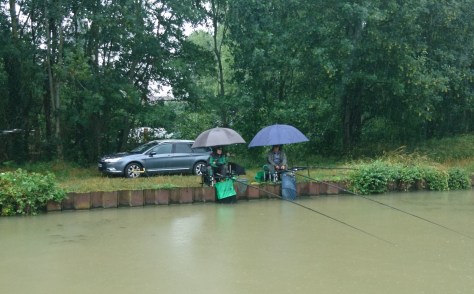
The next day was wet and rainy.. not that it deterred the ubiquitous French anglers. I reckon most Frenchmen would fish in a puddle… after all, they’ve spent a fortune on equipment!
After a long wet day we arrived in Châlons-en-Champagne, scoring the last available place at the port. we had not expected much of Châlons, the last outpost of the champagne-producing region, but we were pleasantly surprised. A fine cathedral and church, some lovely 16th-century half-timbered houses and handsome 17th-century stone residences, a nice square and a couple of lovely parks, and an excellent marché couvert made us wish we were able to spend longer here, and vowing to return as soon as we can.


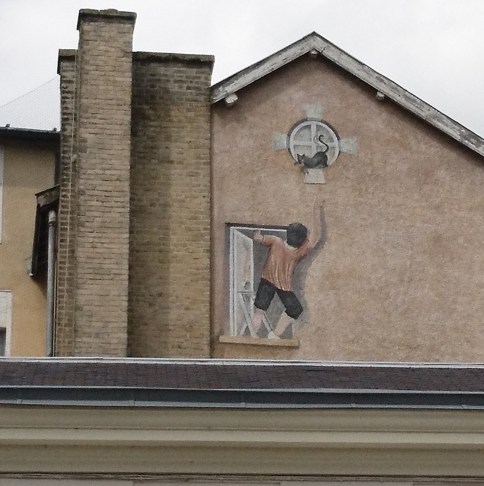
Châlons-en-Champagne is the birthplace of humourist-satirist Pierre Dac (aka André Isaac), best-known as the inventor/creator of the “schmilblick”, an imaginary and utterly useless object which can be used for anything, being ‘rigorously entire’. It became popular in the French vernacular, and “pushing the schmilblick” (faire avancer le schmilblick) now means ‘providing a small amount of help to a large problem’. It appears Châlons has inherited some of Dac’s sense of humour….
Everywhere we travel in France, we witness examples of the devastation wreaked by the Revolution….. closed and ruined churches and abbeys, defaced and decapitated statues, destruction of places and objects from hundreds of years before. In Châlons-en-Champagne we saw an example of the Church doing that work itself, 30 years before the Reign of Terror and the Committee of Public Safety. The Cloister of Notre-Dame-en-Vaux, built in 1170-1180, was demolished in 1759 by the canons of the church to provide building materials for their row of houses. The Museum and Garden on the site, excavated and created in the 1970s, provide a fascinating insight into what was lost for the priests’ comfort.


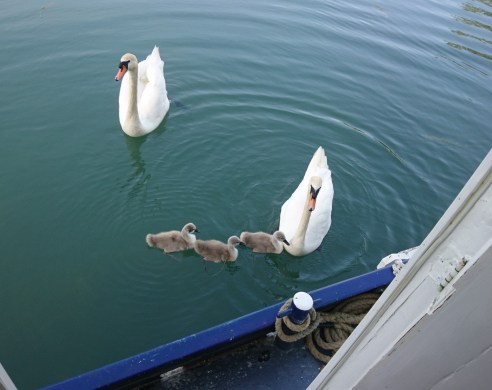
On the morning of our departure from Châlons-en-Champagne, a family visited to bid us farewell from the land of Champagne. And maybe to join us for breakfast.
 Scraping Through France