More to come
Category Archives: 2018 Season
Heading for home (for the winter)
More to come
Moret-sur-Loing…. and Fontainebleau
More to come
Marvellous Montargis
More to come
Canal de Briare
The first thing we had to do in moving from the Canal Latéral à la Loire onto the Canal de Briare was to cross the Loire River itself… across the 662-metre pont-canal built in the late 19th century with input from Gustave Eiffel. Built on 14 piers, its steel beam and channel hold about 13,000 tonnes of water. It’s not scary, being fairly wide and easily navigable, but it’s an impressive crossing all the same.


Our first stop past Briare was in the charming village of Ouzouer-sur-Trézé, with a delightful halte giving easy access to the village, its boulangerie and its impressive 12th-century Église Saint-Martin with massive flying buttresses.


Our next stop was quite a contrast, being in the natural surrounds of the Étang de Gazonne, at the summit of the canal. A lovely wild mooring beside the lake, watched over by the éclusier who was clearly in love with the place and acted as a kind of park ranger. We offered to buy his place but he indicated a strong reluctance. We don’t blame him!


After the sweet natural delights of Gazonne, we headed along the canal to Rogny-les-Sept-Écluse. Apart from being a delightful stop with many lovely walks, Rogny also displays the true genius and industry behind the construction of the Canal de Briare. Its original seven locks, built in the mid-17th century, were replaced by five locks conforming to the Freycinet gauge in the late 19th-century, but the original locks are an impressive monument. Apparently they involved 12,000 workers, bolstered by 6,000 soldiers when work was halted during the Thirty Years War. They were thoroughly ground-breaking when first built, and today provide a fabulous sight and an interesting walk to the summit – where we were lucky enough to find a walnut tree in full fruit. We joined a couple of locals in plundering it for its delicious bounty.


Our next stop was one of the true gems of our canal travels. Chatillon-Coligny, a town of about 2,000, is an absolute delight, with a pleasant mooring, interesting streetfronts, an old chateau (private), the vestiges of its old defensive moat system, a lovely 15th-19th century Eglise Saint-Peter et Saint-Paul, and a sweet old 16th-century salt granary, now a private residence. The town became a centre of Huguenot activity during the Wars of Religion, and boasts a “House of Hell” (Protestant) only a few doors up from the “House of Paradise” (Catholic). Chatillon is also known as the childhood home of the famous French writer Colette, whose house still stands in the town.


The old salt granary


The sign refers to the murders of two Catholic canons by marauding Huguenots in 1562

Colettes’; childhood home
From Chatillon we travelled to the small village of Montcresson. Not much there, with a wild but pleasant mooring, although there was a lovely old 12th-century church, which apparently had a tunnel leading to the old convent (now demolished) – there are vestiges of the old vault still visible. The town is also interesting for its association with the MacMahon family, from Ireland, who came to France in the 17th century during the Glorious Revolution and who claimed descent from the kings of Ireland. Successive generations served in the French army and in 1873 Patrice de MacMahon was elected President of the French Republic, before his death in 1893 at this place.


Entry to the vault that connected the church with the convent

Statue of Patrice de MacMahon
Down the Loire
Leaving Digoin and crossing the Loire via the elevated pont-canal, we started our journey westwards down the Loire along the lateral canal that tracks the river as far as Briare. Our first stop was at Coulanges, a village without much but at least the halte had services and was very peaceful. We had both happy and sad encounters here…. we came across a wreath laid by the canal in memory of someone who had died – possibly, we thought, a drowning, given the location of the sad memorial. Our spirits were lifted soon afterwards by the sweet sounds of a lady singing French folk songs as she picked wild fruit from a tree by the canal.


We continued through a couple more pleasant days on the canal, witnessing the sacred, the profane and the quotidien. The sacred came in the form of a glimpse of the extensive complex of the Abbaye Notre Dame des Sept-Fons – a Cistercian monastery founded in 1132 that later joined to the Trappist order; it now houses around 90 monks, many of them novices from around the world. All we got to see as we passed by on the canal, in truth, was a wall and a gate – but from what we know it is a remarkable complex. The profane came very close by, in the form of a massive canalside foundry on the opposite bank. The quotidien, to our delight, was the éclusier at the last lock of the day before arriving in Beaulon, a wonderfully jovial fellow who unashamedly celebrated his love of the colour blue.


Beaulon proved to be a pleasant stopover – nice mooring with services, some interesting old homes, a chateau (privately owned, not accessible), plus the important thingsd in a small village… boulangerie, boucherie and epicerie with small café. We spent a couple of enjoyable days there, dreaming of re-opening the lovely ivy-clad restaurant that had closed down sometime earlier.


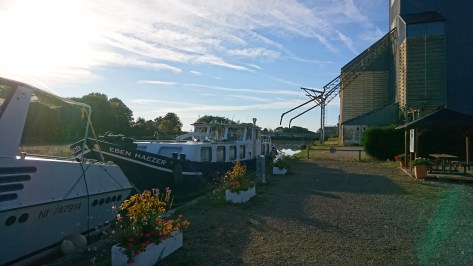
After Beaulon, we arrived in Gannay-sur-Loire, the new resting place for Eben Haezer for the three weeks we would be away visiting Jane’s family in Wales. We had originally hoped to reach the large port of Nevers for this, but a broken lock downstream forced us to choose here instead. To be honest, there was not much to Gannay; the free municipal mooring was limited to a maximum of 48 hours and the private canal-bank marina was somewhat over-priced for a place right off the beaten track with not much to offer in shopping, services or transport. Cést la vie, we made the best of it.
Although there was little in the way of shops, and we had to catch an expensive taxi to get to the rail station in Decize, Gannay was not completely devoid of charm and interest. The Romanesque church of Saint-Jean-Baptiste had unfortunately been extensively destroyed in the Revolution but had preserved its choir and stone vault and a carved statue of the Virgin. There was a very pleasant small café restaurant opposite the church, where we shared a meal with the New Zealand friends we had met in Digoin. There was an interesting relic of a linden tree in the main square by the church, originally planted in 1620 by Sully, Louis XIV’s grand voyer minister of state, part of a scheme to plant such trees in villages throughout France, to act as meeting points after Mass to discuss and manage the affairs of the parish, and to mark important road routes. This particular arbre de Sully had seen better days, having been damaged when the trailer of a lorry detached and smashed into it. The remains of its trunk have been preserved under its own little steeple. And we had a little friend visit us daily at our mooring – a coypu, a South American aquatic rodent introduced to Europe and now fairly common along the canals and rivers. We often see them swimming but this was the first time one had so fearlessly approached so close to us.


To get to Wales, we had to catch a taxi to Decize, then a train to Nevers, where we had reserved a hire car for the trip. We then left Gannay in the car on 6 August and travelled to Calais via Orléans, Chartres and Rouen, then to St Asaf via Dover and a funny little rural BnB in Huntley in Herefordshire. That trip, over three delightful weeks, is a story for another place. I returned a week before Jane to do some work on Eben Haezer before picking her up at the airport in Lyon, where she had flown from Manchester.
I was able to do some good restorative work on the boat while at Gannay, including some repairs to sections of the wheelhouse that had suffered timber rot, and a good coat of paint in various areas crying out for it. I was also able to fit new curtains to our bedroom windows which Jane’s Mum had made up for us in Wales.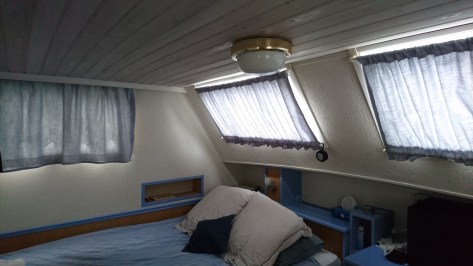
Finally, on 30 August we left Gannay to continue our cruise down the Canal Latéral à la Loire.
After a break for the éclusier’s lunch at Saulx, we made an overnight stop on the canal outside Decize, then the next day on to Fleury-sur-Loire, a small village with a simple mooring but with services (water and electricity) and a cheap and cheerful café in a couple of marquees overlooking the canal.


After a couple of enjoyable days we headed into Nevers, a large town/small city, the capital of the Nièvre department in Bourgogne-Franche-Comté. We had intended to leave our boat here for the three weeks we would be in Wales visiting Jane’s family, but a broken lock meant we had to change plans and we would now be here for only a couple of days. The port here is large and wide, but with many boats, and we found a comfortable place on the edge of the marina, giving us privacy and all services on a new long pontoon.
The city itself is quite charming, or at least the older part of it near the river. It had once been an important depot for Julius Caesar during his campaigns against the Gauls (though he suffered its sacking by the Aedui at one stage). From the 16th century it became a notable centre for the manufacture of faience (tin-glazed earthenware pottery). This heritage is reflected in two museums dedicated to faience, one of which was unfortunately closed when we were there, and another in the former Ducal Palace – the day we were there the Palace exhibits featured not only pottery and glazed works but a fascinating collection of cardboard sculptures of fantastic creatures. We also discovered the HQ of the Montagnon firm of faience manufacturers, which traces its origins to 1648 but which regrettably closed its doors permanently in 2015.


The narrow streets that lead away from the river are interesting, with many houses from the 14th to the 17th centuries. The Romanesque/Gothic Nevers cathedral (Cathédrale Saint-Cyr-Saint-Julitte) was imposing, as was the Romanesque Église Saint-Étienne, as well as the Ducal Palace and its adjacent Place de la République. We also enjoyed a ride through the Parc Roger Salengro to the Chapel of Saint Bernadette Soubirous, the witness to the apparitions of Our Lady of Lourdes in the 19th-century, who died in Nevers and whose “incorrupt body” remains on display. We chose not to view the corpse, but were delighted to find a large mosaic mural under construction in the adjacent courtyard.


Leaving Nevers we cruised to the little village of Cours-les-Barres, a pleasant stop but a place where it seems they have been somewhat opposed to beggars for a long time…


Our cruise from Cours-les-Barres included some lovely locks, well tended with flowers and attentive éclusiers – even when on the phone, as they always were.


Our next stop, la Chapelle-Montlinard proved to be a fascinating place. The mooring, by an industrial site, was less than salubrious, though adequate.
But the nearby town of La Charité-sur-Loire was something else altogether. Across the Loire from the canal mooring and up a slight rise, la Charité had some lovely surprises. The Église Notre-Dame de la Charité-sur-Loire is a magnificent ruin, largely preserved. With a history going back to the 8th century, and the current building dating from the 12th to 14th centuries, it is a marvel of ecclesiastical architecture, one of the foremost “daughters” of the famous Cluny Abbey. Its survival is even more remarkable, given it was marked for destruction in the Revolution and was turned into a series of trade enterprises – a pottery, a shoe manufacturer, a wine store – and then was earmarked for demolition in the 19th century to make way for the Paris-Nevers road (thankfully avoided). It has lost its western chapels and one of its towers, and its walls are green with mould, but it is superb.


For the last thirteen years, la Charité has been hosting an annual Festival du Mot, a literary festival, welcoming poets, writers, critics and the public to celebrate words (rather than just books), with each year dedicated to a particular word. The town has turned itself over to this, with numerous inscriptions and placards throughout town, on steps, walls, roadways and shopfronts.


Another highlight in la Charite was the les halles de loire, an unusual grocery/vegetable store by the river, established in an old abattoir that closed in 1984 and has been turned into a store specialising in local produce, fresh and preserved. It’s a interesting and atmospheric space (even the old rails and hooks for the carcasses have been maintained) and its products are genuinely good, local and sourced. There aren’t many spaces like this in France, and we were delighted to find it.


After la Charité we cruised to Ménétréol, the chief attraction of which was its proximity to the hilltop village of Sancerre, a lovely town and the centre of a noted wine region. It was a nice mooring, but as we approached a lady appeared on the quay, gesticulating and telling us we could not moor there because a large boat was due to arrive. We told her we had arrived and we were staying, and she disappeared. To our horror, we later discovered she was the proprietor of the dockside restaurant we had booked dinner at that evening! All the same, she was friendly and didn’t seem to mind, and the large boat didn’t arrive, so pas de problème. The restaurant was lovely… and clearly obsessed with hats!


The following day, however, the large boat did arrive. It was a hotel boat, and it was arrogant and aggressive. Our first inkling was when a young man pulled up to the port in a van and told us we had to move to make room. He did the same to the boat in front of us. That was when we first met John and Janet Hughes, from Sydney but now of the Gold Coast, fellow Australians who proved they don’t take shit. Tbe hotel boat arrived shortly afterwards and hovered beside us, the crew member yelling at us to move. John, a lawyer and immovable object, simply refused. He winked at me and continued his charade of non-cooperation for a while, insisting that the boat and its crew show a bit more respect and consideration. Eventually, however, we agreed to provide room for the hotel boat and its guests…. it meant we had to move as far back as possible and hammer in our ground stakes, but we were OK.


All that out of the way, we were free to ride our bikes up the hill to Sancerre, to take in the town and its views and its wine shops. It was a challenging ride up the hill but well worth it – the town is a delight, with a lovely square where we enjoyed lunch, great views and a series of narrow streets leading to our target… the Domaine Vacheron et Fils. We enjoyed a lovely tasting in their cave and ordered a couple of dozen bottles, which M. Vacheron undertook to deliver to us at the boat the following morning.


With the Sancerre wine delivered as promised and safely stowed, we set off for the tiny village of Léré, 18 kilometres further down the canal. We arrived at a peaceful setting with only one or two other boats. But lo and behold, events repeated themselves when a hotel boat arrived and rudely requested we shift our settled positions; once again, there had been no sign or warning of their arrival (some other hotel boats are considerate enough to leave notices at moorings to warn of their arrival, by date and ETA). This time it was the turn of the Englishman in front of us to play the role that our friend John had performed in Ménétréol, feigning offence and inconvenience and non-cooperation, until we eventually, reluctantly shifted our boats to make room. Such an unnecessary rigmarole! There was not much to the village, apart from an attractive small lavoir (communal wash house), a nice restaurant (which we did not visit on this occasion), a boulangerie, and the handsome 14th-century Église Saint-Martin.


Our next stop was at the attractive halte at Beaulieu, only a couple of hours further down the canal. On the way we could see in the distance the cooling towers of the Belleville nuclear power plant. Beaulieu is in a nice setting, with power and water, and the village is a delightful little place, with a boulangerie, a pleasant bar-tabac and the sweetest, smallest mairie we have seen. Unfortunately the boulangerie was closed for the annual summer holidays…. we were pretty sure what he would be up to – the photos and trophies in his window were not for achievement in bread-making but for catching fish!


From Beaulieu we headed towards Briare, our last stop on the Canal before turning north. Briare sits at the junction of the Loire River and its latéral canal, and the Canal du Briare. The Loire canal crosses the river just before the town along an elevated pont-canal, and we decided to stop just before it at a wild mooring, rightly suspecting that there might not be a suitable place for us in the town marinas. It was an easy cycle into town and it was peaceful and free! The pont-canal itself is a wonder – for a hundred years until 2003 it was the longest iron aqueduct in the world, at 662 metres, and it has a strong connection with Gustave Eiffel of Tower fame. It provides a great view of the river as you cross it.


Briare is an interesting an pleasant town, with an excellent marina (though with high demand and therefore limited space). The town has some excellent cafés and restaurants, some lovely walks along the riverside, a lot of waterways and waterside parks to walk through and a general air of ease and relaxation. One of our prime interests was the Musée de la Mosaique et des Emaux, dedicated to the mosaic and enamel industries that flourished here in the 19th and early 20th centuries. The Emaux de Briare company manufactured and exported millions of enamel buttons and beads, and pioneered the production of pre-cut mosaic tiles which were used to adorn buildings and to tile bathrooms and kitchens. Within the museum there is still today a factory which sells tiles, mosaic pieces, fixatives and glazes.


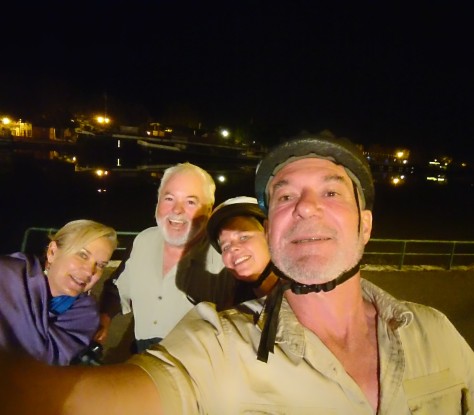
We were only in Briare for a short time, but we were fortunate to reconnect with our Australian friends John and Janet Hughes and to enjoy a lovely meal with them at the Restaurant Le Pont Canal, right by the aqueduct over the river. The meal was fantastic, made even better by John insisting on paying for us. Really lovely folk! The evening was perhaps a bit too enjoyable, judging by the selfie we took at the end of it.
So came the end of our cruise down the Canal Lateral a la Loire; our next stage would be a northward journey along the Canal de Briare and Canal du Loing back towards the Seine. Before we could get away, however, we had to navigate the pont-canal across the river…. a slow but relatively straightforward manoeuvre, but exhilirating in its own small way.
The Canal du Centre
Our transition from the Saône River to the Canal du Centre was a memorable experience, involving as it did an 11-metre high lock. The approach was not only daunting but confusing; from a distance the inside of the lock was so dark we couldn’t tell whether the gates were open or closed, even though the control light was green. Eventually we eased our way in, tied up to the floating bollards, braced ourselves for the rush of water and marvelled at the engineering involved in lifting us some 36 feet onto the canal. It was impressive, and not at all as nerve-wracking as we had thought it might be. We then had an easy 4-kilometre cruise to our overnight stop at Fragnes.
When we arrived in Fragnes on a Tuesday the port was absolutely jam-packed and we secured the very last available spot, requiring use of our mooring spikes. The next day many of the boats moved on and we were able to secure a better spot for our three-day stay in this pleasant and well-serviced mooring.


Fragnes wasn’t the quietest location we’d moored in….there was an aerodrome nearby, with an aerobatic practice facility, so there was a constant soundtrack of a sports plane doing its manoeuvres, as well as the sound of the tractor on the farm opposite cutting the harvest of wheat. And with the heat, several of the large hire boats in port decided to run their air-conditioning, resulting in total port-wide blackout for a couple of hours. All told, though, it was a pleasant place to relax and recover for a couple of days before our journey along the canal.
We were looking forward a lot to our cruise to Santenay, for three reasons – firstly, we had heard it was a very picturesque section of the canal and the mooring very pretty; secondly, we were anticipating some great wines from this distinct southern region of the Cote d’Or; and thirdly and most importantly, we were to meet our dear friend Julian from Australia there, who was due to motor in and spend a few days with us on his French holiday. All three expectations were fully satisfied.


The day we arrived, Julian joined us and after catching up on all our news we walked into the village for a lovely meal at one of its two excellent restaurants, the Restaurant l’Ouillette. That evening, 13 July, was Santenay’s turn to celebrate Bastille Day fireworks (smaller towns seem to do this on the day before, while larger towns and cities do their shows on the 14th), so we strolled down to the parklands at the swimming centre where there were a variety of marquees, one selling cheap beer and wine, one with a wooden dance floor, one with dinner tables set for VIPs, all of them surrounded by joyously celebrating familes and youth and children. The fireworks were very impressive.
The following day we piled into Julian’s hire car and set off for a tour of the region, including a visit to the wine centre of Beaune (which we had previously visited on our trip up the Canal de Bourgogne in 2017), some delightful small villages and country backroads, and a visit to the Rully wine house of André Delorme, where we tasted a few wines and came away with some very nice Chalonnaise burgundy and crémant de Bourgogne.
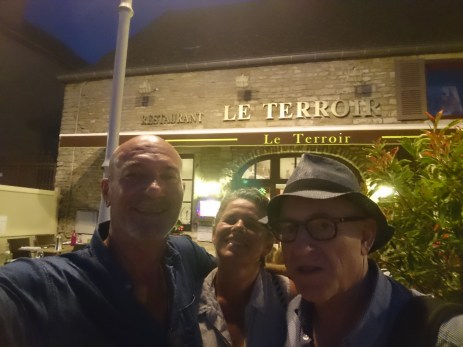
That evening we shared a meal at the other good restaurant in Santenay, Le Terroir – very excellent, and great company.
On our third day we once again did a road trip with Julian, this time visiting the marvellous weekly markets in Chagny. As well as several streets given over to food stalls of all kinds, there is also a section selling bric à brac, some of it truly excellent at great prices and always open to bargaining. Julian nearly needed a separate suitcase for his haul. The other remarkable thing about Chagny is its Poissonerie Kironan, a remarkable fish shop that specialises in sardines, the passion of the owner Ronan Pigent, originally from Brittany. He stocks more than 100 types of sardines and even has a self-service dispenser at his door for those who can’t wait for the shop to open.


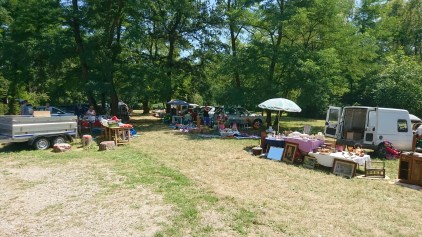
On our way back to the boat at Santenay we detoured to a little rural brocante, where we saw some delightful little trinkets and curiosities for sale by local residents. These flea markets pop up from time to time in regional France and they are always interesting and sometimes throw up some wonderful bargains and eccentricities.
Back at Santenay we decided to have a meal on board and then venture to a café to watch the FIFA World Cup Final between France and Croatia. The first part went well, the dinner was lovely. The second part was hilarious. There was almost no one in the cafe, except for some Belgians who were angry with the French and refused to celebrate. We were in France, France won the World Cup, and we were surrounded by grunts and silence! At least we heard some car horns blaring in the distance on our way back to the boat. It was too funny.
The next few days we had some very pleasant cruising up towards the summit of the Canal du Centre, with overnight stops at Saint-Leger-sur-Dheune (full port, all services, small village) and Saint-Julien-sur-Dheune (no services but delightful setting), until we reached the top of the canal at Montchanin (no services, very pleasant apart from some major roadworks nearby).

Saint-Leger

Saint-Julien

Montchanin
In one sense, we didn’t make all we might have of our stay at Montchanin, because it is the top of the canal and has a number of lakes that supply water to the canal, including the Étang de Montchanin, with some very nice lakeside walks and a swimming beach. But we only had one night there, and we made the most of that with a visit to a nearby Les Routiers restaurant in the company of an Australian couple we befriended at the mooring. The Relais des Morands is essentially a truckers’ restaurant, part of the nationwide network of ‘routiers’ restaurants. A short bike ride from our restaurant, it offered a delicious three-course meal at bargain-basement prices – truck-drivers in France demand more than a burger and ice-cream! And the service was impeccable and very friendly.


We experienced the other end of the dining spectrum at our next stop, at Montceau-les-Mines. Montceau is a former mining town whose fortunes declined in the late-20th century – although, despite recent decades of high unemployment and business closures, it seems to be attempting a bit of a comeback. Certainly, it is doing well enough to support a Michelin-star restaurant, Jerome Brochot, where we enjoyed a fabulous meal on the night of our stay. A wonderful dining room and great food, including a magnificent fish mousseline in shellfish bisque, and the biggest and best crême brulée we have ever tasted.


Leaving Monteceau-les-Mines we had an enjoyable cruise to Génelard, a small town with not much except a delightful mooring, an amazing art déco metal factory and a museum dedicated to the Demarcation Line (La Ligne de Démarcation) between Occupied France and Free France, which ran through here and along the canal during WWII.


The following day saw us arrive in Paray-le-Monial, “la cité du sacré coueur”, an extraordinary place, a genuine centre of Catholic pilgrimage, welcoming 200,000+ faithful every year, attracted by the 17th-century “visitation” experienced by a young lady by the name of Marguerite-Marie Alacoque, who claimed repeated visions of the Sacred Heart of Jesus, confirmed by her Confessor, Father Colombère. The pilgrimage business really took off in the latter 19th century, and it’s never looked back. Today it involves acres of marquees, hours of singing, numerous shops selling religious souvenirs, books and artefacts…. the whole noodle. I have never seen so many people with walking sticks, all presumably looking for “the cure”.


Queuing for lunch

Ready to serve the masses

Pilgrims’ gift shop


Though it is a thoroughgoing centre of pilgrimage and all its associated religious hooha and commercialism, Paray has a long, illustrious religious history. The oldest churches here date from the middle ages, and there is a close association with the Abbey of Cluny (one of Christendom’s treasures until its destruction in the Revolution). The basilica of the Sacred Heart is a Romanesque triumph (one tower 11th-century, the other 12th). The 17th-18th century Cloister is delightful. And other religious buildings likewise.


Paray also boasts some delightful side streets and alleyways and some remarkable civic and domestic architecture.


It isn’t just about Eternity in Paray…. we found a horloger plying his trade, with some lovely old watches and clocks on display.


One of the most impressive things we saw in Paray-le-Monial was the museum dedicated to Paul Charnoz, founder of a ceramic tile industry here. Unlike others using glazes and tints, he developed techniques of manufacturing tiles using compressed baked, coloured clay powders, resulting in the most magnificent products for floors, walls and decoration. He flourished in the late 19th century-early 20th, exhibited at the Paris World Expo in 1889 (the one that welcomed the Eiffel Tower) and was a genius of industrial production of exquisite craft. Sadly, his factory ceased production in the 1970s and had been lost, but this little museum preserves his legacy in a small way.


Leaving Paray-le-Monial (without crossing ourselves) we headed the last sector of the Canal du Centre for Digoin, cruising slowly and sedately and pausing only to wait for a lock to be reset.
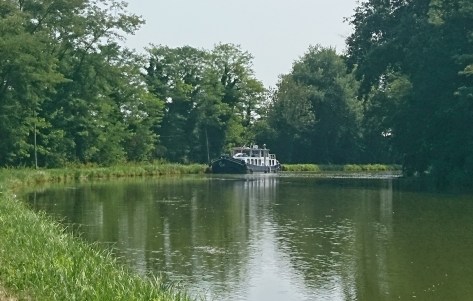
Digoin is where the Canal du Centre meets the Loire, France’s longest river. If you could (but you can’t, because it’s not navigable), you could turn left towards the source of the Loire in the Ardèche, up in the Massif Central. As it was, we had to settle for turning right, onto the Canal Latèral à la Loire, which would track the river westwards until Briare. But not before crossing our first major pont-canal, which would take us over the river from one canal to the next.


Before we crossed the river, however, we spent a few anxious but still pleasurable days in Digoin. The anxiety was produced by news that the canal was to be closed indefinitely some distance to the west, because a boat had crashed into and badly damaged a lock gate (we still don’t understand how someone can do that). It meant we could not get through to Nevers, where we had proposed to leave the boat in a safe harbour for three weeks while we visited Jane’s family in Wales. We fuffed around a bit waiting for a positive update which never arrived, until we settled on getting through as far as Gannay, where there appeared to be another place we could leave the boat. Our stay in Digoin was enlivened by a New Zealand couple we met, great bon vivants, with whom we shared an excellent cheap meal at a Chinese restaurant (the Dragon Phenix) and afterwards a drink at an bar across the road – the decidedly eccentric Hippie Kozi.


And that finished our cruise along the Canal du Centre. Our next stage would take us westwards down the Canal Latèral à la Loire.
Between Champagne and Bourgogne
Leaving Châlons-en-Champagne, we headed towards the end of our sojourn in the land of bubbly. Our first call was Vitry-le-Francois, the junction of the Canal Lateral a La Marne (which we had just cruised), the Canal Marne au Rhin ( heading east towards Nancy, Strasbourg and the Rhine) and the Canal Entre Champagne et Bourgogne (where we were headed). Vitry was a non-event, proving that the best laid plans can easily go wrong. Despite pre-booking a day ahead and a phone call 20 minutes before arrival, we found ourselves without a capitain du port and without any obvious place to moor in the tiny tight harbour channel, so we tied up to the industrial quay opposite. Then moved on without a backward look the following morning.
The next day brought a delightful cruise along the canal to a lovely mooring at the village of Orconte. Nothing much there, except a boulangerie (yay) but it was peaceful and pretty so we stayed an extra night.


Orconte has a population of 450 and there’s not a lot there. But it has more delightful old half-timbered houses than we’ve seen in other villages. We were there on the day of the Football World Cup match between France and Australia. A patriotic Orcontois had given his garden nymph some extra decoration, and the local boulanger had dyed his hair blue, white and red. We bought his bread and told him we felt sorry for him… but we did not truly expect to be the ones cheering victory that night!


We transited in Saint-Dizier, a large town with a convenient halte, before cruising on to a delightful wild mooring at a little place called Chevillon. Very picturesque and calm, apart from the sounds nearby from the most musical metals foundry I have ever heard — like Tubular Bells with a smattering of a men’s chorus singing Volga Boatmen and a soprano Valkyrie dub. Quite extraordinary and a weird but not unpleasant accompaniment to our evening BBQ. On the way there we experienced unusual waterfalls in some of our locks.


From Chevillon we cruised to Joinville, a delightful town with much going for it. There are two moorings – the municipal quay, which seems quite satisfactory (except that it shares space with a park for camping vans), and a private mooring just before town at the Hotel de la Vinaigrerie, a former light industrial site that has been transformed into a pleasant gîte hotel. A large supermarket, brico (hardware store) and gamm vert (garden store are within a few hundred metres. Even better, behind the hotel is the Restaurant La Vallée Gourmande where, despite us being the only booking for the evening, we were served the most magnificent four-course meal, prepared in miraculous time, and served on the terrace by the owner as if we were royalty.


Joinville itself offers an interesting range of sights for a visit of a day or two, including the Château du Grand Jardin and a setting on a kind of island between two branches of the Marne that lends some interesting vistas of water and bridges.


Cruising between Joinville and Froncles, we experienced all the best and most ordinary of French canal cruising. Some lovely scenery, a broken lock that took ages to pass through, and a trifecta lock – first the lock, then a pont-canal (aqueduct over a stream) and then a lifting bridge. It made for a long but very interesting and picturesque day.


We also experienced one of those unique French locks where the lock-keeper’s house boasts an extraordinary collection of garden gnomes. We have seen many of these but this particular one might just take the cake…. particularly for its combination of Snow White and a display of naked gnome and gnomette.


Our stop in Froncles was a delight in several ways. The setting was beautiful, and we enjoyed a fully-serviced mooring pretty much on our own, except for some camper vans that were placed at a discrete distance. The adjacent Marne in its upper reaches was a small, calm, tree-lined stream and we enjoyed a serene riverside park right by our mooring.


Froncles is known for its metal forges, originally from the 18th century and then, from 1927 until quite recently, production of sheet metal sections for the fabulous old Citröen 2CV. We explored the place on foot and our interest turned to joy when we found the best village boulangerie we have so far discovered. Guillaume Perreau and his wife Sandra welcomed us and showed us their set-up. Guillaume is a true artist, battling through rising prices of flour and butter, and competition from cut-price supermarkets, to make superb products that he sells from his shop and and a mobile operation with a van. We salute him and Sandra.


After a couple of lovely days in Froncles we enjoyed another delightful cruise to our next stop at Viéville…. again, a village pretty much in the middle of nowhere with not a lot of services, but a sweet place with a cool surprise. We discovered that there was a concours de pétanque (boules competition) scheduled for later in the day just across the canal from our mooring, with a music concert to follow. We couldn’t resist… we grabbed a cheap meal, some cheap drinks, checked out the play and stayed for a great show – a very good four-piece playing covers of The Who, The Stones, Led Zep, U2, The Police, and at least four from Acca Dacca. Truckloads of fun.


From a small party to a big one…. After Viéville we stopped in the larger town of Chaumont, in time to witness the 81st edition of their “Grand Pardon” (Great Forgiveness), a traditional religious/popular festival with a 500-year history. Some religious ceremonies aside, the streets were festooned with crepe flowers, people everywhere walking, drinking, eating, and fireworks in the evening.


In Chaumont – first we spotted the hanging meat, on the rear of the boat right behind us, then we met the owners, a delightful Norwegian couple, Eddy and Sigrid, who were taking their yacht to the Med for a couple of years. The meat is a cured lamb, which they never refrigerate, cutting thin slices as needed. It’s delicious. They became firm friends over after-dinner drinks. And they were kind enough to lend us their electric bike and cart to fetch 100 litres of fuel in our jerry cans from a nearby servo. Permanently sunny-humoured, they had to cope with setbacks at Chaumont including water in their fuel (fixed by a local garage for big bucks) and the disappearance of their cat (unresolved when we left them but we were glad to find, at our next stop, with a happy ending).


After the bustle of Chaumont, with its many boats and festive atmosphere, we were glad to find some serenity at our next stop at the tiny village of Foulain. No services, no rush, no hassle, just quiet balm for the soul.
Our next stop was nearly as calm and peaceful, but this time with power and water, in the small village of Rolampont. We were greeted by a girl who seemed to think she was the port capitain, and who insisted on introducing us to her clan. Rolampont has a typical French village intersection, a pleasant church square and an interesting historic communal wash house (lavoir). Not a lot of people sighted on a Saturday afternoon. Signs on fences indicating not much happiness at the plan to cease recyclable waste collections door-to-door in favour of central “voluntary” collection points (increasingly common throughout regional France).


From Rolampont we had a pleasant cruise to Langres, an attractive and ancient hilltop town in the Haute-Marne department. It had considerable strategic importance and religious power for a long time and it has retained its impressive defensive walls. It was the only town we have visited by shuttle bus from our mooring, being just too damn high and steep to attempt walking or cycling. At least the bus was regular, and free! We were rewarded with fine views of the region, a marvellous 12th-century cathedral, and enchanting narrow streets with Renaissance houses.


Langres offered something unique…. a continuous 4km path along its encircling defensive walls, with numerous old towers and gates, and fabulous views. It also offered another day above 38 degrees. So we took the easy option, with a covered electric trolley cycle. Jane went faux Bedouin.


Like all French towns, Langres is proud of its notable sons and daughters…. In this case, the famed 18th-century Enlightenment figure Denis Diderot (co-founder and editor of that jewel of the Enlightenment, the Encyclopèdie) and the lesser known but also remarkable 17th-century nurse and colonial pioneer, Jeanne Mance, acknowledged as the co-founder of Montreal, Quebec.


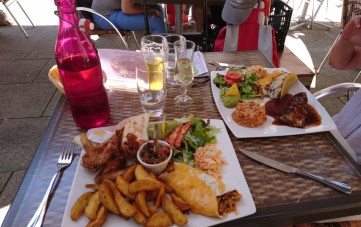
In Langres there were plenty of lunch options, we settled on a nice tex-mex place for a change from the usual French delights. Sitting outdoors on the town’s main street, we were even more aware than normally, of that special French phenomenon…. the sanctity of lunch. On the strike of noon, cars became fewer, previously dense foot traffic slowed to a trickle, shops closed, and cafes and restaurants filled. Then as 2.00pm approached, normal busy life resumed.
Leaving Langres, we faced our first big test of the season…. navigating the Tunnel de Balesmes. At nearly 5 kilometres long, it was more than half as long again as the Pouilly Tunnel we conquered in 2017. One hour out of a lifetime doesn’t seem like much until you are halfway through, no light at either end, each minute like a quarter-hour. Then you finally emerge into sunshine and greenery. Aaaah!


After exiting the tunnel we had a short coffee break and then headed down the canal to Villegusien-le-Lac. Not a particularly attractive mooring between two industrial sites, though very peaceful, and we found a delightful little restaurant in the village for a light dinner in the evening sunshine… the Logis Hôtel le Relais du Lac.


The next few days were similar, having left the busy port at Langres and cruising through the rural, uncrowded section of the Canal Entre Champagne et Bourgogne. Almost no boat traffic, and we shared a mooring with another boat on only one occasion. Very calm and peaceful, except for some lads having a drink and a dip at Cusey, and the aircon generator starting up at the old grain silo at Champagne-sur-Vingeanne. Five days after leaving Langres we were at Maxilly-sur-Sâone, the last stop on the canal before entering the river.

Quiet morning at Saint-Seine

By the disused grain loader at Champagne-sur-Vingeanne

Early-season corn crop

Lifting bridge at Cheugy – setting for the 1971 film ‘La Veuve Couderc’ starring Simone Signoret and Alain Delon

Maxilly-sur-Saone, last stop on the Canal Entre CHampagne et Bpourgogne
Before our next canal stage, we had nearly 100 kilometres of the Sâone River to navigate, including the towns of Auxonne and Saint-Jean-de-Losne, both of which we had visited before and quite liked, as well as the port of Seurre, which was unknown to us.
Auxonne is an old fortress town that gave Napoléon his first leg up while studying at the Artillery School there. We had explored the town on our last visit in 2017, so this time we took the opportunity to relax and take in the ambience. Our first evening brought a riverside Night Market… mostly cheap tat but also cheap drinks, decent street food, wonderful atmosphere and outstanding musical entertainment. A real-life princess on a life-size musical box stage was thoroughly enchanting. An then it was an easy short walk along the river to our mooring for a restful night’s sleep.


The next day we didn’t strain ourselves…. we strolled through the town and took lunch at our favourite restaurant there, at the Hôtel du Corbeau, in the square by the cathedral. It was nice to be greeted by the bells of the cathedral chiming the hour of noon as we arrived, after which we enjoyed a thoroughly classic French 3-course lunch of pâté de campagne, boef bourgignon, crême brulée and some nice wine.


After we left Auxonne, we made good progress down the river with the current to Saint-Jean-de-Losne, which is styled as “the centre of the French watwerways” because of its position at the junction of several cruising routes, and its collection of chandleries, boatyards and ship brokers. We had a pleasant meal in the riverside cafe by our mooring and the following day filled our fuel tanks at the Rives de Saône on-water station du carbeurant before continuing downstream to the pleasant port of Seurre. Unfortunately no spaces for a boat our size so we had to raft up outside another even larger boat, a péniche owned and occupied by some lovely Australians who were restoring her and committing to a permanent on-board existence.
We then passed through the highest, darkest, most forbidding narrow-gauge lock we have ever seen, to rise up from the Saône into the Canal du Centre, and the next stage of our cruising season.
Into Champagne
After the rigours of the transition from the Seine to the Marne were soothed away by our pleasant stay in Lagny, we continued up the river towards our rendezvous with a bit of bubbly. Our next stop was in the town of Meaux, still only 50 kilometres from Paris, at the end of a slow, relaxing cruise upstream along the meandering Marne. We arrived as the only boat in the port, and it was clear why: the mooring pontoons were undergoing major repairs after the January floods and the gangways from the pontoons to the shore had been removed! No problem – we pulled out our DIY passarelle and voilà, connection made. Power and water, no mooring fee, and a lovely city to explore.


Meaux is most famous for its variety of brie… which is truly delicious…. and also for its mustard, one of the great alternatives to Dijon. It is full of beguiling, narrow streets, many of which have been pedestrianised, hosting all the major brands, plus lots of boulangeries, patisseries, chocolateries, epiceries and restaurants and cafes. On our first evening we stuffed ourselves silly with a magnificent meal at the Chinese resto just across from our mooring.


The city is dominated by its Gothic Cathédrale Saint-Etienne and the episcopal palace and gardens behind it. It was interesting to see all the statues of saints and angels, decapitated during the French Revolution. Apart from the magnificent 17-century organ, the cathedral is best known for its association with Bossuet, bishop of Meaux 1681-1704, known as l’aigle de Meaux and reputedly one of history’s greatest orators and rhetoricians .


After a couple of days in Meaux, a delightful morning cruise up the river brought us to a very different place, the small village of Mary. Nothing much there, except calm, peace and an excellent restaurant, the Quai des Brumes, right by the mooring.


Another easy meandering morning cruise delivered us to La Ferté-sous-Jouarre, where we moored in a lovely secluded channel behind an island in the river. It was peaceful, but sobering to see the markers on the pontoon pylons showing how high the water had been during the floods of February – only 4 months previous!


La Ferté boasted a fine Hotel de Ville and, even better, a café that made excellent coffee using beans roasted on site – a rare find anywhere in France, in our experience.


We gave our new electric bikes their first real workout with a 3km uphill ride to the Abbaye Notre Dame de Jouarre. The abbey was first established by Saint Columban in the 7th century, then devastated and rebuilt in the 11th century, again during the Hundred Years War, and yet again in the Revolution. Today it hosts a community of 33 Benedictine nuns; the church is a suitably austere affair, without ornamentation, and the whole place and its gentle sisters give off an air of calm, serene contemplation, but not removed from the outside world. When not engaged in prayer and contemplation and good works, the sisters seem to be well occupied in producing rather kitsch pieces of ceramic figurines of children and saints.


As we moved on up the river from La Ferté, the hills on either side of the canal gradually gave more evidence that we were moving deeper into Champagne, with vineyards shyly revealing themselves then combining into vistas of vines stretching into the distance on both sides. We pulled into the town of Château-Thierry after a long day, having decided not to stop at Nanteuil or Nogent d’Artaud further downstream.
Château-Thierry is a sweet town with a handsome Hotel de Ville, a distinctive art déco cinema and a fascinating ruined château of the 12th/16th centuries. It was also the home of the 17-century fabulist storyteller, Jean de la Fontaine whose most popular and best-loved tale of the grasshopper and the ant (la cigale et la fourmi) is celebrated with whimsical statues about town.


Especially in this Centenary year of the Second Battle of the Marne, reminders of WWI were never far away in Château-Thierry, from the American monument on Hill 204 above the town, to a small ceremony of remembrance one afternoon at the Jean Moulin Resistance memorial just by our boat.


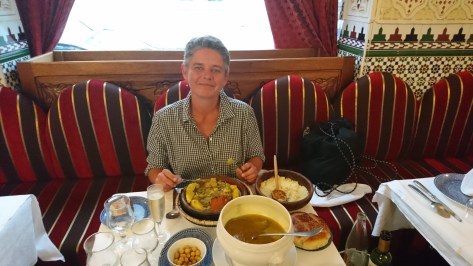
Château-Thierry also offers a couple of lovely restaurants; we chose the Moroccan Palais de Marrakech in the town square and were not disappointed!
After a thoroughly enjoyable couple of days we set off for our next stop, the town of Dormans. By this time we were really in the thick of Champagne country. We postponed our thirst, though, and took a visit to the lovely old 14th-century Château de Dormans and its delightful gardens, and the adjacent Great War Memorial built on the orders of Maréchal Foch to commemorate the victories in the battles of the Marne. Impressive, sombre, but a little too glorious, we thought…. It was refreshing to come back down the hill and see some locals playing pétanque in the grounds of the château.


The next day we pulled out our bikes and went for a delightful cycle along the banks of the Marne, to the villages of Verneuil and Vincelles. We came across Champagne Jacques Copin and managed to score a tasting and a bottle of their Polyphénoles 2006, a fabulous drop from a very good year. The deep red roses around Verneuil’s little 12th-century church were stunning!


In Dormans we enjoyed two other delights, both surprises and both unplanned. The first was when I got a flat tyre on my bike when we were visiting the château, which meant walking the bike back to the village… where we found a bicycle and lawnmower service shop in the centre of town, 5 minutes before closing. The lovely man let me in, threw my bike on his repair cradle, and replaced the inner tube in about 3 minutes, then refused to charge me more than the cost of the tube itself.
The second delight was out discovery of the restaurant Sylvain Suty, where we had a magnificent four-course meal for a bargain price, complete with the most extravagant cheese chariot and dessert chariot.


The next day’s cruise was delightful, and the mooring we found at Damery was fantastic. The village is crawling with champagne houses! We picked out J. de Telmont and were treated to a wonderful tasting by Lucille, our knowledgeable and friendly hostess. We scored a 2006 vintage and an excellent ratafia, which we enjoyed from our rear deck as we took in the magical slow dying of the light across the river.


The following day we cycled along the river from Damery to Cumières, then up the hill to Hautvillers, which styles itself as the berceaux, or cradle, of Champagne, because of Dom Perignon who lived and worked at the village’s Abbaye de Saint-Pierre in the late 17th century. In fact, he was not responsible for discovering or developing Champagne, despite claims by many, including the well-known Champagne house of Moët et Chandon, which now owns the Abbaye (closed to the public but undergoing expensive renovations) as well as extensive vineyards in the surrounding hills. It’s quite a touristy town, but still attractive, with fabulous views back down to the Marne River.


On our way back to the boat we met a man in Cumières who gave us a bag of fresh cherries and introduced us to his extensive collection of geraniums, including one whose leaves he claimed were an excellent mosquito repellent. We enjoyed lunch at a lovely little cafe, run by an old couple with serious mobility issues. Essentially, you ordered your meal and collected each of the three courses from a laminate-top table, ladling the stew course into your bowl and collecting a thick cut of bread to go with it, then returning for cheese and/or pudding which you selected from the table and served onto your own plate. La Paillotte (The Hut) has adopted the motto à la bonne franquette, which basically means “homely and unpretentious”. The steady stream of cyclists who stopped in seemed to agree, and the river views and ambience were priceless.


We cruised up the river to Mareuil-sur-Ay, where we had decided to base ourselves rather than in the centre of Épernay (the self-proclaimed capitale de Champagne), whose port seemed a bit pokey and outrageously expensive. We were unable to connect to the services at Mareuil, but never mind, it was a pleasant stop and the village was filled with champagne houses, while Épernay was an easy, level 7km ride away.
Our first stop in Épernay was the Avenue de Champagne, where the major houses have their HQs. They date mostly from the mid-late 19th century; it’s a bit like what I imagine LA aimed for with Rodeo Drive, but with class and history. Surprisingly, with the exception of Moët et Chandon, it was not at all touristy.

Hotel de Ville, Epernay

Ugly modern section of Moet et Chandon

Hotel Moet

Maison Collard-Picard

Pol Roger

chmpagne des Venoges

Maison Boizel
Returning from Épernay to our mooring at Mareuil-sur-Ay, we had hoped for a tasting at Billecart-Salmon, a small-medium house that in 1999 earned the accolade of “champagne of the millenium” for its 1959 vintage… alas, they only receive visitors by prior appointment. Our consolation was a visit to the House of Bénard Roland, where the owner Philippe Bénard (fourth-generation champagne producer), cigar permanently planted, greeted us with a fine and generous degustation. Really good champagne at bargain prices. The portraits of his family on the walls were a nice touch.


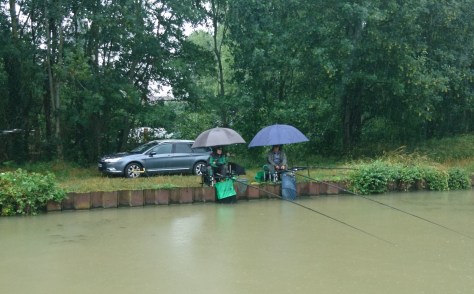
The next day was wet and rainy.. not that it deterred the ubiquitous French anglers. I reckon most Frenchmen would fish in a puddle… after all, they’ve spent a fortune on equipment!
After a long wet day we arrived in Châlons-en-Champagne, scoring the last available place at the port. we had not expected much of Châlons, the last outpost of the champagne-producing region, but we were pleasantly surprised. A fine cathedral and church, some lovely 16th-century half-timbered houses and handsome 17th-century stone residences, a nice square and a couple of lovely parks, and an excellent marché couvert made us wish we were able to spend longer here, and vowing to return as soon as we can.


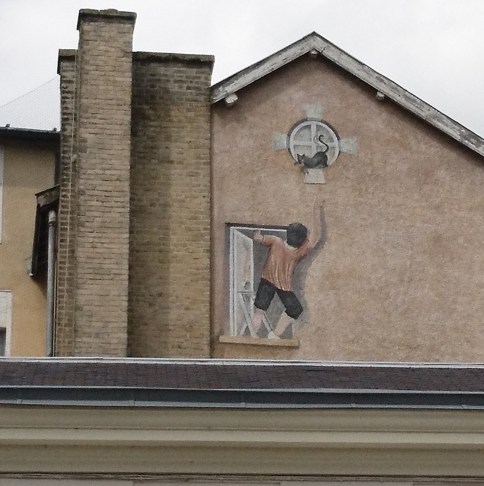
Châlons-en-Champagne is the birthplace of humourist-satirist Pierre Dac (aka André Isaac), best-known as the inventor/creator of the “schmilblick”, an imaginary and utterly useless object which can be used for anything, being ‘rigorously entire’. It became popular in the French vernacular, and “pushing the schmilblick” (faire avancer le schmilblick) now means ‘providing a small amount of help to a large problem’. It appears Châlons has inherited some of Dac’s sense of humour….
Everywhere we travel in France, we witness examples of the devastation wreaked by the Revolution….. closed and ruined churches and abbeys, defaced and decapitated statues, destruction of places and objects from hundreds of years before. In Châlons-en-Champagne we saw an example of the Church doing that work itself, 30 years before the Reign of Terror and the Committee of Public Safety. The Cloister of Notre-Dame-en-Vaux, built in 1170-1180, was demolished in 1759 by the canons of the church to provide building materials for their row of houses. The Museum and Garden on the site, excavated and created in the 1970s, provide a fascinating insight into what was lost for the priests’ comfort.


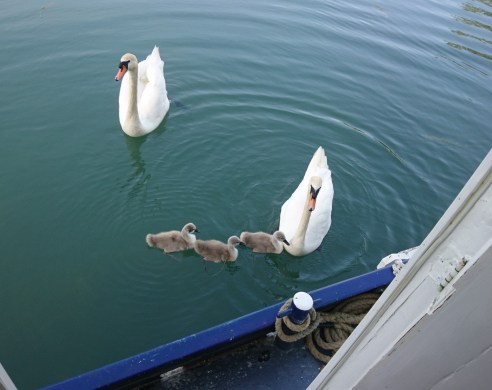
On the morning of our departure from Châlons-en-Champagne, a family visited to bid us farewell from the land of Champagne. And maybe to join us for breakfast.
Towards the Marne
It was such a delight to be on the move again after all the work we had done on Eben Haezer in the port at Saint-Florentin…. getting back into the rhythm of slow, calm movement along the canal, the neat little lock-keeper’s cottages with their garden gnomes, and of course the lunch-break stuck in a lock for the éclusier’s lunch. On our first day we made it as far as Migennes, at the very end of the Canal de Bourgogne, ready to enter the river systems of the Yonne and Seine.


The next day we went through the last lock on the canal and entered the river, increasing our speed and covering a good distance to Villeneuve-sur-Yonne, where we endured a vigorous downpour before the evening turned calm and mild.


Our next stop was at Pont-sur-Yonne, modern pontoons without services, but a pleasant walk over the bridge to a riverside park and walking path, and a welcoming little bar in the town square for a pre-dinner refreshment.


The next day we made good progress to Montereau-fault-Yonne,, at the river’s confluence with the Seine. We reacquainted ourselves with one of our favourite friends along the waterways, Thierry, who used to be responsible for managing the municipal mooring, which is now absolutely chaotic since the authorities withdrew their agreement and basically abandoned the place to chance. Thierry found a mooring nwhere we could not, and ensured we were able to connect to water and electricity. Wonderful man!
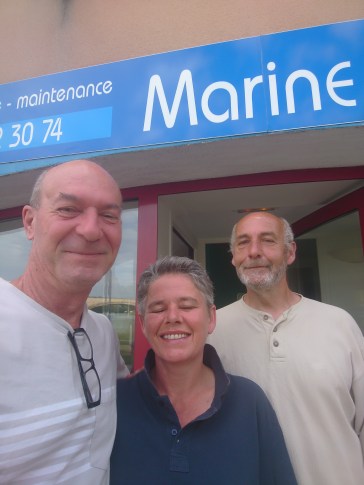
We experienced a very pleasant awakening at our next stop, on the Seine at Melun. We had previously formed the impression that this was a necessary but not very attractive mooring, buffeted by the wash of large commercial vessels. We found this time that the town has charms if you seek them out beyond the immediate environs of the quay., and we enjoyed a lovely meal at L’ Atelier des Saveurs just off one of the little town squares, where live music entertained the dinner crowds..


After spending the next night at a waiting pontoon before one of the big river locks on the Seine, we endured one of the hardest, longest days – 9 hours in total – that we have so far experienced on the European waterways. We had to deal with lots of major commercial traffic. In itself this is not normally as problem, but coming off the Seine into the lower reaches of the Marne, we were forced to wait for extended periods on precarious dolphins as the big vessels and tourist boats were given priority into the difficult high locks, and we then had to follow them through narrow tunnels before we could emerge into the easier sections of the river. It didn’t help that they were laden the aromatic garbage refuse of Paris!
The rigours of the day were more than compensated by the delights of our first stop on the Marne, at Lagny. This delightful town offered peace, calm, a good bistro and an excellent boulangerie/patisserie, which was nearly everything we might have wanted. It also boasted the very atmospheric abbatial church of Notre-Dame-des-Ardents, an attractive church with an interesting history and a connection with Joan of Arc. Plus a very excellent tourist office. We spent a couple of lovely days in this delightful town.


We were now well and truly on the Marne River, cruising our way westwards to the delights and indulgences of Champagne.
 Scraping Through France