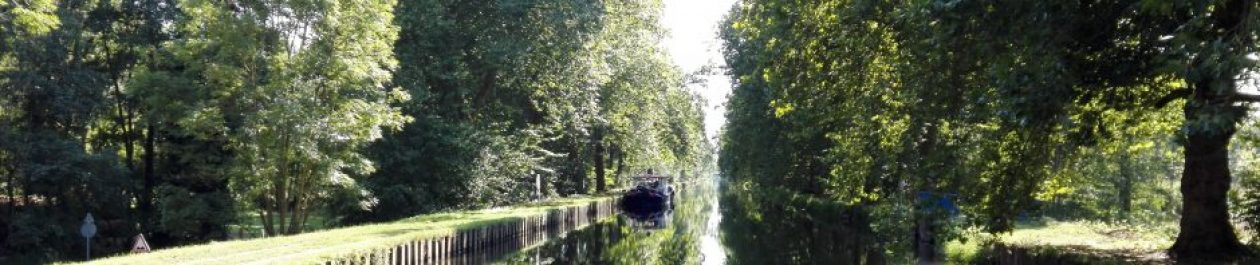
The next leg of our journey would see us leaving the Cote d’ Or region of Bourgogne and entering the Department of the Yonne. The middle of July saw the sunflowers in France in full bloom and, as we cruised along the canal, we were treated to views of brilliant golden fields.


We had more mundane issues when we pulled into our next mooring at Ravières. As we completed our engine checks, we noticed that the transmission case had leaked a significant amount of oil into the collection box underneath, just above the bilge. This prompted me to check the automatic greasers along the propellor shaft, of which there were three. They were marvellous little gas-driven injectors, of the “set-and-forget” type. And I had forgotten. I normally changed them at the beginning of the season but they had plenty of grease left when we left Èpinal so I had left them in place. A bit too long. Now, with the extra effort of pulling through weed, the shaft had worked too hard and overheated the transmission, which had then ejected a far bit of oil. No damage, but an immediate need to replace the lost oil. Out here, in the middle of nowhere. After checking my online maps I located an agricultural machinery service place a couple of kilometres away, so I set off to cycle there, fingers crossed. Fortunately, I was able to buy some oil rated for large tractor transmissions, and I felt this would probably see us through until we could find somewhere with the real stuff. I kicked myself, then counted my blessings.
These mechanical tasks meant we missed the marvellous stained-glass windows in the 12th/15th-century church of Saint-Panteléon in Ravières, but not too much else in this small but attractive village. Like so many similar villages in France, it lost population continuously over the course of the 20th century, and today has only about half the number of inhabitants it boasted in 1910. Still, it has a boulangerie, a small supermarket, schools, a post office, a retirement home and a stone quarry. It persists.
Keeping a close watch on our gauges to make sure our transmission was OK, the next day we cruised three hours to Ancy-le-Franc, where we spent a couple of days. First order of business was the renowned Château d’Ancy-le-Franc. This 16th-century Renaissance marvel was designed by the Italian Sebastian Serlio with interiors by Francesco Primaticcio, both of whom worked at Fontaineblau. Its lofty ambitions were later continued by the work of landscape architect Andre le Nôtre, famed for his work at Versailles. The most notable features, however, are the amazing interiors, murals, motifs, trompe l’oeil and glazed tiles on every surface.


It was almost a relief to escape all this richness for a light lunch at the modest Bar du Chateau in town, before heading out on a bike ride to the nearby village of Chassignelles, for a look at the extraordinary Église Saint-Jean-Baptiste. This smallish 12th-century Romanesque church sits lonely on a hill above the village. With a roof of flat stones, its interior is a wonder of 12th and 13th century murals and paintings. On a very hot and windy day, we waited in the cool of its portico for the man to come and open the church for a couple of hours; he was a very keen and talkative guide and commentator and we even managed to understand some of what he said!


Back in Ancy, just by the Chãteau, we came across a 19th-century communal wash house, or lavoir, another of these facilities that dot the towns and villages of rural France.


Another nine locks down the Canal de Bourgogne (including one in which we stopped for the lock-keeper’s lunch break) brought us to the village of Tanlay. Another pleasant mooring in a wide basin, with a top little café/restaurant right by the quay, where we joined an extended family of English boaters for an excellent dinner of buckwheat galettes.


Tanlay’s claim to fame is another 16th-century Renaissance château, built around the same time as the château we visited in Ancy-le-Franc, but in different circumstances, this time by a leader of the Protestant Huguenot faction, Francois de Coligny dÁndelot. His death during the Wars of Religion meant the castle remained unfinished, until the work of its new owner Michel Particelli d’Hemery in the 17th century. It then passed to Jean Thevenin when he was created Marquis de Tanlay in 1705 and has been in the same family ever since. We especially liked the trompe-l’oeil work in the main gallery, and the frescoes in the original Tour de Ligue, where the Huguenot rebels met in secret… as well as the massive stables complex and the nymphaeum at the end of the “Grand Canal” within the grounds, separating the chateau from the neighbouring golf course.


We were looking forward to our next stop, at Tonnerre…. because we knew there were a number of interesting sites in the town itself, but also because it was where we would take a side trip to the wine village of Chablis. We didn’t know how we would do that yet, just that it was obligatoire. An easy morning cruise through six locks brought us to the mooring basin at Tonnerre; we spent the afternoon catching up on paperwork, researching our visit to Chablis and catching up with a New Zealand couple and their friends with whom we had played canal leapfrog since we had first met them back in Pont Royal. Part of our research and socialising revealed that we could catch a bus to Chablis the next day for the princely sum of €2 and return later in the afternoon for the same price via the Mobigo regional service. Problem solved; we rang the number, reserved our seats and planned to gather with our NZ friends at the SNCF car park at a bit after midday, trolley bags at the ready.
On the morning of our trip to Chablis we squeezed in a trip to the small but excellent covered market (marché couvert) in Tonnerre for provisions.


A 40-minute ride through picturesque wine country brought us into central Chablis, home to some of the world’s best Chardonnay and a miracle of recovery from the phylloxera decimation of the late-19th century and a slow decline up until the 1950s. The village itself is an attractive collection of old buildings, narrow alleyways, shops and winesellers, and we had a pleasant walk down the main street, to an old riverside lavoir and back to catch some sustenance before our tastings.
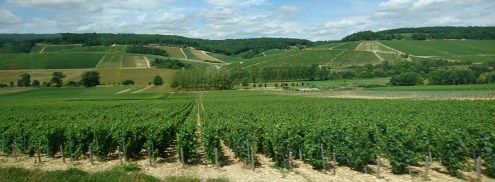


We bypassed the Domaine de la Moutonne… it looked closed and, with mainly grand cru wines, it was beyond our range in any case!


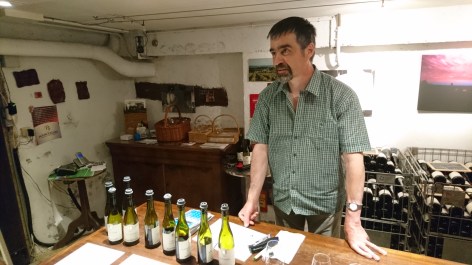
Our target was La Chablisienne, a co-operative of growers and winemakers formed in 1923 housing a great representation of Chablis wines at various levels of quality, complexity and price. The tasting started well, with a couple of excellent wines, but it really got interesting when our NZ friends let it drop that they had owned a South Island winery some years before. When our host asked for the winery’s name, the answer produced a gasp and wide-eyed smile; she disappeared momentarily and came back with a couple of bottles… from that very winery! I’m not sure but I think this connection resulted in us tasting at least 7 different wines (a casual tasting usually gets only 3) as our host strove to introduce us to her range. Jane and I left with several cases stowed in our trolley bag, including Chablis “Les Vénérables”, Premier Cru “Les Lys” and a single Grand Cru “Les Clos” which our La Chablisienne host snuck into my hands as we were leaving, a fantastic, unexpected complementary extra!


We returned to our boat well satisfied with our outing and well-stocked to remember and enjoy it for some time to come.
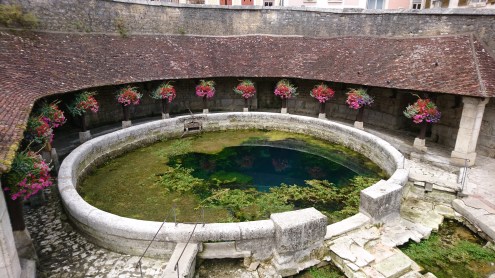
The following day, our third in Tonnerre, was spent wandering the town and exploring some of its sights. The most famous is the Fosse Dionne, a spring-fed pool with a prodigious flow of water averaging 300 litres per second. The town of Tonnerre was essentially built around this spring, and in the 18th century an eleborate lavoir wash basin was built to surround the pool.
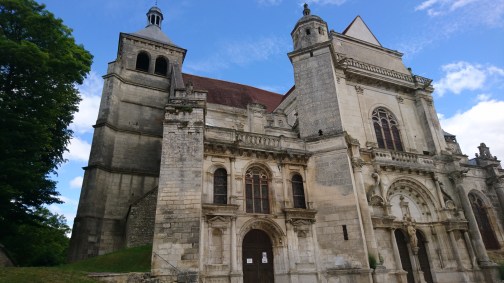
We then ascended to the Eglise Saint-Pierre, with its original foundation and choir surviving from the 11th century, its Renaissance side chapels dating from rebuilding works after fire in the 16th century, and its classical-style southern facade and portals from the completion of those works in the 17 century. It’s therefore quite a mix, but very imposing and commanding a great view over Tonnerre.
Back in the centre of town we had a look over the Hotel-Dieu, the 13th-century hospital for the poor built by Margeurite de Bourgogne. At the time it was the longest medieval hospital in Europe. After 350 years it was replaced as a hospital by a new adjacent building and it became a chapel and mausoleum, then a market after the French Revolution, before being declared an Historic Monument in 1862. It contains the tombs of its founder Margeurite de Bourgogne (died 1308) and the Marquis Louvois, Count of Tonnerre (d. 1691). The space inside the Great Hall of the Poor is impressive, as are the 16th-century altar and the sacristy with its 15th-century marble Mise en Tombeau.


Leaving Tonnerre we travelled to Flogny-la-Chapelle, a somewhat out of the way place but where we had expected to find a stone mooring with services. To our disappointment when we arrived, much of the quay had collapsed into the canal, we had to moor alongside another boat that had already arrived, and there were no services to be had. A shame, as it was quite a pretty spot. There were metal baffles ready to be driven into the bankside to repair the damage; we hope it won’t be too long before the work starts.


Passing on from Flogny, the next day we arrived at Saint-Florentin, where we found a pleasant, well-equipped and well-managed port de plaisance.


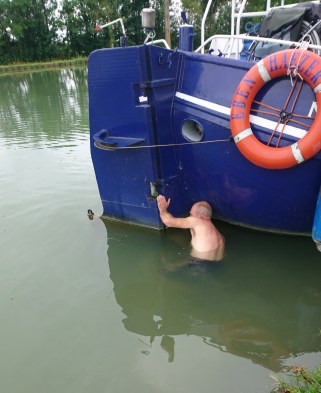
With a week in Saint-Florentin and in no hurry to keep moving, we took the opportunity to undertake some necessary maintenance and administration. First up, we stripped down for a swim and manually cleaned the weed and debris that had collected around the propellor and shaft. Then, with the help and advice of Didier, who ran the excellent marine works yard near the port, we had some specialist marine transmission oil delivered so we could empty and refill our precious gearbox.
Then we set about discovering the town. Delights included a couple of half-timbered houses, an historic church and old towers, and a market that operated on Saturdays in a market hall and on Mondays in the hall plus the surrounding streets.


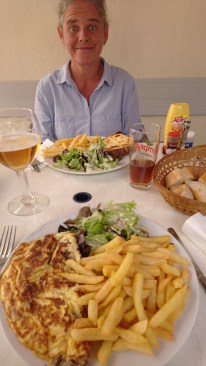
We also found a lovely little place for a beer, wine or casual lunch, the Café des Fontaines, where we could enjoy our new favourites – croque madame with frites, and omelette composée with frites. Bonnes frites!
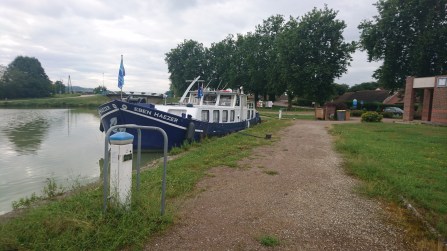
Saint-Florentin, we found, is also blessed with an excellent supermarket, a couple of very good hardware stores, a garden centre, several boulangeries and butchers and various other commercial services. There is a nearby rail station with services direct to Paris. The marine atelier was a useful facility for any work we wished to do or have done – mechanical, painting, repairs. And the capitain of the port de plaisance, Vincent is an absolute gem – good-humoured, endlessly helpful, fluent in English. It didn’t take us long to change our plans for the season and decide to make “Saint Flo”our winter port, where we would leave Eben Haezer in mid-October for six months when we returned to Australia. There was an added bonus: because we no longer needed to travel so far to a winter port such as Briare, we could afford to spend a good length of time in Paris – an idea which, in its own regard, of course but also after so much rural cruising, took on a brilliant shine.
As a result, we decided to travel to the regional prefecture in Auxerre and apply for my carte de séjours, or long stay visa, using the port at Saint-Florentin as our residential address in France. This was to be the first of several trips to Auxerre, we were sure (not just because French bureaucracy would demand it), and we were delighted to find it a beautiful, welcoming, historic, buzzy town.


We entrusted our paperwork to the prefecture in Auxerre and were told to return in a couple of months for the next stage of the process. Having read all kinds of stories of woe concerning the barriers to gaining a long stay visa, we found it no so difficult so far and could only resolve to deal with things as they emerged.






















 Scraping Through France