Category Archives: 2016 Season Part 6. Canal des Vosges

Side trip – Plombières-les-Bains and Remiremont

Deep into the third week of our thoroughly delightful stay in Épinal, we thought it high time we got out a bit wider and explored the region round the city. But how to do it? Well, our new best friend, Ron on his big old tjalk, had a car. And his port neighbour and close mate, Fredi had returned to Switzerland for a couple of weeks on family business, so Ron was alone and at a loose end. We suggested a day excursion and he leapt at it.

We set off on 20 October for the towns of Plombières-les Bains and Remiremont, about half an hour’s drive south. Plombières is best known as a spa town, famous for its hot springs; Remiremont, a dozen kilometres to the east, is notable as an abbatial centre and for its community of noble nuns. Both promised oodles of interesting sights, interesting histories and, we hoped, some fine refreshments.

We made Remiremont our first stop in the morning, because we hoped we might later find a better range of lunch choices in the spa town rather than the town of nuns.

Remiremont is situated on the Moselle upstream of Épinal, near its confluence with the Moselotte, in the foothills of the Vosges mountains. An abbey was originally founded there in the 7th century but by the 9th century it had become a community of Benedictine nuns. Over time they became less and less wedded to the severity of convent life and by the 13th century they were an order of secular canonesses; entry was restricted to those who could prove 200 years of noble descent. They acquired extraordinary power and privilege, including the protection of the Dukes of Lorraine, the Kings of France, the Holy Roman Emperor, and the Pope; their abbess was bestowed the title of Imperial Princess.

The canonesses lived independently within the abbey with their own circle of friends and servants. They each received a share of the abbey’s considerable income to dispose of as they wished, and could leave to visit family, sometimes for months at a time. In  fact, they were only formally required to live in the convent for three months in a year and, even then, they mostly occupied elegant townhouses surrounding the church, some of which which can still be seen today. By the 17th century they were styling themselves as countesses and hosting balls, concerts and other entertainments.

The abbatial church was consecrated in 1051 but dates primarily from the 13th century. It is in a marvellous state of repair and betrays some fine ornamentation and decoration.

The townhouses of the cannonesses/countesses surrounding the church are fine buildings, where it is easy to imagine the elegant, elevated social life these singular women enjoyed.

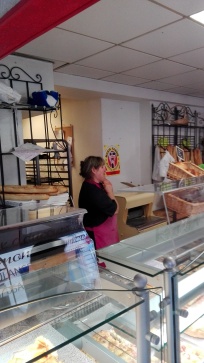
Perhaps only fitting, given the relics of all these powerful women, that it was in Remiremont we came across our first female boulanger in France. She was a little shy, but her shop displays implied a baker of considerable skill.
Remiremont22.jpg

We proceeded to Plombières, to experience the pleasures of a hot springs spa town. Right from the start, I think, it is important to say that the town has a fascinating history and a somewhat less stellar present existence.

One approaches the town from the heights. descending into a tight valley formed by the diminutive L’Augronne River. The town is laid out in a narrow strip along the riverside at the base of the valley, and the broad, long approach along the tree-lined Avenue de Remiremont holds strong promise of prosperity and amenity. Parks and gardens and the forested hillsides lend an attractive setting.

The hot springs that surround and flow through the town were enjoyed by the Romans and over the centuries it became quite a popular spa town, visited by the likes of Voltaire, Montaigne, the dukes of Lorraine, Berlioz, Lamartine and assorted members of the Bonaparte clan including Napoleons I and III and Josephine.

The town remains proud of these visitors and temporary residents and displays little plaques on the handsome town houses they once occupied.

Plombières was also a favourite place of the lay canonesses of the Abbey of Remiremont who, when they could tear themselves away from the rigours of social devotion in that place, could partake of the waters here.

Plombières was the scene for the clandestine meeting in 1858 between Napoleon III and Camillo Benso, Conte di Cavour and Chief Minister of Piedmont, leading to the “Plombières Agreement” that is considered the precursor to the unification of Italy.

It must have been quite a place in its heyday, with baths, spas, hotels and chic townhouses with their balconies overlooking the main squares, a centre for pleasure, gossip and the warm enjoyment of one’s place in society.

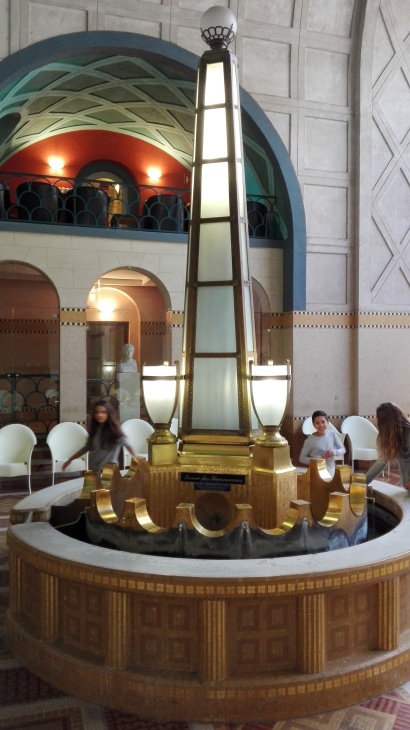
Even today, though, one can enjoy the waters, regardless of one’s social position. At the facility below, a spa with treatment rooms and a fountain of assorted mineral waters, we witnessed an elderly local, nonchalantly entering the room, armed with a couple of plastic containers, and calmly filling them with the life-giving fluids that still flow continuously from below ground. The fountain boasts four different outlets, each of which claims to provide a slightly different balance of minerals and their associated benefits. Our lady seemed either to know exactly which variety she favoured or didn’t care, because she went straight to one tap, filled her containers, nodded in our direction and went on her way.
Plombieres side trip34

It has to be said that Plombières does not buzz any more with the feel of a place patronised and valued by the elites. It has a lovely historic aura but also the slightly seedy feel of a place that has already experienced most of the better things that are its due.

We repaired with Ron to the place we had identified as the best place for lunch, on the way passing a crumbling pile that in the 19th century must have been a lively, luxurious hotel but was now a sad ghost surrounded by hurricane fencing. We arrived at our destination and entered the quietest casino I have ever seen. Small as it was, it still seemed cavernous because of the absence of gamblers.

At the rear, though, was a very pleasant restaurant located by the river and set, for some reason, in an old railway carriage, sumptuously appointed. The luxurious setting didn’t deter Jane and Ron, however, who each ordered a massive open burger and fries. I had a very acceptable boeuf bourgignon. We enjoyed it all and escaped without too much financial damage.

And so ended, with a pleasant drive back to Épinal, our side trip with Ron. We were glad of the excursion, and even gladder to have enjoyed it with him.

Now we were back to the serious business of getting ready to leave the boat and return to Australia.

Épinal

As mentioned in our last post, we were immensely relieved to arrive in Épinal, a haven from the winds, close-spaced locks and tensions of the past week of travel on the Canal des Vosges. How relieved, and how happy we would come to be in Épinal, would only gradually be revealed in the coming days and weeks.

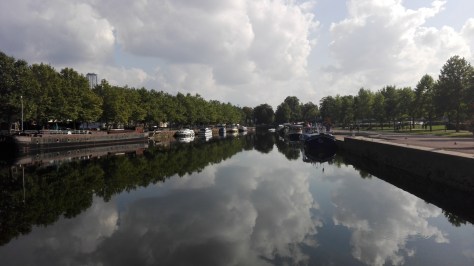
The Port itself is well-situated, well-equipped and well-serviced. A broad basin at a dead end of the canal embranchement, it has a long stone wall on one side and a long low stone quay on the other, facing a broad, flat park. It affords ample opportunity for mooring of large and small boats and ready access to power and water, plus a capitainerie with cafe, toilets and showers. There is a resident capitaine, the dapper Pierre, who lives on his boat in the Port, walks his friendly little dog and collects the mooring fees each day, armed with a ready smile and a keen eye for beauty. The fees are astoundingly cheap, being a mere €5 per day for a boat of our size.

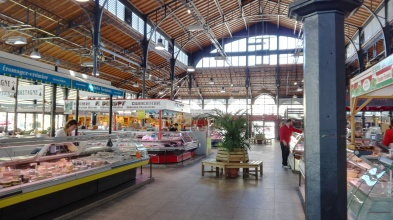
The city is prosperous, with a multitude of shops, big-box stores, restaurants, cafes, boulangeries, patisseries and epiceries. There is a marvellous covered market three days a week.

hdr

It’s an attractive city, on the banks of the Moselle, with a handsome central square (the Place des Vosges) lined by cafes and boutiques.

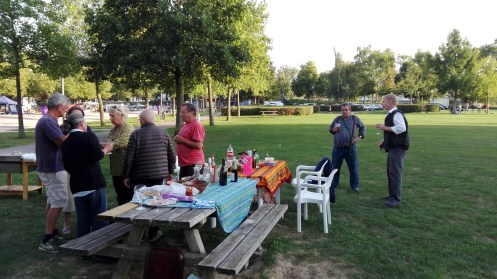
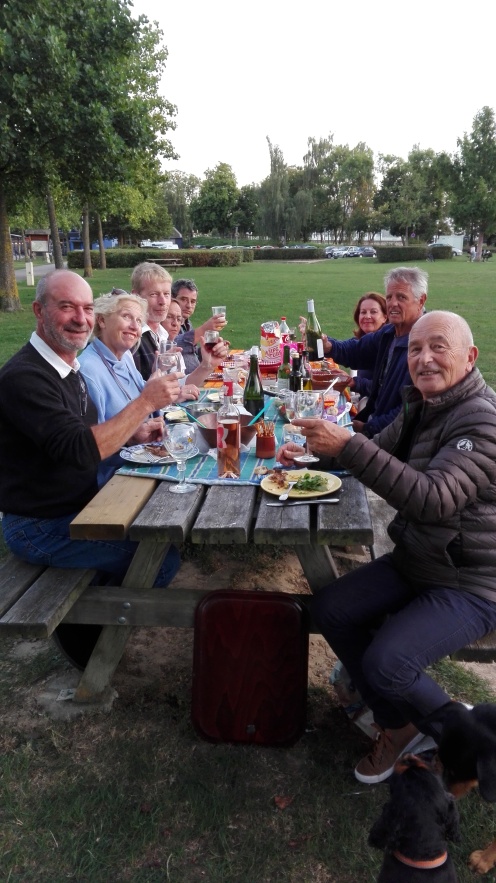
We fell in love with the place very quickly. We were aided in this by the rapid forming of friendships that happened within 24 hours of our arrival. A BBQ was organised on our second day, where we met and fell in love with some of our fellow boaters, including Knud and Erica (Australia), Fredi and his dog Willi (Switzerland) and Ron (US). These people became very special to us over the next few weeks and proved to be generous, open, interesting and helpful companions.

Day 50 - Epinal BBQDay 50 - Epinal BBQ5

Two of the most helpful among our new friends were Knud and Erika. It turned out they are from Albury, less than 2 hours from us; also, that their son is a baker, just like us. Pretty extraordinary, the way you meet people on the other side of the world with connections to your life back home.

They are also extraordinarily generous, open people, happy to share their experiences of cruising in France and Europe for the past 14 years. Knud in particular is forthright, honest and kindhearted in his advice, and he it was that persuaded us that we should abandon any thought of plodding on to Roanne, our planned winter port.

It was already the end of September, and we knew that the Canal de Roanne would likely close by early November. It was a long way to go to get there. And Knud bluntly reminded us that the wind we had experienced for the five days or so before we arrived in Épinal would persist for the rest of our trip, not to mention rapidly-dipping temperatures. No, he said, you are not going any further, you are staying here. He was pretty persusasive. And we were pretty persuadable.

Knud also proved to be a wonderful source of advice and practical demonstration of setting up one’s boat – electrics, hydraulics, spares, winterising – which we were able to call on and emulate or adapt when the time came for us to prepare Eben Haezer for hibernation and our return to Australia at the end of the season.

Fredi and Ron also turned out to be great companions – friendly, generous and honest. They each had large boats they were cruising basically single-handed, though frequently with friends or family to assist. Each of them also had a car, and they were pretty keen shoppers, so it was easy most days to persuade them to go for a drive with us to pick up various bits and pieces from hardware stores and electrical or plumbing specialists, always with a detour to the supermarché for a load of wine/beer on the way back!

Speaking of hardware stores, we were amused by the difference between the sausage sizzle stalls we were used to outside Australian outlets like Bunnings, and the food stalls we found at the Épinal equivalents… fresh crêpes with a beer were definitely out of our home zone!

Food generally in Épinal was fabulous… nothing fancy, and we didn’t eat out terribly often… but with a fabulous fresh food market every couple of days, an excellent supermarket only a pleasant bike-ride-through-the-park away, and a great boulangerie around the corner, we enjoyed wonderful simple meals. Lunch generally was salad with cheeses, pâtés, terrines and, occasionally a tourte Lorraine or pâté Lorrain. And always baguettes, of course. Dinners were kinda similar to what we cooked at home, with French variations, and always with lovely fresh ingredients.

Among the many fabulous offerings at the Épinal market, fresh wild mushrooms were prominent. Whether it was a bag of fat, juicy, dirt-covered cèpes (porcini) or a mixed bag like the one below which we used for a delicious risotto one night, they were all outstanding. For the most part, the mushrooms were wild-picked in forests and fields by licensed mushroom-gatherers, and many pharmacies in France are specially licensed to identify and certify them as suitable for consumption. The other lovely discovery at the market was milk. It is surprisingly difficult to buy fresh milk in French supermarkets, which sell masses of UHT and tiny amounts of the real thing. We were delighted to find a cheese seller/dairyman at the marché who, when we asked, undertook to bring us lait cru (raw milk, i.e. unpasteurised) to us, packaged in sealed plastic bags. It was divine!

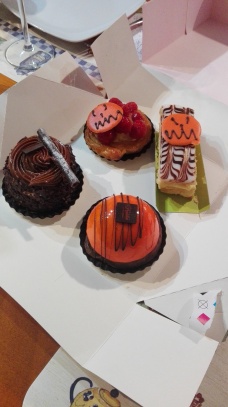
Sometimes, we couldn’t help ourselves, we just went for a bit of indulgence.

Epinal cakes

There was always something to see just outside our window in the Port, whether it was the advance of autumn reflected in the colour of the trees, groups of valiant citizens doing their morning exercises, kayakers going through their watery routines, or more unusual events like the pink run/walk for charity that took place one cool day.

We knew that our time in Épinal was drawing to a close as September became October and November threatened, but we were determined to make the most of every day. We prepped the boat for winter, made minor repairs and all manner of other chores, but we also made time to explore the region and visit other towns and villages – which we’ll cover in a separate post.

Canal des Vosges and the Moselle

Having sorted our electrical problems at Toul, thanks to Duncan Flack from Lorraine Marine, and having celebrated with a slap up dinner at the wonderful restaurant Table à Victor, we were ready to resume our journey on my 60th birthday on 21 September. We had thoroughly enjoyed our extended stay at Port de France but it was time to move on.

This day’s trip would see us on three different waterways in the course of one day: the Canal de la Marne au Rhin (Ouest) as we left Toul, turning onto the Moselle shortly afterwards, then turning off the Moselle onto the Canal des Vosges which runs along the river.

Our journey to Richardménil  took us through 9 locks, a distance of 30kms. It took us 6.5 hours, which included a stop for lunch in the écluse (lock) at Villey-le-Sec. On most canals in France where the locks are still operated by éclusiers (lock-keepers), there is always a break for lunch between midday and 1.00pm. The trick is to try to plan your day’s travel to arrive at a lock just before midday, so you can get through before the break. On this day, still new to the magic of it all, we arrived at the lock at five minutes past midday. Désolée! Déjeuner….

No mind, we arrived at Richardménil just before 4.00pm and found ourselves alone at the very nice halte nautique… power but no water in a very attractive, peaceful setting. The village is located a short walk from the canal and, after tying up and turning on power, then relaxing with a birthday drink as the afternoon sun shone dappled through the trees lining the canal, we decided to explore it a little.

Imagine our surprise when we found that, though the village contained not very much else, it did possess a fine restaurant, Au Bon Accueil. We had already celebrated my birthday the night before in Toul, anticipating a simple home meal tonight. Now it looked like I would get a second celebration! And a truly marvellous meal it turned out to be…

After two pleasant days at Richardménil we departed on 23 September, bound for Roville-devant-Bayon, a wild mooring some 18kms, 8 locks and 4.5 hours further up the canal. This time, the rule that states a lunchtime break is mandatory was proven by its exception, as we were able to negotiate two locks between 11.55 and 12.40, enabling us to arrive at Roville shortly after 2.00pm.

We were glad of the early finish, because Roville was a decidedly beautiful place and, the more time we had to enjoy the beauty and serenity, the better. This was our first truly wild mooring, with no bollards or other fittings to tie up to, so we got to use our mooring stakes for the first time. We had had these stakes made for us by a guy we met at the yacht club in Schoten and, although simple, they weren’t super cheap. Essentially, they were pieces of angle iron, with a flat plate welded on the top and a pointed end cut at the other end, finished with a dipped, rust-proof paint coat. There were four of them, and the recommended technique was to hammer them into the ground in pairs, at cross-angles, to reduce the chance of them being accidentally dislodged or pulled out. The technique, dutifully followed on this occasion, was proved the next morning at breakfast when a Swiss yacht screamed by without slowing down, causing a ferocious wash and much tightening and yanking of the mooring ropes, but no threat of dislodgement.

We were a bit sorry that morning, after the Swiss disruption, to leave Roville, because it was such a beautiful, serene spot, and our new batteries had retained sufficient charge for us to survive a bit longer without access to shore power…. but we had set ourselves a timetable in order to make it to our winter mooring, so we reluctantly packed up and moved on.

24 September saw us cruise just over 3 hours, 7 locks and 13kms into the town of Charmes. We experienced quite a bit of wind on the canal, as we had done on the trip out of Toul, and of course Sod’s Law meant it was worst just when we were entering or leaving locks, blowing us around a bit and detracting from our enjoyment of the day.

When we arrived at the port de plaisance in Charmes, we found there was only a limited length of the canal that had been prepared for mooring with concrete banking. Nevertheless, there was plenty of room for us so we drifted slowly alongside and prepared to tie up behind a German cruiser. We had found in similar situations that boat people on shore would, more often than not, come to help by offering to take a thrown rope to tie around a bollard. Not on this occasion; the German couple merely moved their chairs to take advantage of the shifting sun which, judging from their leathery skins, had been their favourite pasttime for many years. Comme ci, comme ça, pas de probleme.

We were bemused a little later when a lovely old Swiss vessel arrived, with by now very little room left at the end of the concrete embankment. It would have been easy for the Germans to move their boat closer to us; instead, as soon as they saw the other boat approaching, they moved more quickly than we had seen them do so far…. straight inside their boat and down below, not to be seen again for another half-hour. The Swiss managed to tie up with their stern extending beyond the quay, but it didn’t seem to bother them so we just shrugged and went off to explore the town.

It has to be said that Charmes does not contain much of the name in its physical character, having been extensively destroyed in both WWI and WWII. It’s maybe in that fact that most of its charm lies; with nearly 5,000 inhabitants its mere survival, its persistence and refusal to just die, is its saving grace. Being thus charitable, we did some shopping and prepared to move on the next day….

Our next stop was Thaon-les-Vosges, a journey of 17kms and 11 locks, which took us 5 hours and once again saw us battered a bit by blustery winds. We were glad to pull into the halte nautique at Thaon, a simple affair with no services but located next to an attractive park with pathways, fountains and pavilions.

There was a major petanque festival under way, but very different to the serious affair we had witnessed at Commercy a fortnight prior. At 2.00pm there was no sight of actual games underway, because the competitors were still seated at their long tables enjoying lunch. Eventually they drifted back to the competition and for the next few hours we enjoyed the click-clack and tut-tuts and words of encouragement and disparagement that form the sound backdrop to a large boules event. One of the highlights was the music of guitar and harmonious voices that surrounded the arena where a large group of Pacific Islanders (French Polynesians?) were playing.

Day 47 - Thaon3.jpg

That evening, after an exploration of the village, we decided to eat out at a pizzeria near the mooring, having checked in its window that it would be open. To our dismay, with a light drizzle setting in shortly after we set off, we found that the restaurant was not, in fact, open. We tramped off, awning to awning, down the main street and found a little kebaberie, Alp Kebab, a few hundred metres further on. Wonderful fresh kebabs, crisp french fries, happiness. We managed to devour the chips in between rain showers on our way back to the boat, where we finished off the kebabs and licked our fingers with damp satisfaction.

The next morning, 26 September, we noted at breakfast the passing of three huge sand barges, immense peniches with their wheelhouses re-sited to the front, laden low in the water with gravel they had taken on board a couple of kilometres back down the canal towards Igney. We had no idea where they were headed but decided to delay our departure until they had a chance to get several locks ahead of us. We knew the locks could only take one of them at a time, so we decided to give them a couple of hours to clear away.

About 10.30 we set off on our journey to Épinal, 8kms, 5 locks and a pont-canal over the Moselle River. Once again, we we were hit by winds, making manouevring through the locks difficult and tense. The most tense moment arrived when we met the sand barges coming back, obviously having unloaded their cargo not far up the canal and now returning for another load. The first two barges, no problem; we just waited for them to exit the locks and we scooted straight in, going the opposite way (although the incessant wind made waiting for them to exit the locks a delicate operation).

The scary moment came when we rose up the final lock, only to see the third sand barge waiting impatiently on the other side, eager to get in and on his way. He was positioned very close to the lock, his engines idling. As we exited the lock, battling the wind and trying to squeeze into the narrow space he had left us, he gunned his engines and headed straight for the lock, forcing us to make an even more radical manouevre to avoid a scraping either on him or the canal side. Hairy indeed!

The thing is, there’s no point getting upset with these guys. They work this section of the canal, five or six days a week, every week of the year, for a living. Plaisanciers like us might pass this way once or twice, maybe a handful of times in a decade of cruising., for pleasure. They deserve the right of way. But respect and consideration should ideally travel both ways, right?

Less than two kilometres further on we turned left onto the Embrachement d’Épinal, a short deviation off the main canal leading to the city of the same name. This canal is very shallow and suffers from a lack of ready replenishment of its water levels; there are frequent advices and closures to craft with more than a minimum draught. On this day, we found it shallow and narrow but no problem as long as we stuck to the centre of the canal, though we noticed the very obvious sucking effect on the banks that we effected with our displacement as we passed along.

To be honest, whatever caution was necessary because of water depth was more than offset by the relief from the wind that the river valley and its hilled, densely wooded canal banks provided. Through the short few kilometres to Épinal, the forested environment was enchanting.

Finally, we exited the canal into a broad basin, stone-fenced on one side and with a long low stone quay facing a broad-lawned park on the other. It was a relief to arrive and it was with enormous pleasure that we tied up and set about preparing for an extended stay.

Day 49 - Epinal3