Category Archives: 2016 Season Part 5. A Taste of the Moselle

Canal des Vosges and the Moselle

Having sorted our electrical problems at Toul, thanks to Duncan Flack from Lorraine Marine, and having celebrated with a slap up dinner at the wonderful restaurant Table à Victor, we were ready to resume our journey on my 60th birthday on 21 September. We had thoroughly enjoyed our extended stay at Port de France but it was time to move on.

This day’s trip would see us on three different waterways in the course of one day: the Canal de la Marne au Rhin (Ouest) as we left Toul, turning onto the Moselle shortly afterwards, then turning off the Moselle onto the Canal des Vosges which runs along the river.

Our journey to Richardménil  took us through 9 locks, a distance of 30kms. It took us 6.5 hours, which included a stop for lunch in the écluse (lock) at Villey-le-Sec. On most canals in France where the locks are still operated by éclusiers (lock-keepers), there is always a break for lunch between midday and 1.00pm. The trick is to try to plan your day’s travel to arrive at a lock just before midday, so you can get through before the break. On this day, still new to the magic of it all, we arrived at the lock at five minutes past midday. Désolée! Déjeuner….

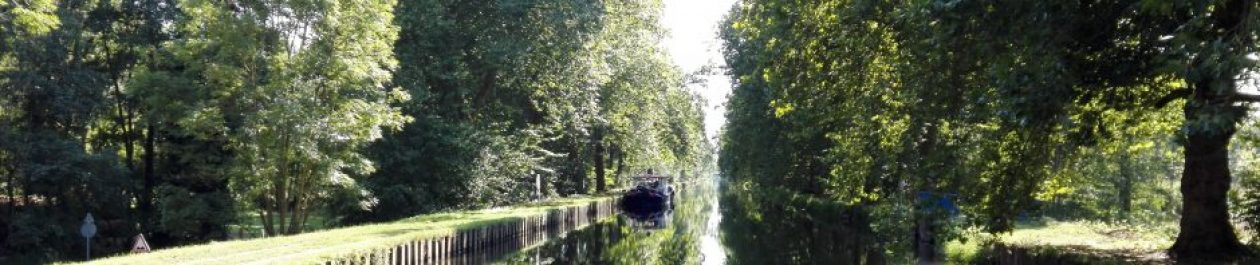
No mind, we arrived at Richardménil just before 4.00pm and found ourselves alone at the very nice halte nautique… power but no water in a very attractive, peaceful setting. The village is located a short walk from the canal and, after tying up and turning on power, then relaxing with a birthday drink as the afternoon sun shone dappled through the trees lining the canal, we decided to explore it a little.

Imagine our surprise when we found that, though the village contained not very much else, it did possess a fine restaurant, Au Bon Accueil. We had already celebrated my birthday the night before in Toul, anticipating a simple home meal tonight. Now it looked like I would get a second celebration! And a truly marvellous meal it turned out to be…

After two pleasant days at Richardménil we departed on 23 September, bound for Roville-devant-Bayon, a wild mooring some 18kms, 8 locks and 4.5 hours further up the canal. This time, the rule that states a lunchtime break is mandatory was proven by its exception, as we were able to negotiate two locks between 11.55 and 12.40, enabling us to arrive at Roville shortly after 2.00pm.

We were glad of the early finish, because Roville was a decidedly beautiful place and, the more time we had to enjoy the beauty and serenity, the better. This was our first truly wild mooring, with no bollards or other fittings to tie up to, so we got to use our mooring stakes for the first time. We had had these stakes made for us by a guy we met at the yacht club in Schoten and, although simple, they weren’t super cheap. Essentially, they were pieces of angle iron, with a flat plate welded on the top and a pointed end cut at the other end, finished with a dipped, rust-proof paint coat. There were four of them, and the recommended technique was to hammer them into the ground in pairs, at cross-angles, to reduce the chance of them being accidentally dislodged or pulled out. The technique, dutifully followed on this occasion, was proved the next morning at breakfast when a Swiss yacht screamed by without slowing down, causing a ferocious wash and much tightening and yanking of the mooring ropes, but no threat of dislodgement.

We were a bit sorry that morning, after the Swiss disruption, to leave Roville, because it was such a beautiful, serene spot, and our new batteries had retained sufficient charge for us to survive a bit longer without access to shore power…. but we had set ourselves a timetable in order to make it to our winter mooring, so we reluctantly packed up and moved on.

24 September saw us cruise just over 3 hours, 7 locks and 13kms into the town of Charmes. We experienced quite a bit of wind on the canal, as we had done on the trip out of Toul, and of course Sod’s Law meant it was worst just when we were entering or leaving locks, blowing us around a bit and detracting from our enjoyment of the day.

When we arrived at the port de plaisance in Charmes, we found there was only a limited length of the canal that had been prepared for mooring with concrete banking. Nevertheless, there was plenty of room for us so we drifted slowly alongside and prepared to tie up behind a German cruiser. We had found in similar situations that boat people on shore would, more often than not, come to help by offering to take a thrown rope to tie around a bollard. Not on this occasion; the German couple merely moved their chairs to take advantage of the shifting sun which, judging from their leathery skins, had been their favourite pasttime for many years. Comme ci, comme ça, pas de probleme.

We were bemused a little later when a lovely old Swiss vessel arrived, with by now very little room left at the end of the concrete embankment. It would have been easy for the Germans to move their boat closer to us; instead, as soon as they saw the other boat approaching, they moved more quickly than we had seen them do so far…. straight inside their boat and down below, not to be seen again for another half-hour. The Swiss managed to tie up with their stern extending beyond the quay, but it didn’t seem to bother them so we just shrugged and went off to explore the town.

It has to be said that Charmes does not contain much of the name in its physical character, having been extensively destroyed in both WWI and WWII. It’s maybe in that fact that most of its charm lies; with nearly 5,000 inhabitants its mere survival, its persistence and refusal to just die, is its saving grace. Being thus charitable, we did some shopping and prepared to move on the next day….

Our next stop was Thaon-les-Vosges, a journey of 17kms and 11 locks, which took us 5 hours and once again saw us battered a bit by blustery winds. We were glad to pull into the halte nautique at Thaon, a simple affair with no services but located next to an attractive park with pathways, fountains and pavilions.

There was a major petanque festival under way, but very different to the serious affair we had witnessed at Commercy a fortnight prior. At 2.00pm there was no sight of actual games underway, because the competitors were still seated at their long tables enjoying lunch. Eventually they drifted back to the competition and for the next few hours we enjoyed the click-clack and tut-tuts and words of encouragement and disparagement that form the sound backdrop to a large boules event. One of the highlights was the music of guitar and harmonious voices that surrounded the arena where a large group of Pacific Islanders (French Polynesians?) were playing.

Day 47 - Thaon3.jpg

That evening, after an exploration of the village, we decided to eat out at a pizzeria near the mooring, having checked in its window that it would be open. To our dismay, with a light drizzle setting in shortly after we set off, we found that the restaurant was not, in fact, open. We tramped off, awning to awning, down the main street and found a little kebaberie, Alp Kebab, a few hundred metres further on. Wonderful fresh kebabs, crisp french fries, happiness. We managed to devour the chips in between rain showers on our way back to the boat, where we finished off the kebabs and licked our fingers with damp satisfaction.

The next morning, 26 September, we noted at breakfast the passing of three huge sand barges, immense peniches with their wheelhouses re-sited to the front, laden low in the water with gravel they had taken on board a couple of kilometres back down the canal towards Igney. We had no idea where they were headed but decided to delay our departure until they had a chance to get several locks ahead of us. We knew the locks could only take one of them at a time, so we decided to give them a couple of hours to clear away.

About 10.30 we set off on our journey to Épinal, 8kms, 5 locks and a pont-canal over the Moselle River. Once again, we we were hit by winds, making manouevring through the locks difficult and tense. The most tense moment arrived when we met the sand barges coming back, obviously having unloaded their cargo not far up the canal and now returning for another load. The first two barges, no problem; we just waited for them to exit the locks and we scooted straight in, going the opposite way (although the incessant wind made waiting for them to exit the locks a delicate operation).

The scary moment came when we rose up the final lock, only to see the third sand barge waiting impatiently on the other side, eager to get in and on his way. He was positioned very close to the lock, his engines idling. As we exited the lock, battling the wind and trying to squeeze into the narrow space he had left us, he gunned his engines and headed straight for the lock, forcing us to make an even more radical manouevre to avoid a scraping either on him or the canal side. Hairy indeed!

The thing is, there’s no point getting upset with these guys. They work this section of the canal, five or six days a week, every week of the year, for a living. Plaisanciers like us might pass this way once or twice, maybe a handful of times in a decade of cruising., for pleasure. They deserve the right of way. But respect and consideration should ideally travel both ways, right?

Less than two kilometres further on we turned left onto the Embrachement d’Épinal, a short deviation off the main canal leading to the city of the same name. This canal is very shallow and suffers from a lack of ready replenishment of its water levels; there are frequent advices and closures to craft with more than a minimum draught. On this day, we found it shallow and narrow but no problem as long as we stuck to the centre of the canal, though we noticed the very obvious sucking effect on the banks that we effected with our displacement as we passed along.

To be honest, whatever caution was necessary because of water depth was more than offset by the relief from the wind that the river valley and its hilled, densely wooded canal banks provided. Through the short few kilometres to Épinal, the forested environment was enchanting.

Finally, we exited the canal into a broad basin, stone-fenced on one side and with a long low stone quay facing a broad-lawned park on the other. It was a relief to arrive and it was with enormous pleasure that we tied up and set about preparing for an extended stay.
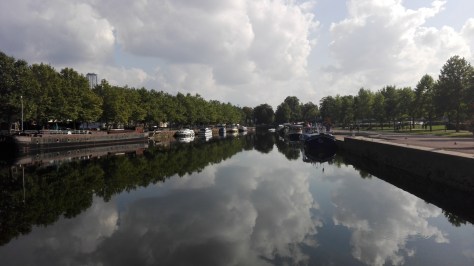
Day 49 - Epinal3


Nancy

Though not strictly a part of the Moselle, lying rather on the banks of the Meurthe, Nancy is only a few kilometres from where the latter joins the Moselle and so we’ve included it in this little section. Besides, our itinerary lay to the south and so we actually did not cruise to Nancy, instead catching the train from Toul, which is most certainly a town on the Moselle.

We decided to visit Nancy when we were detained in Toul waiting for new batteries and battery charger to arrive and be fitted in Eben Haezer. It was an easy 24-minute train journey from the station near our mooring.

Though not the largest city in the region, and only about 20th-largest in France in population, Nancy is nevertheless the largest city we had visited since leaving Schoten/Antwerp. Its size and character as a major city revealed itself immediately we emerged from the railway station, where we were gently accosted and beseeched by people young and old cadging cigarettes and money “for coffee”. Pas de probleme, we thought, but the trick is deciding who to give to and who might merely be seeking cash for a bit of meth or another drug.

The area around the railway  station is the newest part of central Nancy, with some striking examples of modern architecture. The rest of the city is easily reached on foot, encompassing the old quarter, the Vieille Ville – Léopold, dating from the Middle Ages, and the “new town” of Charles III – Centre Ville, dating from the 16th-18th centuries, closer to the railway station.

Sights in the older quarter include the Ducal Palace, built in the 15th century, extended in the 18th, and now home to the Musée Lorrain. Nearby is the the triumphal arch of the Porte Désilles, built in 1782-84 partly as a memorial to the citizens of Nancy who died in the American Revolutionary War. Also here is the 14th-century Porte de la Craffe, a picturesque old gate with twin turrets that is the remaining relic of the city’s medieval fortifications; and the Arc Héré, built by Duke Stanislas in 1753-55, leading from Place Stanislas to Place de la Carrière, a fine boulevarde.

Nancy has its share of fine churches, including the Nancy Cathedral – Cathédrale Notre-Dame-de-l’Annonciation et Saint-Sigisbert (18th century); Eglise Notre-Dame-de Bonsecours (18th century); Église des Cordeliers de Nancy (15th century); and the neo-Gothic Basilique Saint-Epvre de Nancy (19th century).

Undoubtedly, though, the crowning architectural glory of Nancy is its Place Stanislas, built by Stanislas I, twice-deposed King of Poland, the last Duke of Lorraine and the father-in-law of Louis XV. Built in 1752-55, designed by the royal architect Emmanuel Héré de Corny, the square was a major project of urban planning, designed to link, on the one hand, the ducal seat of government (Palais du Gouvernement) with the seat of city government (Hôtel de Ville); and, on the other hand, the old medieval quarter with the “new town” to its south.

In 1983 the square and its offshoots Place de la Carrière and Place d’Alliance were listed as a UNESCO World Heritage Site (presumably after the city ceased to use it as a car park, which it had done since 1958). A major restoration was undertaken in 2004/5, bringing it back to its former glory and, it has to be said, the results are stunning.

In the late 19th/early 20th century, Nancy was a major centre of art nouveau, via its École de Nancy, a movement started by the glassmaster and furniture maker Émile Gallé. Still today chic shops in the city sell furniture, glassware and pieces of decorative art from the major artists of the time, and the architectural traces are found through the city in stained-glass windows and lacework on doors and balconies.

All in all we spent a thoroughly enjoyable day exploring Nancy, before catching a train for the short journey back to our boat in the port at Toul. We had little chance to enjoy the chic shops, boutiques, boulangeries, patisseries, cafes, brasseries and restaurants on offer (in any case, it was a Sunday), but what we saw of them encourages us to dream of a longer return visit soon.

Toul

As mentioned in our previous post, we had arrived in Toul on 14 September expecting to spend a few days there. Events conspired to keep us there for a few days more than we anticipated, but we regretted none of them.

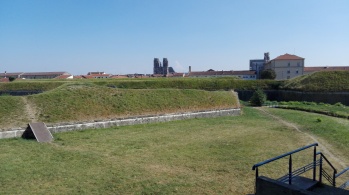
Early on, the city was part of the Holy Roman Empire but by the 16th century it had been annexed by France, a fact recognised by the Treaty of Westphalia in 1648. Toul’s most striking features at first sight are its stone ramparts, yet another example of the work of Louis XIV’s ubiquitous military engineer, Vauban, in the late 17th century.

Day 35 - Toul

The Port de France, where we moored is located between the railway station and the old city, which is a typical walled town hemmed in by its ramparts and with lovely old streets radiating from its generous central circus. A small city of some 16,000, it enjoys what you would expect in the way of shopping, with smart boulangeries/patissseries, boucheries and fromageries, boutiques and specialty shops. Every Wednesday and Friday there is an excellent outdoor marché in the centre ville, with a range of food stalls as well as clothes and bric à brac.


Toul was blessed with several excellent boulangeries but foremost among them is Battavoine avec deux thes, opposite the port which, along with its satellite Maison Battavoin alongside the port, kept us in constant supply of baguettes, breads, custard flans, tourtes de Lorraine and other delicious goodies.

We also found an excellent bike dealer in the town centre who was able to fix Jane’s bicycle, which had suffered a flat tyre and for which we had back in Belgium bought an entirely unsuitable spare inner tube. The nice man there also adjusted the brakes, seat and handlebar settings for us, making it almost like a new bike.

To be honest, the restaurants and brasseries of Toul  are nothing to shout about, with one or two exceptions which we will get to later. But it is possible to find a nice place in the town centre to grab a coffee and a snack and spend some lazy time watching the world pass by.

Two businesses right across the road from the port proved to be fantastic finds for us. The first was the Dépôt Vente de Toulois, a second-hand store selling an extraordinary range of pre-loved stuff. Everything from bistro chairs to banjos, from bathroom vanities to violins. Every visit was a delight and a torture in finding new things we wanted but couldn’t have.

When we bought Eben Haezer we inherited, along with all sorts of useful stuff, a truly massive, heavy, unwieldy “captain’s chair”, which took up most of the wheelhouse, was never particularly comfortable or useful, and had outlived its welcome as far as we were concerned. At the Dépôt we discovered a sweet little bistro stool which seemed to us perfectly suited to the role. We bought it for not very much, and negotiated with the lovely man at the Dépôt to sell him the captain’s chair for a song, a fraction of its true value, but with the added bonus that he would pick up the 40-kilo monster himself from the dock. A great bargain, in our minds. And probably his, as far as we knew.

The other delight was our discovery of Domaine de l’Ambroisie, a wine producer/cellar hidden down a laneway opposite the port. This was our first experience of a genuine domaine, as opposed to a “cave” or wine dealer, since we had arrived in France, and we loved it.

It was great to speak to the young winemakers, and to hear them boast about the quality of their wines, the terroir which they considered the equal of Champagne, the methode they used to make their vintages. Their prices were great so we bought a few boxes of white, sparkling and rosé, à Lorraine. In the event, they proved to be perfectly respectable and good value, but not outstanding. But it was a great buying experience and interaction with the producers.

So far, so wonderful. But there is another attractive aspect of Toul.  A short 2kms up the canal there is a second port, operated by Lorraine Marine, under the management of Duncan Flack, a bit of a legend, and a native English-speaker to boot. Duncan’s port offers a very acceptable winter mooring, but it also offers a wide range of services for boaters needing attention to their seemingly endless series of problems.

Our particular problem had manifested back in Anseremme on the Meuse, when we became aware that the house batteries were not recharging as they should, and the engine batteries were also a bit low in the morning when we wanted to get cruising. It got worse one day when we were actually unable to get enough current to start the engine and had to run the generator for a while to pump some charge back in to them.

We arranged with Duncan to come and have a look. He ascertained pretty quickly that (1) our house batteries were old and basically stuffed, and (2) our battery isolator was not working.

The point of the isolator is that it allows current to flow in only one direction, i.e. from the house batteries to the engine batteries and not the other way. In our case, the house batteries were losing charge (or not recharging), and were raiding the engine battery for current. The solution was to buy new batteries (ouch!) and physically disconnect the isolator. We also decided to buy a new Victron dual battery charger which, when we had access to shore power, would fully charge the house batteries as well as trickle charging the engine starter batteries.

At the end of a few days, Duncan had fitted four lovely but expensive new house batteries, giving us a boosted capacity of 420 amp hours (at 24 volts), connected the engine alternator to the engine batteries alone, bypassing the house batteries (a temporary but foolproof fix) and connected a new intelligent battery monitor to our wheelhouse control panel. We were significantly poorer, but immeasurably happier.

As if the efficient and effective attentions of Duncan F were not enough, Toul had two further delights for us. The first was its proximity to Nancy, less than half an hour away by frequent train service – but more of that in a separate post. The second was the opportunity to celebrate my 60th birthday in a truly memorable restaurant.

In fact, we were to leave Toul on September 21, the day of my birthday anniversary. Not knowing what lay ahead, we decided to take advantage of our location the night before and booked dinner in the best restaurant in town – La Table à Victor, right across from the port. Victor apparently refers to Victor Hugo (may have had something to do with its address, on Avenue Victor Hugo!)… one can only hope that the author might regularly have eaten as well as we did at the place named for him.

The restaurant’s decor was truly amazing and set the scene for a magnificent dinner. Jane had scallops followed by chicken, I think. I definitely know I had a beef dish cooked for 15 hours, followed by a miraculous souffle “mirabelle”, an impossibly light concoction flavoured delicately with Lorraine’s famous yellow plums, the mirabelles. It was the best meal by far we had enjoyed together in France (and Europe for that matter), it was staggeringly good value, and it was a fabulous way to celebrate entering my seventh decade on this little blue planet.