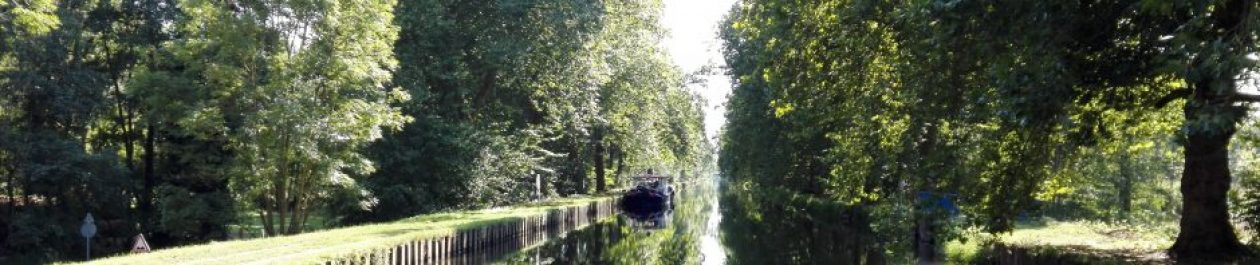
As the canalised sections of the river increased, the river itself was becoming more and more a narrow, rocky, meandering stream running alongside the canal sections. The Meuse had carried us all the way from Visé in Belgium, and perhaps one day would carry us nearly to the North Sea if we ever had the opportunity to follow it down into the Netherlands.
And so it was that on 7 September we left Verdun and travelled the next week into Toul along the Canal de la Meuse, following the river but not in it, the natural, meandering course of the river mostly never than a few metres away.
Our first stop, after a short cruise of 3 hours (13.5kms, 5 locks) was in the small village of Dieue-sur-Meuse. There is not a lot to Dieue, but at least it still has an operating boulangerie, even though it can no longer support a boucherie.


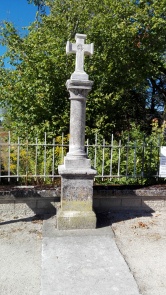
One interesting feature we discovered in Dieue was the Rogation Cross in a road leading out from the village centre – a small but fascinating glimpse into the life of little communities like this. The cross marked the beginning of a series of processions traditionally held on the three days before Ascension Day, beseeching God to protect the crops. It harks back to an earlier pagan tradition, the Robigalia, at which a dog was sacrificed to propitiate Robigus, the deity of agricultural disease. In areas like this, with few buildings and no churches but large wheat crops and the ever-present threat of rust, such crosses were frequently erected, for prayer, fasting and abstinence, in the hope of attracting the benevolence of their god. Presumably of considerable significance for a religious people for whom wheat, in the not-too-distant past, provided 70% of the calories in their diet.
The following day, 8 September, we cruised 24kms (5 hours, 4 locks) from Dieue-sur-Meuse into Saint-Mihiel. A larger town of some 5,000 inhabitants, Saint-Mihiel has some points of interest, and provided an incident of major interest to first-season novices like us.
Occupied for most of WWI by the Germans, the town was liberated by US-French forceS in September 1918, marking the first major entry into the war by a US-led force, under the command of General “Black Jack” Pershing.
Somewhat earlier, a Benedictine abbey had been created in Saint-Mihiel in the early 8th century, only dissolved (like so many others) in the Revolution. The abbey is best known for its library, which is still on the same site, purpose-built in 1775 and which preserves some 9,000 volumes, dating back to the 9th century.
Saint-Mihiel is also known as the home of the 16th-century sculptor Ligier Richier, whose marvellous works in wood and finely-grained, locally-quarried limestone can be seen in the abbey church and the Eglise Saint-Etienne. He was lost to Saint-Mihiel when his conversion to Protestanism forced him into exile in Geneva.
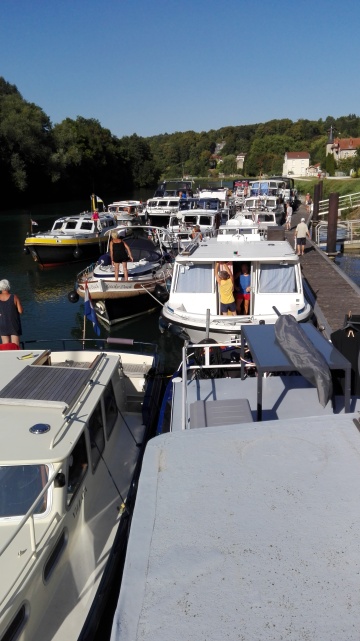
The most famous aspect of Saint-Mihiel for us, however, will forever be known to us and our friends as The Dutch Armada. When we arrived at the small, modern, neat pontoon in the port de plaisance right below the town, we were forced by the presence of other boats to moor right at the end of the pontoon, in fact with half our boat protruding precariously beyond it, pointing straight towards shallow water under the town’s bridge.
Some hours after we had triple-checked that everything would be OK for our brief stay, a series of small to medium craft of various styles began arriving, cruising up and down, looking for spots to tie up, the faces of each new arrival looking increasingly concerned and confused as they realised how little mooring space there was for an ever-increasing flotilla.
A few of them gave up and cruised back down river a few hundred metres to an alternative mooring without services. The others took to rafting up outside each other and to the boats already moored to the pontoon. Because of our precarious position we made it clear that we were prepared to permit only one boat to moor up against us. More and more boats continued to arrive. We advised the skippers that, when the leader of their expedition arrived, we wished to meet him and discuss the situation, which we felt was highly inconvenient as well as dangerous.
Finally, the Armada’s leader arrived, bounded off his boat to the shore, barefoot, naked from the waist up and swaggering like an admiral who had already consumed more than his daily ‘ration’. “I understand you want to see me,” he said. I took him a short distance away, to have a private word. I explained the situation as I saw it…. the sheer number of boats was placing a dangerous load on the pontoon, and the small town could ill-afford to repair any damage. Some craft had simply rafted up to small boats already tied up with only small ropes, without securing additional lines to the pontoon, posing a risk of boats breaking loose. The number of boats travelling together, on a canal with locks and limited capacity, posed a cause of great inconvenience not only to lock-keepers but to other craft wishing to proceed in an orderly, timely manner. At moorings with power, such a large number of boats would inevitably overload the power supply, even if all boats could plug in to the limited number of points. I asked if he had thought of the fleet breaking up into smaller packs, perhaps only joining together in larger cities.
The admiral’s response was dismissive, contemptuous and arrogant, so I decided to give him a little Aussie logic. Raising my voice just enough to be heard by his imprisoned fellow-travellers, I gave him to understand that I thought he may be displaying something akin to thoughtlessness, arrogance and recklessness. I might have mentioned that his competence as a leader was under considerable doubt, and there may have been something in there about giving his country and its citizens a bad name abroad. I pointed out to him that several people in his fleet seemed to me to be confused and worried by the situation but were receiving no guidance or relief. I suggested he talk to his group to seek a solution to a problem that was obvious to all except his good self.
These were the first harsh words I had used to strangers since we arrived in Europe, certainly on the water, and it left me a little shaken. With Jane, I retreated somewhat abashed on a tour of the town, calming my nerves but still shaking my head at the stupidity and thoughtlessness of this expeditionary invasion. We returned to Eben Haezer and took a low profile.
Late in the afternoon, we became aware that the invaders had convened a meeting on the grass beside the pontoon. We tried to look uninterested, and couldn’t hear what was being said, but it was obvious that there was a lot of animated and concerned discussion going on. The Admiral, still casually semi-naked, looked on from the edge of the group but didn’t appear to be playing a leading role in the discussion.
An elderly couple who had rafted up to us proved to be the most lovely people, and we felt sorry for them as they struggled from their boat across our deck to make it to land, and vice versa. We later learned from them that the group had changed its plans and would now try to avoid smaller places, mooring wherever possible only in larger towns. At least that was something!
The next morning, the Dutch Armada took their leave, departing in a series of four or five craft at a time, to arrive at the upstream locks in a staggered fashion. Our elderly neighbours were among the last to leave and we wished them bon voyage and best of luck. Nearly two hours later we made our own departure, not really knowing what might confront us at our next stop but with our fingers firmly crossed and our minds trying to focus on good thoughts.
After 4 hours, 21kms and 5 locks, we pulled into Commercy and – joy, oh joy! – discovered a completely empty pontoon to tie up to. Obviously the Dutch Armada had decided to continue on, to our immense relief.
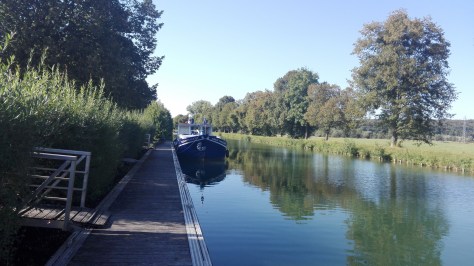
The port de plaisance at Commercy is delightful, set on the edge of town in a picturesque location, with water and power available via jetons (tokens). We spent three very pleasant days there, 9-12 September, and thoroughly enjoyed our stay.
Commercy is quite an attractive town, well-kept with interesting architecture, good shops and a market. It is best known as a residence of the last Duke of Lorraine, King Stanislaw I of Poland and, of course, also as the birthplace of the madeleine.
It is also home to people who take their petanque VERY VERY seriously. Next to our mooring there is a complex with a couple of dozen petanque courts, as well as a modern and well-equipped indoor arena, the walls of which are covered in trophies. On our last day, a petanque festival took place, with a crowd of several hundred, at least 12-16 games being played simultaneously, and a marvellous atmosphere of joyous competition. They were serous about it, though…. no time off, even for a quick lunch, although the fast food vans and beer/wine stall did a brisk business.
Right next to the petanque complex is a very well set-up velodrome, although we saw no evidence of its being used while we were there.
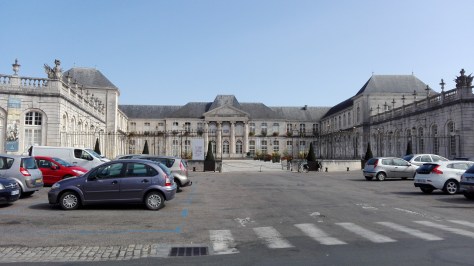
The main architectural feature of the town is the Chateau de Commercy, originally built in the early 18th century and massively enlarged by King Stanislaw I in the 1740s. After his death in 1766 the complex fell into disrepair and was heavily damaged in WWII by a fire that broke out when it was being used by American forces. The city of Commercy acquired the Chateau in 1957 and embarked on a program of restoration lasting until 1977. Designated a Monument historique in 1960, it is currently occupied by the town hall, municipal offices and library, and presents an imposing courtyard and facade.
It was during the time of King Stanislaw, according to the most common legend, that Commercy’s most famous product, the gateau Madeleine, was invented. The story goes that Madeleine Paulmier, one of Stanislaw’s chefs, perfected the recipe and its shell-like moulded shape; Louis XV, who happened to be Stanislaw’s son-in-law, was charmed by the little cakes and named them after the cook. He and his wife Maria took them back to Paris and the court at Versailles from where they became enormously popular in the following centuries, to the point where they were famously used by Proust in his monumental work À la recherche du temps perdu, to illustrate his theme of involuntary memory. In any event, they are delicious little creations, and we bought a box of them to enjoy on our cruising.


The other wonderful thing about Commercy is a firm in town that will deliver fuel – both red and white diesel – in a tanker truck to your dockside and pump it into your tanks, for not much more than the best lowest price you might find at a service centre. Really efficient and friendly, notwithstanding our piss-poor attempts at French and their non-existent skills in English.


Our next day of cruising, 12 September, saw us leave the Canal de la Meuse behind and enter the western end of the Canal de la Marne au Rhin (Ouest). After 3.5 hours, 15.5kms and 5 locks, we arrived in the small village of Pagny-sur-Meuse, which marks the point where we would leave the southward (upriver) course of the Meuse behind and head west towards Toul and the Moselle.
Pagny is another of the villages and small towns in this stretch of waterway that offer a neat, modern pontoon to moor at, without services, but pleasant enough for a short stay. Once again, as at Commercy, we had the mooring to ourselves. The village has a boulangerie, a couple of small brasseries/pizzerias and a lot of flowers!


But by far the outstanding feature of Pagny is Le Relais Favorite, a bar/restaurant/grill in the Total Service Centre, between the village and the N4 motorway, only a short walk from our mooring. This marvellous establishment is one of the restaurants les routiers one can find throughout France, unpretentious but reliable and cheap restaurants that cater for truckers and travellers. For €12 each we got a five-course meal, including soup de jour, massive entrée buffet, a choice of plat (main course), a dessert buffet and a cheese plate, plus a bottomless carafe of wine!


We can only dream of such motorway layovers in Australia…..
The following day we set off for the city of Toul, only 14kms away but with 12 locks and a short tunnel to deal with. The tunnel (souterain de Foug) was only 867m long, with pretty good clearance at sides and top, and we navigated it without trauma. The locks, though there were many of them, were all going downhill (much easier than uphill) and fairly shallow, so they were also accomplished with a minimum of fuss, even though they just seemed to keep on coming, one after the other….
We arrived in the Port de France in Toul, immediately after the last lock, and glided ever so slowly, scanning the quays and pontoons for a space sufficient for a boat of our size. Eventually, just as we were despairing, we spied a spot against the main quay. Only trouble was, it required a 90º turn, then a fairly tight manoeuvre through a crowd of craft and another 90º turn at the last moment to come alongside the quay, with very little space fore and aft. I took a deep breath, slowed Eben Haezer even further, and went for it.
Many modern, smaller boats than ours have bow and stern thrusters; even those with only bow thrusters seem to be able to use them to make their craft go virtually sideways. Our boat is fitted with hydraulic bow thrusters – a great convenience, to be sure, but not permitting the kind of fast and tight manoeuvres granted to the smaller, lighter craft. The advantage is that our bow thrusters do not drain the electrical supply and never give out; the disadvantage is that they depend on engine power which, when you are trying to go very, very slowly, means there isn’t a great deal of power to drive them. So you plan, aim, plan, aim and glide, very slowly.
As it happened, I must have entered some kind of dream space, a zone of concentration and calm, because we managed to execute a perfect set of turns and glides to come alongside the quay and drift without fuss or incident to where we could tie up. High fives and inner elation all round.
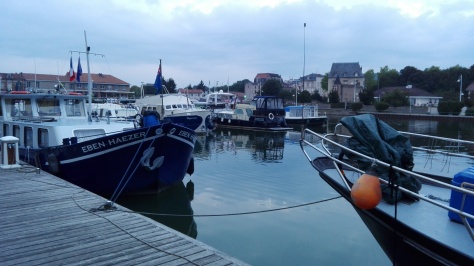
Toul is a marvellous place, with a well-run port, excellent port capitaine and much to see, do and enjoy in the city. We stayed days longer than we had intended, but enjoyed every moment and we look forward to returning soon. We’ll cover our experiences of Toul in a separate post.






 Scraping Through France