Category Archives: 2016 Season Part 2. Up the Meuse To France

Dinant

On August 18 we departed Namur and cruised our way for five hours along 28kms (6 locks) of calm, picturesque, winding Meuse River, to the swish surroundings of Anseremme. We moored on a long pontoon facing a row of very swanky houses and ate dinner that evening at the nearby Anseremme Yacht Club, a small marina off the river, home to some very expensive small boats.


We had cruised straight past the city of Dinant, because its docksides were undergoing major rebuilding, and we knew that it was an easy cycle back along the riverside from our picturesque, quiet mooring at Anseremme.

Dinant was worth a couple of days exploring, for sure. Hemmed in by steep limestone hills and cliffs of the Meuse valley, the city developed in a long thin riverside strip. Riding a cable car to the top of the Citadel de Dinant gives some fabulous views over the city and along the river. The citadel dates from the 11th century, with major modifications installed in the early 19th century.

Day 10 - Dinant5


The citadel also played a significant role in WWI when it was overrun by Saxon troops of the German army. French troops put up stiff resistance (a young Charles de Gaulle was among the wounded). The Saxons, blaming the citizens, committed the first massacre of civilians by Germans in the First World War when, on 23 August 1914, 674 inhabitants were summarily executed and the town was set alight, destroying hundreds of homes and other buildings.

On a brighter note, Dinant is the birthplace of of Adolphe Sax, inventor of the saxophone. It is also the home of a peculiar confection, the couque de Dinant, made with flour and honey into a firm dough, shaped in wooden moulds with patterns of animals, flowers, landscapes and human scenes, and baked at high temperatures into a hard, durable large biscuit. To be completely honest, we somehow missed the opportunity to sample it. But it looked impressive.


Much more enticing to our palate was the Maison Leffe, a charming historic edifice housing a museum and tasting-house dedicated to Leffe beer, which originated in the nearby Abbaye de Leffe, First produced by the monks and abbots in the 13th century, the brand is now owned under license by the global conglomerate Annheuser-Busch, but the values and taste of the old beer persist… it is one of the best ales I have ever tasted. There are about a dozen varieties in the range, but I am an avowed fan of good old Leffe Blonde, and Eben Haezer is almost never dry of it.
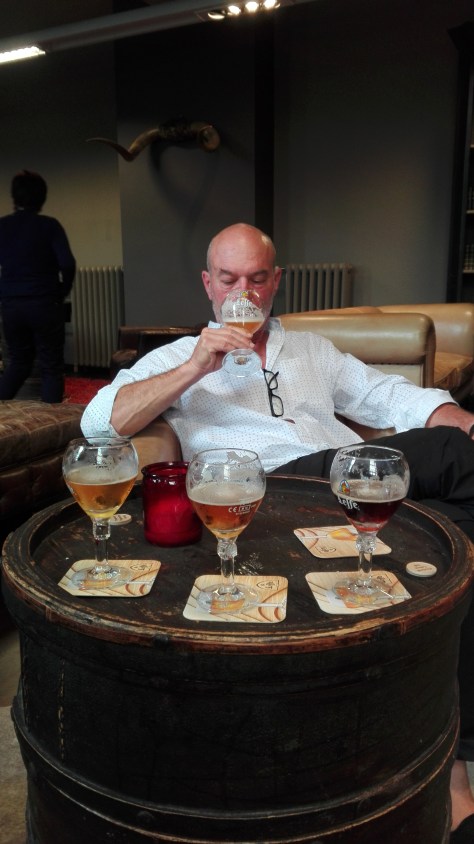
Day 10 - Maison Leffe, Dinant

Namur

August 15 brought us a relatively easy day of slow travel, 27kms and 3 locks, to the city of Namur. There are two marinas here: the first, called Port de Plaisance Henri Hallet, is close to the city centre but is really only suitable for smaller vessels; the second, a little upstream and located in a gorgeous park setting, is called Port de Plaisance d’Amee, which is where we headed. Right by the mooring pontoons we discovered a lovely park with ever-active petanque courts; the next few days were filled with the muffled click-clack of boules.

Namur is a major commercial and industrial centre, and the capital of Wallonia. Located on a couple of major trade routes, it has a long history of being invaded, traded and governed by a variety of rulers, including the French, the Spanish, the Dutch and the Austrians, before becoming Belgian after independence in 1830 and then the capital of the federal region of Wallonia within Belgium. The city is best known for its chateau and citadel, the latter primarily the work of Louis XIV’s ubiquitous military engineer, Vauban.

Mooring at the Port de Plaisance was free, while power and water was accessed with jetons (tokens), purchased at the capitainerie. One token, worth €2, gave four hours of electricity, so it could cost up to €12 a day, or less if you used the power just to charge your boat’s auxiliary batteries.

During our three days at Namur we befriended Pierre, a retired Wallonian teacher, who lived on his boat with his wife Nicole, who still worked in Brussels and joined us on our last evening. Pierre was a great source of information and patient assistance with our French language skills, as well as being great company. On our final day we bought a couple of coquelettes at the local market and, using our small gas kettle BBQ, managed to roast them to a surprisingly good result, sharing them with with Pierre and Nicole, who contributed some delicious salads and a cheese plate.

Day 8 - Namur2

While in Namur we decided to take the opportunity to refuel, having heard that there was a man who would deliver to the dock. With the help of Pierre and the capitain, we located our man, paid him the cash to purchase the fuel and waited for him to arrive, presumably in a van. We were amazed, though, to see him pull up an hour later on a bicycle, towing a purpose-built trailer loaded with eight jerry cans filled with 240 litres of diesel. As he unloaded each can we hauled them on board and poured the fuel manually into our fuel inlet, losing only a litre or two in spills but not thoroughly enjoying the smell on our hands, shoes and deck and more than a little concerned at the small but discernible slick that formed on the waterline. The cost of the fuel, including delivery, was as good as we might have achieved at a specialist dockside fuel outlet elsewhere, but we resolved to buy a small electric-powered fuel pump at the next opportunity, especially as we knew we would have cause to do the same transfer from jerry cans to fuel tank in the future.

Industrial vistas

Bidding farewell to Visé on 14 August, we headed for the Meuse and the industrial region of Liège and Huy. Signs of massive industry lie on both sides of the river here, reminders of the role the region played in the sillon industriel of Belgium, the 1000 square kilometre ‘furrow’ of industry stretching from  Verviers in the east to Mons in the west, passing through Liège, Huy, Namur and Charleroi.

It also meant dealing with a fairly heavy amount of river traffic from very, very big commercial barges travellng very, very fast (compared to our sedate speed of 10-11kph).

Day 5 - Liege

Although we didn’t stop in Liège, we were glad to pass through and glimpse a city with a fascinating history and legacy. In the 14th century, the city established a unique guild-based form of democracy, the spirit of which survived incorporation into the Holy Roman Empire and the Hapsburg rule of prince-bishops. In 1789 the city erupted into revolution at the same time as the French Revolution in Paris. In the early 19th century Liège developed into a major industrial city, one of continental Europe’s first large-scale steel-making centres. In 1950 the city’s unions led the general strike which forced the abdication of King Leopold III for alleged collaboration with the Nazis. And again in the General Strike of 1960-61 which, although originally aimed against government austerity measures, eventually led to the rise of Wallonian identity and the formation of a federal structure in Belgium.

It’s done it tough since the 1970s with the decline of its industrial wealth but it’s good to see that in recent years Liège has experienced some recovery from late 20th-century deindustrialisation, with the emergence of new advanced-tech and high-tech industries. The inner city district of Le Carré with its pubs and vibrant nightlife, and the Sunday Batte market along the banks of the river, are just a couple of reasons we look forward to the opportunity to return to Liège and stay a while.

Passing through the upstream city of Huy, also an industrial centre, we arrived at the Port Fluvial de Plaisance de Statte, just beyond the centre of the city, at 5.45pm after 7.5 hours and 41kms of steady travel. The port is a small and rather tight harbour off the river, protected by high stone walls and a narrow entrance, and we nervously edged Eben Haezer through the space and alongside the quay – not daring to take her further into the mass of smaller but more expensive plastic boats moored on pontoons.

The port capitaine gave us a friendly wave, indicating all was OK . A moment later, however, an agitated man advanced along the pontoon opposite us and gesticulated, indicating we should move further back along the stone wall to allow space for a boat arriving later…. a manouevre which would have made it impossible for us to get off the boat. The capitaine ignored the self-appointed admiral of the port, and we decided to do the same. As it happened, the boat we were supposed to make room for entered the port about an hour later, driven by what appeared to be a very calm pre-pubescent skateboarder and populated by an assortment of jewellery-adorned grandparents, and easily found a spot in a smaller space further within the harbour. We clung to our spot that had cost us €10 including power and water, and spent an enjoyable evening.