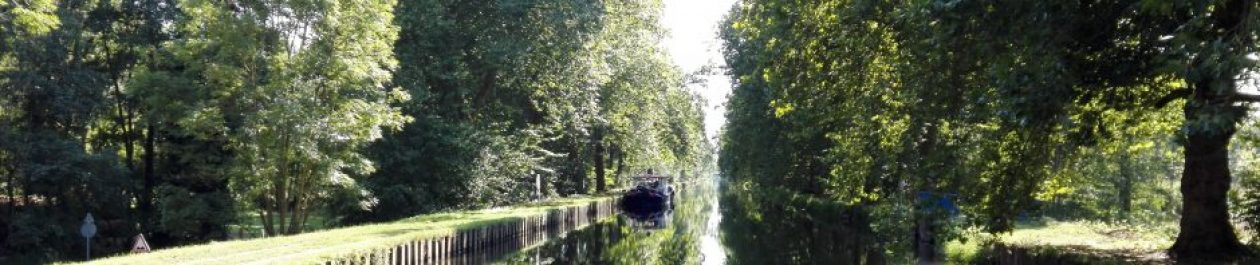
After Looking for a boat and Finding a boat we found ourselves at a new frontier.
We’d spent years researching, months deliberating, weeks preparing and days inspecting boats for our project of summer cruising the rivers and canals of Europe. The day came in May 2016 when we made an offer, it was accepted, and we would shortly become the proud owners of our very own converted Dutch barge.
I had a sneaking feeling, though, that there would be much hard work and many obstacles to overcome before we could set off. And that suspicion proved correct.
The first thing that needed to be done was to complete the paperwork with my new friends Patrick and Pierre, the French boat brokers who had found Eben Haezer for us.
Prior to our three-day jaunt across Belgium and the Netherlands in search of a boat, I had signed an agreement with them that I would pay for their petrol, food and accommodation. That was no problem and, as we sat in the brasserie celebrating the sale just accomplished, I forked out the requisite euros.
Then we had to sign a sale contract with the owner of Eben Haezer. Patrick and Pierre provided me with a draft (in French and Dutch), plus some time to do furious Google Translating so I could discern the meaning and significance of it all. It wasn’t a complicated document, so I agreed to it and we set off to get it all signed.
The contract had a couple of important considerations. Firstly, it was subject to a survey of the boat, and the repair of or price adjustment for any shortcomings discovered. The other important element was that I was required to complete payment of the agreed sum by a certain date… and that date was only a few weeks away. It also necessitated immediate payment of a deposit.
Additionally, my contract with Patrick and Pierre, the brokers, required payment to them of their sales commission, in full, at the earliest possible date. So far, it seemed like I was paying out a lot of dosh and sacrificing a lot of uncertain time against the hope that all would turn out well. I swallowed hard and went along with the process.
I presented myself a week later for the trip downstream to Boom, on the fringes of Antwerp, where we had an appointment with the shipyard that would conduct the survey. I had also requested that, while Eben Haezer was out of the water for the survey, the shipyard would clean and repaint her hull with antifouling.
The trip from Schoten to Boom was to be a two-day affair, mooring at the public quay in Boom for the evening before entering the shipyard dry dock the following morning. There would be three of us – the owner (another Pierre), his friend Viktor from the Schoten Yacht Club (like Pierre, a professional bargeman) and myself. My brokers Patrick and Pierre had returned to their respective homes in southern France and eastern Belgium.
Starting off from the picturesque town and canalside yacht club at Schoten, we soon entered some monstrous canals and locks on the waterways around Antwerp. We navigated the Albertkanaal, the Netekanaal and the murky waters of the Nete and Rupel Rivers. Making good time on the outgoing tide, we arrived in the afternoon at a commercial/municipal pontoon at Boom.
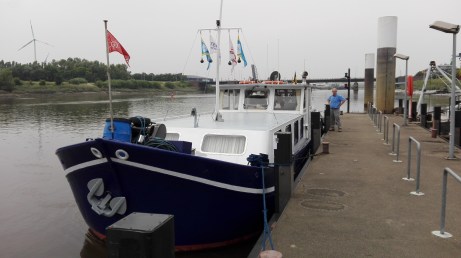
All the way, while being perfectly friendly and positively cheerful, my two new friends Pierre and Viktor conversed almost exclusively in a stream of Dutch. I smiled a lot and enjoyed the scenery. Tying up at the pontoon, I asked Pierre what happened now. He said I should find some accommodation and return in the morning. What?!?
I had expected to stay on board for the evening…. after all there was the main cabin, a lounge with a sofa bed and the aft cabin with a blow up mattress. Plenty room for three grown men. But no… it appeared, at 4.00pm in the afternoon, that I must step off, wander the streets and find a hotel, in a town I didn’t know, in a country whose language I didn’t speak.
Leaving my big bag on board, I threw a change of clothes into my backpack and set off, muttering surprisingly gentle profanities. I managed to find what looked like the centre of town though it was almost completely deserted and I could find little evidence of commercial activity, let alone something that resembled a hotel, tourist office or other place of respite.
I pulled out my phone, opened Google Maps and managed to find two hotels. One was nearby, the other was a fair hike across the other side of the river. The nearby hotel seemed like a good choice, had good reviews and looked pretty schmick in the pictures. It cost about twice as much as I would have preferred to pay, but…..
I found my way to the closed door of the Hotel Domus. I rang the bell and eventually a smartly dressed urban hipster answered. I asked if he had a room and he smiled apologetically. Before he’d finished his sentence I knew I would need to find an alternative.
After the hipster closed the smart grey door to his immaculately decorated, well furnished but completely unavailable hotel, I rang the Fevaca Inn, across the river at the Rupel Yacht Club. A young woman answered and, speaking brightly, revealed that they had a room and would be awaiting my arrival. I shouldered my back pack and set off on the two-kilometre walk.
Turns out I had gotten lucky: ten months later, it appears that the Fevaca Inn has permanently closed, with no replacement, so Boom has only the totally booked Domus, or…… nothing.
The next day, having fed and slept reasonably well, I returned to Eben Haezer and caught up with Pierre and Viktor, just as they were preparing to cast off and motor the few hundred metres downstream to the shipyard.
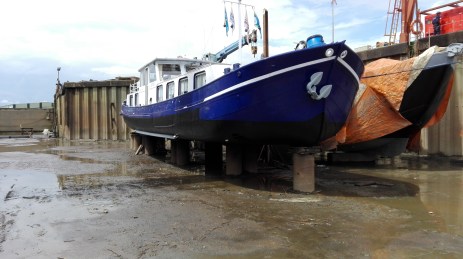
We glided slowly into the shipyard, followed soon afterwards by a massive 80-metre barge and we waited as the water was slowly pumped out to leave us high and dry on our concrete and wooden supports, ready for the hull to be power cleaned, surveyed with an ultrasound device and repainted.
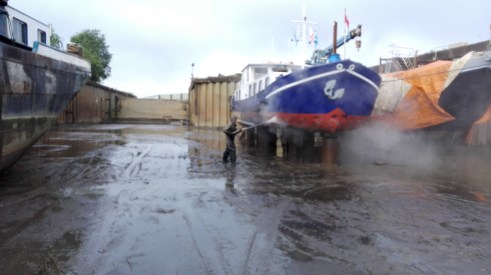
The good news was that I was able to stay on board, Pierre was to return to Schoten, and I would have the place to myself. The bad news was that I could not use the onboard toilet and shower, refused to use the shipyard’s unbelievably filthy amenities, and I would have the place to myself. A dirty industrial shipyard in a foreign place in a grey rainy week was not my idea of blessed isolation.
Nevertheless, time passed, I found decent food nearby and the necessary tasks on the boat got done… slowly. By this time, my return flight to Australia loomed closer – I had already postponed it by a week and further changes were nearly impossible. I willed the weather to stay clear long enough for cleaning and painting to be completed, which happened sometimes quickly and sometimes agonisingly slowly. I think it was partly due to the fact that the Euro16 football competition was underway and the shipyard’s predominantly Romanian workforce was occasionally distracted by their team’s exploits.
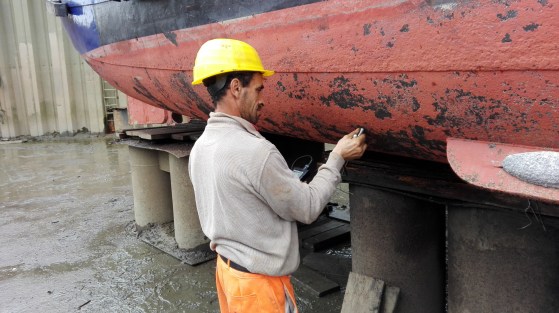
The survey of the hull of Eben Haezer was a positive…. her steel was in excellent condition throughout with thicknesses well over the minimum required. I managed eventually to secure a written report to this effect from the shipyard management, which I knew would be an important consideration in securing insurance.
I had got a bit of pressure from Patrick and Pierre over payment of their broker’s commission. My attitude was that if the sale collapsed because the survey revealed insurmountable problems, then the commission should be renegotiated. Their attitude was screw the survey, I had agreed to the purchase and they should be paid the full amount regardless. I managed to stall things using the vagaries of international transfers until I had an indication that all was well with the boat and the sale was certain to proceed.
International money transfers were an interesting diversion in several ways. I had agreed to pay Pierre, the previous owner, a deposit upon signing the contract of sale. Then I discovered I could only pay him the balance in a series of three transfers because my bank limited the total transfer allowable in any one transaction. Then when Pierre received the deposit he discovered his Belgian bank had deducted a transfer fee of 15 Euros. Quelle horreur! Or more accurately (because he is from Flanders) Hoe Vreselijk! He computed how much this meant he would lose in total and looked at me in dismay…. I had no choice. I pulled out 60 Euros in cash and told him it would cover the four transfers, each of which was for many thousands of Euros. And then I thought it was a good thing he was such a nice guy. And that in a few weeks I might never see him again.
OK, so I had completed the hurdles of purchase, deposit, survey, payment of commission and a schedule of payments for the balance owing on the boat. Within a few weeks I would be the owner of the boat. I had also paid the shipyard for the costs associated with hauling the boat out, cleaning, surveying and painting her. Downhill run from here, surely.
Not so fast. A boat in Europe, particularly one of this size, needs to be properly registered and insured. Patrick and Pierre had repeatedly assured me that they would assist with registration and insurance. But now that the sale had been completed, they were increasingly difficult to contact and time was fast running out. It was beginning to dawn on me that I might have to achieve these things on my own, despite knowing next to nothing about the processes required.
In the meantime, I had a plane to catch. I had to return to Australia and, with my wife Jane, pack up our business and our house before returning in a few weeks to embark on our first season of cruising.
Insurance was absolutely necessary, to take effect from midnight on the day we formally took ownership of the boat, which would be when we transferred the final instalment of her purchase price. On my return to Australia, I tried one more time to contact Patrick and Pierre to see if they would make good on their promise of assistance. No response.
With time rapidly running out, I did some online research on companies that specialised in marine insurance, found what looked like a good one with Australian and European offices, sought a quote, sent them all the appropriate paperwork on the boat and her provenance, ownership and location, and then remitted payment for the policy they drew up in response.
So far so good. Perhaps Patrick and Pierre would help me with the registration when we landed back in Europe. Pierre had, after all, promised to pick us up at Antwerp Station and drive us to the boat in Schoten.
This seemed to us to be an extraordinarily kind gesture. It looked even better when Pierre detoured to a local supermarket and helped us stock up on groceries in readiness for our move on board Eben Haezer.
We felt a sense of gratitude and friendship as he helped us move our things on board before he said goodbye and walked further down the yacht club to where the other Pierre, the previous owner, had moved on board his own new boat.
That sense of gratitude and fondness was diminished a few days later when Pierre (the previous owner) told us with a wry and weary smile that Pierre (the broker) had really only come to Schoten to collect what he claimed was outstanding broker’s commission. This surprised us since Patrick and Pierre had assured us that only the buyer paid commission, not the vendor. Pierre (the previous owner) said they had claimed from him a commission of several thousand euros, in addition to the (supposedly exclusive) several thousand euros they charged me as the buyer.
Used boats, used cars….. dealers are dealers, we thought.
Over the next few weeks we learned just how much we had ceased to mean anything to them as they failed utterly to assist us as they had promised with the boat’s registration. In the end, we managed to achieve it ourselves, a process outlined in Aboard Abroad


 Scraping Through France