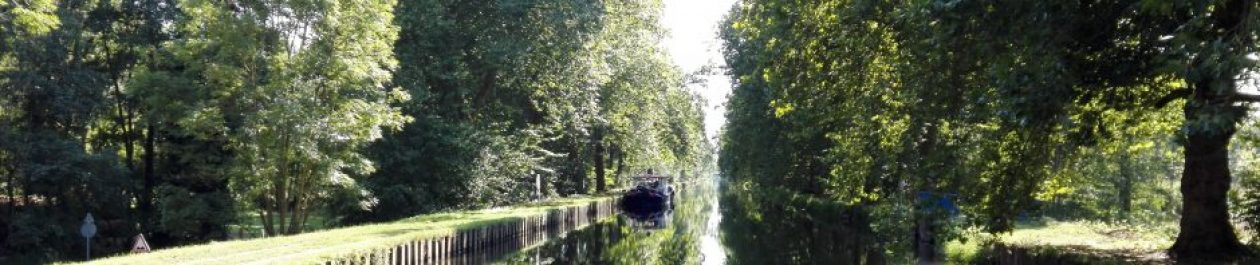
The first thing we had to do in moving from the Canal Latéral à la Loire onto the Canal de Briare was to cross the Loire River itself… across the 662-metre pont-canal built in the late 19th century with input from Gustave Eiffel. Built on 14 piers, its steel beam and channel hold about 13,000 tonnes of water. It’s not scary, being fairly wide and easily navigable, but it’s an impressive crossing all the same.


Our first stop past Briare was in the charming village of Ouzouer-sur-Trézé, with a delightful halte giving easy access to the village, its boulangerie and its impressive 12th-century Église Saint-Martin with massive flying buttresses.


Our next stop was quite a contrast, being in the natural surrounds of the Étang de Gazonne, at the summit of the canal. A lovely wild mooring beside the lake, watched over by the éclusier who was clearly in love with the place and acted as a kind of park ranger. We offered to buy his place but he indicated a strong reluctance. We don’t blame him!


After the sweet natural delights of Gazonne, we headed along the canal to Rogny-les-Sept-Écluse. Apart from being a delightful stop with many lovely walks, Rogny also displays the true genius and industry behind the construction of the Canal de Briare. Its original seven locks, built in the mid-17th century, were replaced by five locks conforming to the Freycinet gauge in the late 19th-century, but the original locks are an impressive monument. Apparently they involved 12,000 workers, bolstered by 6,000 soldiers when work was halted during the Thirty Years War. They were thoroughly ground-breaking when first built, and today provide a fabulous sight and an interesting walk to the summit – where we were lucky enough to find a walnut tree in full fruit. We joined a couple of locals in plundering it for its delicious bounty.


Our next stop was one of the true gems of our canal travels. Chatillon-Coligny, a town of about 2,000, is an absolute delight, with a pleasant mooring, interesting streetfronts, an old chateau (private), the vestiges of its old defensive moat system, a lovely 15th-19th century Eglise Saint-Peter et Saint-Paul, and a sweet old 16th-century salt granary, now a private residence. The town became a centre of Huguenot activity during the Wars of Religion, and boasts a “House of Hell” (Protestant) only a few doors up from the “House of Paradise” (Catholic). Chatillon is also known as the childhood home of the famous French writer Colette, whose house still stands in the town.


From Chatillon we travelled to the small village of Montcresson. Not much there, with a wild but pleasant mooring, although there was a lovely old 12th-century church, which apparently had a tunnel leading to the old convent (now demolished) – there are vestiges of the old vault still visible. The town is also interesting for its association with the MacMahon family, from Ireland, who came to France in the 17th century during the Glorious Revolution and who claimed descent from the kings of Ireland. Successive generations served in the French army and in 1873 Patrice de MacMahon was elected President of the French Republic, before his death in 1893 at this place.


 Scraping Through France