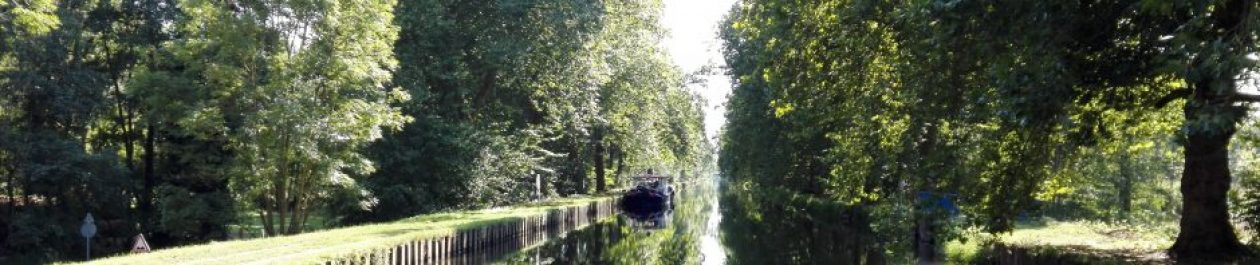
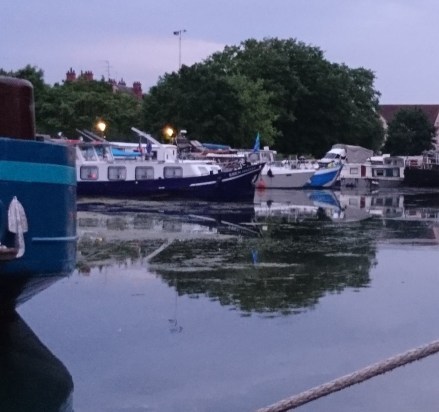
We had decided that on one of the days the Dijon Market was closed, we would take a side trip south to the wineries and villages of the Côte d’Or…to taste and to buy. We dreamed of names like Nuits Saint-Georges, Beaune, Pommard and their surrounding hills….homes to some of the best pinot noirs and chardonnays one could hope to find. But how to go about it? If we hired a car we would inevitably miss some of the sights and would definitely have to miss the tastings. If we caught a bus we would have a problem getting anything more than a few bottles back on board. If we joined one of the guided tours we would be shunted to someone else’s idea of good – probably the bigger houses/domaines – or pay through the nose for a custom tour. In the end we got lucky: we asked our young neighbour in the pirate’s harbour that posed as the Dijon marina what he thought we should do, and he offered himself and his car to drive us for the day. Voila!
So it was, that on a Monday at 9.00am ‘ Flo’ (Florent) picked us up in his little old Renault and we set off down the Route des Grands Crus. Flo didn’t appear to know very much about wine or wineries, but he knew his way around and he was a very handy interpreter. We didn’t know any more than he did, though we had done a little research and had decided our day tour should have five elements: (1) a small family domaine where we could taste and buy; (2) a large commercial domaine where we could taste and be given a prepared lecture on the region; (3) a clos or walled vineyard with a domaine on site; (4) a look around some of the villages and surrounding vineyards; and last but not least (5) a nice lunch.
First stop was the village of Nuit Saint-Georges, just 25kms south of Dijons. Although home to no Grand Crus, Nuit is well known for its Premier Cru reds, which account for nearly half of its terroir, with 41 distinct climats at this level within the Nuit Saint-Georges AOC geographic designation. It’s a pretty and well-kept village, surrounded entirely by the vineyards that are the basis of its prosperity. The connection between the village and the countryside was reinforced by the regular sight of the weirdly-shaped vineyard tractors driving through town.


Next stop was the Maison Bouchard Père et Fils in the town of Beaune. This domaine is both very old and very chic. Tracing its origin to 1731 with Michel Bouchard, it gradually through the generations acquired more and more vineyards; today it owns 130 hectares, including 12 Grand Cru and 74 Premier Cru. In 1820 they acquired the 15th-century Chateau de Beaune, which today forms their headquarters and remarkable cellars. We managed to hold ourselves back and bought a handful of wines, including a couple of Grand Crus and a handful of Premier Crus.


The other highlight of our visit to Beaune was the remarkable Hotel-Dieu, or Hospices de Beaune, founded in 1443 by Nicolas Rolin, Chancellor to the Duke of Burgundy, and his wife Guigone de Salins as a hospital and refuge for the poor, which operated continuously until the 1970s, and financially maintained by philanthropic gifts of vineyards to its estate as well as other riches such as works of art and, since 1859, an annual wine auction and festival. It is in remarkable condition and provides a fascinating insight into its historical operation, including its wards, chapel, kitchens and apothecary.


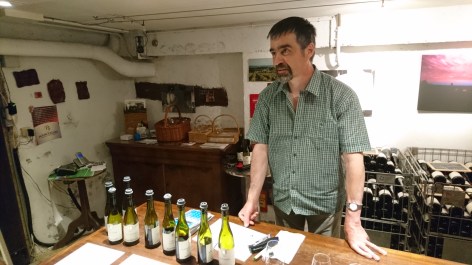
After our visit to the Hospice we refreshed ourselves with a delightful light lunch at L’Air du Temps in the centre of town, before making our way to Pommard for a tasting and buying session at the small family-operated Domaine Michel Rebourgeon. This domaine traces its roots all the way back to 1552, but the current incarnation dates to the grandmother of the current proprietors. Delphine, her brother and her husband (who, to our surprise, is English), own all of 3.5 hectares of vines, from which they produce a variety of excellent wines including a couple of Premier Crus. They are the epitome of small wine producers from the Cote d’Or, and we love them for it. Delphine’s grandmother Palmyre, or Mary, who was a Bourgogne (a family which first began cultivating vines here in the 16th century), married Emile Claude Rebourgeon in 1920. She inherited some vineyards and they acquired some more. But they passed on their lands to two sons – Michel in this case, and another, whose descendants still operate adjacent plots under another name (Rebourgeon-Mure). Anyway, we enjoyed a lovely tasting and walked out with a few cases, including some of their excellent Premier Cru. We were delighted to discover that Delphine’s son William, aged 19, intended to continue in the family business, and even happier to discover that he was continuing his wine education in Australia.
After leaving Pommard our next destination was the fabled Clos de Vougeot. First established by Cistercian monks in the 12th-14th centuries, with the current buildings dating to the 16th century. It was sold off after the French Revolution and passed through a series of owners and subdivisions by inheritance until in 1944 it was sold to the Société civile des Amis du Château du Clos de Vougeot (Friends of the Château du Clos de Vougeot), who leased it to the Confrérie des Chevaliers du Tastevin (Fraternity of Knights of the Wine-Tasting Cup), who operate it today. At around 50 hectares it is the largest single Grand Cru vineyard in the Côte de Nuit appellation. There is no wine processing on site these days but the château is a fascinating historic site and holds a number of receptions and dinners every year.


Our final visit was to la Grande Cave de Vougeot, not far from the Château. It has some amazing underground cellars dating back to the 17th century.


A final note on our visit to the wineries and villages and vineyards of Cote d’Or. We learned a great deal about the unique geographic designations that attach to Burgundy wines, which we will try to outline here. We hope we don’t muck it up: it’s very complicated, though absolutely fascinating. It is part of the joy of discovering the industry, the agriculture, the art and the tradition of wine in Burgundy.
The system is based on the AOC – appellation d’origine côntrolée – which basically assigns official designations to geographic areas of food production. Dating back as far as the early 15th century, it gained increasing application in the early 20th century, especially for wine but also for cheese and a number of other products. Burgundy is the most AOC-conscious area in France, which is all to do with terroir.
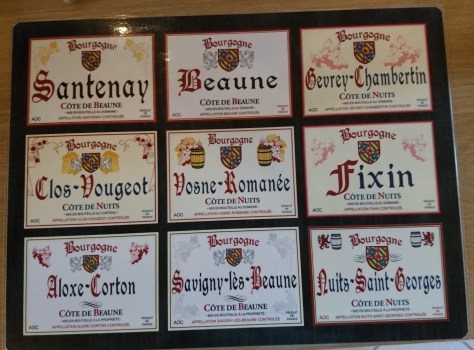
The vineyards in the Côte d’Or are intensively mapped and analysed – for soil characteristics, crop phenotypes and growth habitats, with such designations going back centuries. Over time, areas were designated as specific to their geographic location, mainly around certain villages – such as Nuit Saint-Georges, Pommard, Puligny-Montrachet, and so on. There are physical signs erected indicating when one enters and leaves these areas, and boundaries are strictly observed. Within each of these areas, specific locations are designated capable of producing grapes for Grand Cru, Premier Cru, or village classification, with the regional appellation applied to wines that come from across non-designated plots within the AOC area.
Then, within Grand Cru and Premier Cru designations, you will find micro-designations of specific acreages allocated a distinct climat, based on their unique terroir – which is a composite judgement based on soil, aspect, habitat and historic characteristics. In some cases a particular climat might only refer to a few hectares or less, and rarely to more than 10 or 20.
Overlaying this complex system of designation of terroir is the system of land ownership, which has taken form over hundreds of years. Families have acquired land, then gained more through marriage or acquisition, then split their holdings between descendants, who have in turn tried to increase their holdings through marriage or acquisition, then in turn split inheritances. The result is an almost impenetrable patchwork of thousands of tiny plots, often no more than a hectare or two, which vignerons work in composite across their holdings to grow the grapes they need to produce their annual output – unless of course they sell their grapes to neighbours or larger collectives and processors. It’s a marvellous and fascinating mosaic and a testament to the dedication and commitment of families over decades and generations and centuries to their craft and the production of fine wine. There are large conglomerates and mega-producers in the Cote d’Or. But it is not Bordeaux. The Cote d’Or is above all about small landholders and small producers. It is unique, and it is beautiful.






 Scraping Through France