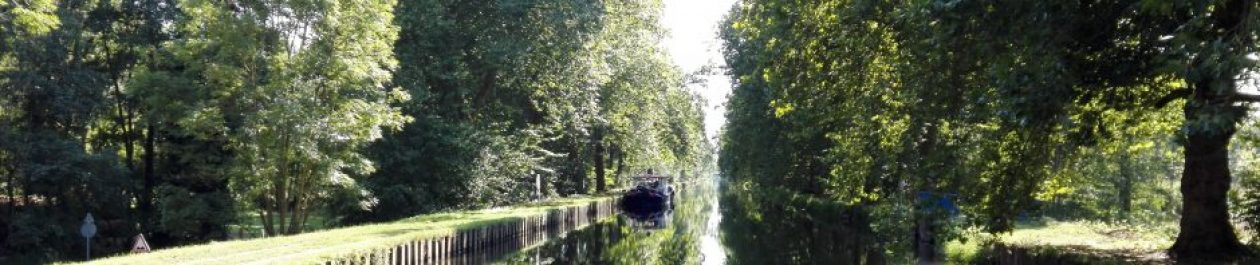
Leaving Châlons-en-Champagne, we headed towards the end of our sojourn in the land of bubbly. Our first call was Vitry-le-Francois, the junction of the Canal Lateral a La Marne (which we had just cruised), the Canal Marne au Rhin ( heading east towards Nancy, Strasbourg and the Rhine) and the Canal Entre Champagne et Bourgogne (where we were headed). Vitry was a non-event, proving that the best laid plans can easily go wrong. Despite pre-booking a day ahead and a phone call 20 minutes before arrival, we found ourselves without a capitain du port and without any obvious place to moor in the tiny tight harbour channel, so we tied up to the industrial quay opposite. Then moved on without a backward look the following morning.
The next day brought a delightful cruise along the canal to a lovely mooring at the village of Orconte. Nothing much there, except a boulangerie (yay) but it was peaceful and pretty so we stayed an extra night.


Orconte has a population of 450 and there’s not a lot there. But it has more delightful old half-timbered houses than we’ve seen in other villages. We were there on the day of the Football World Cup match between France and Australia. A patriotic Orcontois had given his garden nymph some extra decoration, and the local boulanger had dyed his hair blue, white and red. We bought his bread and told him we felt sorry for him… but we did not truly expect to be the ones cheering victory that night!


We transited in Saint-Dizier, a large town with a convenient halte, before cruising on to a delightful wild mooring at a little place called Chevillon. Very picturesque and calm, apart from the sounds nearby from the most musical metals foundry I have ever heard — like Tubular Bells with a smattering of a men’s chorus singing Volga Boatmen and a soprano Valkyrie dub. Quite extraordinary and a weird but not unpleasant accompaniment to our evening BBQ. On the way there we experienced unusual waterfalls in some of our locks.


From Chevillon we cruised to Joinville, a delightful town with much going for it. There are two moorings – the municipal quay, which seems quite satisfactory (except that it shares space with a park for camping vans), and a private mooring just before town at the Hotel de la Vinaigrerie, a former light industrial site that has been transformed into a pleasant gîte hotel. A large supermarket, brico (hardware store) and gamm vert (garden store are within a few hundred metres. Even better, behind the hotel is the Restaurant La Vallée Gourmande where, despite us being the only booking for the evening, we were served the most magnificent four-course meal, prepared in miraculous time, and served on the terrace by the owner as if we were royalty.


Joinville itself offers an interesting range of sights for a visit of a day or two, including the Château du Grand Jardin and a setting on a kind of island between two branches of the Marne that lends some interesting vistas of water and bridges.


Cruising between Joinville and Froncles, we experienced all the best and most ordinary of French canal cruising. Some lovely scenery, a broken lock that took ages to pass through, and a trifecta lock – first the lock, then a pont-canal (aqueduct over a stream) and then a lifting bridge. It made for a long but very interesting and picturesque day.


We also experienced one of those unique French locks where the lock-keeper’s house boasts an extraordinary collection of garden gnomes. We have seen many of these but this particular one might just take the cake…. particularly for its combination of Snow White and a display of naked gnome and gnomette.


Our stop in Froncles was a delight in several ways. The setting was beautiful, and we enjoyed a fully-serviced mooring pretty much on our own, except for some camper vans that were placed at a discrete distance. The adjacent Marne in its upper reaches was a small, calm, tree-lined stream and we enjoyed a serene riverside park right by our mooring.


Froncles is known for its metal forges, originally from the 18th century and then, from 1927 until quite recently, production of sheet metal sections for the fabulous old Citröen 2CV. We explored the place on foot and our interest turned to joy when we found the best village boulangerie we have so far discovered. Guillaume Perreau and his wife Sandra welcomed us and showed us their set-up. Guillaume is a true artist, battling through rising prices of flour and butter, and competition from cut-price supermarkets, to make superb products that he sells from his shop and and a mobile operation with a van. We salute him and Sandra.


After a couple of lovely days in Froncles we enjoyed another delightful cruise to our next stop at Viéville…. again, a village pretty much in the middle of nowhere with not a lot of services, but a sweet place with a cool surprise. We discovered that there was a concours de pétanque (boules competition) scheduled for later in the day just across the canal from our mooring, with a music concert to follow. We couldn’t resist… we grabbed a cheap meal, some cheap drinks, checked out the play and stayed for a great show – a very good four-piece playing covers of The Who, The Stones, Led Zep, U2, The Police, and at least four from Acca Dacca. Truckloads of fun.


From a small party to a big one…. After Viéville we stopped in the larger town of Chaumont, in time to witness the 81st edition of their “Grand Pardon” (Great Forgiveness), a traditional religious/popular festival with a 500-year history. Some religious ceremonies aside, the streets were festooned with crepe flowers, people everywhere walking, drinking, eating, and fireworks in the evening.


In Chaumont – first we spotted the hanging meat, on the rear of the boat right behind us, then we met the owners, a delightful Norwegian couple, Eddy and Sigrid, who were taking their yacht to the Med for a couple of years. The meat is a cured lamb, which they never refrigerate, cutting thin slices as needed. It’s delicious. They became firm friends over after-dinner drinks. And they were kind enough to lend us their electric bike and cart to fetch 100 litres of fuel in our jerry cans from a nearby servo. Permanently sunny-humoured, they had to cope with setbacks at Chaumont including water in their fuel (fixed by a local garage for big bucks) and the disappearance of their cat (unresolved when we left them but we were glad to find, at our next stop, with a happy ending).


After the bustle of Chaumont, with its many boats and festive atmosphere, we were glad to find some serenity at our next stop at the tiny village of Foulain. No services, no rush, no hassle, just quiet balm for the soul.
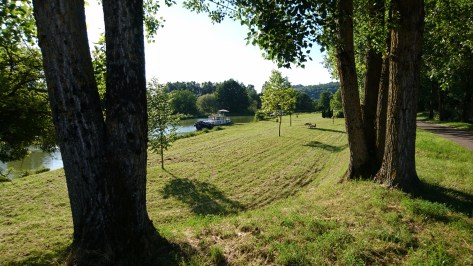
Our next stop was nearly as calm and peaceful, but this time with power and water, in the small village of Rolampont. We were greeted by a girl who seemed to think she was the port capitain, and who insisted on introducing us to her clan. Rolampont has a typical French village intersection, a pleasant church square and an interesting historic communal wash house (lavoir). Not a lot of people sighted on a Saturday afternoon. Signs on fences indicating not much happiness at the plan to cease recyclable waste collections door-to-door in favour of central “voluntary” collection points (increasingly common throughout regional France).


From Rolampont we had a pleasant cruise to Langres, an attractive and ancient hilltop town in the Haute-Marne department. It had considerable strategic importance and religious power for a long time and it has retained its impressive defensive walls. It was the only town we have visited by shuttle bus from our mooring, being just too damn high and steep to attempt walking or cycling. At least the bus was regular, and free! We were rewarded with fine views of the region, a marvellous 12th-century cathedral, and enchanting narrow streets with Renaissance houses.


Langres offered something unique…. a continuous 4km path along its encircling defensive walls, with numerous old towers and gates, and fabulous views. It also offered another day above 38 degrees. So we took the easy option, with a covered electric trolley cycle. Jane went faux Bedouin.


Like all French towns, Langres is proud of its notable sons and daughters…. In this case, the famed 18th-century Enlightenment figure Denis Diderot (co-founder and editor of that jewel of the Enlightenment, the Encyclopèdie) and the lesser known but also remarkable 17th-century nurse and colonial pioneer, Jeanne Mance, acknowledged as the co-founder of Montreal, Quebec.


In Langres there were plenty of lunch options, we settled on a nice tex-mex place for a change from the usual French delights. Sitting outdoors on the town’s main street, we were even more aware than normally, of that special French phenomenon…. the sanctity of lunch. On the strike of noon, cars became fewer, previously dense foot traffic slowed to a trickle, shops closed, and cafes and restaurants filled. Then as 2.00pm approached, normal busy life resumed.
Leaving Langres, we faced our first big test of the season…. navigating the Tunnel de Balesmes. At nearly 5 kilometres long, it was more than half as long again as the Pouilly Tunnel we conquered in 2017. One hour out of a lifetime doesn’t seem like much until you are halfway through, no light at either end, each minute like a quarter-hour. Then you finally emerge into sunshine and greenery. Aaaah!


After exiting the tunnel we had a short coffee break and then headed down the canal to Villegusien-le-Lac. Not a particularly attractive mooring between two industrial sites, though very peaceful, and we found a delightful little restaurant in the village for a light dinner in the evening sunshine… the Logis Hôtel le Relais du Lac.


The next few days were similar, having left the busy port at Langres and cruising through the rural, uncrowded section of the Canal Entre Champagne et Bourgogne. Almost no boat traffic, and we shared a mooring with another boat on only one occasion. Very calm and peaceful, except for some lads having a drink and a dip at Cusey, and the aircon generator starting up at the old grain silo at Champagne-sur-Vingeanne. Five days after leaving Langres we were at Maxilly-sur-Sâone, the last stop on the canal before entering the river.


Before our next canal stage, we had nearly 100 kilometres of the Sâone River to navigate, including the towns of Auxonne and Saint-Jean-de-Losne, both of which we had visited before and quite liked, as well as the port of Seurre, which was unknown to us.
Auxonne is an old fortress town that gave Napoléon his first leg up while studying at the Artillery School there. We had explored the town on our last visit in 2017, so this time we took the opportunity to relax and take in the ambience. Our first evening brought a riverside Night Market… mostly cheap tat but also cheap drinks, decent street food, wonderful atmosphere and outstanding musical entertainment. A real-life princess on a life-size musical box stage was thoroughly enchanting. An then it was an easy short walk along the river to our mooring for a restful night’s sleep.


The next day we didn’t strain ourselves…. we strolled through the town and took lunch at our favourite restaurant there, at the Hôtel du Corbeau, in the square by the cathedral. It was nice to be greeted by the bells of the cathedral chiming the hour of noon as we arrived, after which we enjoyed a thoroughly classic French 3-course lunch of pâté de campagne, boef bourgignon, crême brulée and some nice wine.


After we left Auxonne, we made good progress down the river with the current to Saint-Jean-de-Losne, which is styled as “the centre of the French watwerways” because of its position at the junction of several cruising routes, and its collection of chandleries, boatyards and ship brokers. We had a pleasant meal in the riverside cafe by our mooring and the following day filled our fuel tanks at the Rives de Saône on-water station du carbeurant before continuing downstream to the pleasant port of Seurre. Unfortunately no spaces for a boat our size so we had to raft up outside another even larger boat, a péniche owned and occupied by some lovely Australians who were restoring her and committing to a permanent on-board existence.
We then passed through the highest, darkest, most forbidding narrow-gauge lock we have ever seen, to rise up from the Saône into the Canal du Centre, and the next stage of our cruising season.
 Scraping Through France