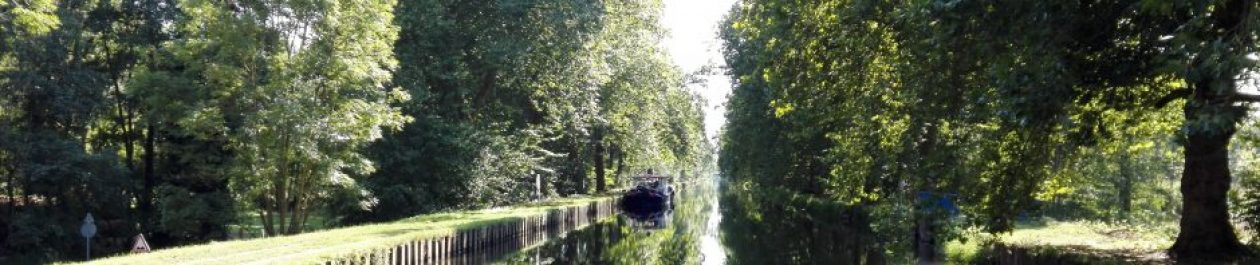
From Pouilly we were faced with a few challenging days as we scaled down from the summit of the Canal de Bourgogne through a series of lock “chains”, with several days of up to 19 locks to navigate each day. From Pouilly to Pont Royal = 13 locks, the first 12 of them in only 7 kms; Pont Royal to Marigny-le-Cahouët = 13 locks in 11.5kms; Marigny to Pouillenay = 19 locks in 5.7kms; Pouillenay to Venarey = 10 locks in 4.5kms. Fortunately, we were aided by the efficient travelling lock-keepers and managed to complete our daily passages fairly quickly and without incident. The countryside we passed through, when we had a chance to take it in, was beautiful and enchanting.
Our first stop was Pont Royal, a tiny village in the middle of nowhere. We spent a couple of pleasant days there, with power and water provided by the Maison du Canal at the halte (which also operated as a Maison d’hôtes or B&B). The village restaurant, Le Pont Royal was a typical roadside cafe/bar but was unfortunately closed for meals during our stay.


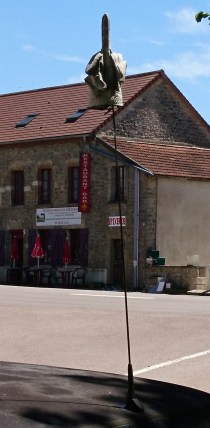
One of the local residents clearly had an unsubtle sense of humour, judging by the decoration on his car’s radio aerial….
We only spent one night at the next stop in Marigny-le-Cahouët, but we received a pleasant surprise when we visited the nearby Château de Marigny-le-Cahouët. This castle was originally built in the 13th century by Montaigus of royal blood, then remodelled in the 17th century and restored in the 19th century. It was acquired by the family of the current owners in 1962 and early on was the location for the noted French film Angélique, Marquise des Anges. The day we were there, work was being done restoring the wonderful Burgundian tiled roof; we admired the walls and the moat and the gate but did not expect to see inside, since it is a private property. As we were about to leave, a voice came from one of the huge old windows… a young girl cried out to us, asking if we wished to come in. Of course we did! She was the daughter of the current owners and she and her friend guided us around the main interiors of the castle, clearly pleased to be practising their English. We were delighted.


After a long, hot day with many locks out of Marigny, the calm quiet of our solitary mooring at Pouillenay (no services) was a chance for a restful afternoon, and later a walk through the village.. not a lot there, but neat and quite attractive, mostly modern building styles with an occasional touch of old French rural.


Another slog of 10 locks brought us to Venarey-les-Laumes – only 4.5kms further along the Canal, accomplished in under 2.5 hours. We had to settle for an uncomfortable temporary mooring nearly under the bridge and against the rocky canalside, until a couple of large hotel boats departed and we claimed a spot along the quay. To be honest, although the port included a Nicols hire boat base and marine shop, it was a little bit run down in many respects. The town was interesting, all the same, with a pleasant bike ride through a park to reach the town centre, which boasted all the services one could wish for.
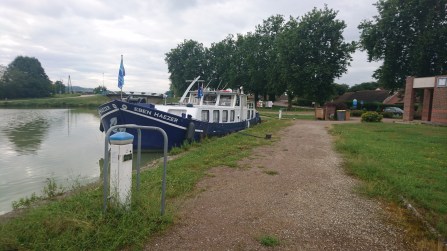
Our main interest in Venarey lay in the nearby Gallo-Roman ruins of Alesia, the site of Julius Caesar’s last and greatest battle against the Gauls, under their leader Vercingetorix, in 52B.C. After the battle the Gallic town was occupied and rebuilt by the Romans and today the archaeological diggings have uncovered a treasure of fascinating relics and ruins of this significant town, while further diggings have uncovered extensive evidence of the extraordinary siege fortifications built by Caesar in the weeks and months leading to the decisive battle… which saw the besieged Gallic forces of 80,000 and their reinforcements of 100,000 or more overcome by a Roman-Germanic force of 60,000. We caught a taxi to the site and spent a couple of hours wandering the remains of houses, arcades, forges, bathhouses, theatre and basilica, before our taxi returned to take us back to the boat – but not without a detour to see the bronze statue of Vercingetorix commissioned by Napoleon III in 1865


I am tickled pink to report that once again we defeated the best efforts of bad weather to deter us…. it rained in the taxi out, stopped for our walking tour of the historic site, then began again just as we got back into the taxi and thundered down once we got back to the boat.
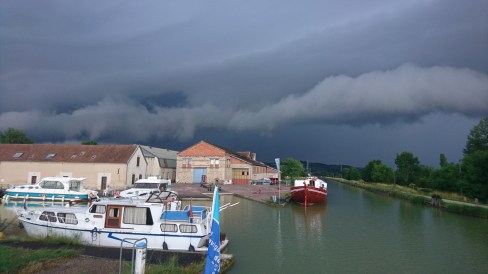
While in Venarey, we also enjoyed a visit to the modern interpretive museum attached to the historic ruins, known as the MuséoParc Alesia – a modernist building within a large park with a recreation of the siege fortifications. Inside there are various interpretive displays and we managed to catch a rather quaint performance of a battle between Gallic and Roman troops.


We also managed to fit in lunch at Bistro de Louise, a delightful restaurant with modern minimalist interior, tiny open kitchen and truly delicious menu.


Our next stop was the provincial town of Montbard, where we hoped to enjoy three principal points of interest: the Parc and Musée of the town’s most famous inhabitant, the Comte de Buffon; Bastille Day celebrations; and a visit to the nearby Abbaye de Fontenay.
After a pleasant morning’s cruise we elected to moor at the old port near the railway station, in preference to the newer port de plaisance further along. We felt this was closer to the action in town and had more space for larger boats. We tied up right outside the VNF (French Waterways) offices and set off to explore the town.
The Parc de Buffon sits on a hill overlooking the town. Not much remains of the château, originally built in the 11th century and transformed by Buffon into kind of botanic gardens and zoo dedicated to his studies in natural history. Today it makes a pleasant walk before diving into the crazy, eclectic collection of oddities preserved in the Musée de Buffon by its side. Buffon, born George-Louis Leclerc in Montbard in 1707, was a naturalist, cosmologist, mathematician and encyclopédiste in the age of Voltaire, with whom he corresponded. He was the director of the Parisian botanic gardens, the Jardin du Roi, for nearly 50 years, and he was a member of both the French Academy of Sciences and the Academie Francaise, as well as an Honorary Member of the American Academy of Arts and Sciences. He propounded a number of ideas that could be considered loose precursors of Darwin’s theories of evolution a hundred years later. Today there is evidence of Buffon everywhere in Montbard – statues, the Parc, the Museum, street names. What you will not find is his body; although he was buried there, during the French Revolution his grave was looted for the lead casing to make bullets, and his body parts were lost…. except for his cerebellum, which was preserved in the base of the memorial statue and is today located at the Natural History Museum in Paris. Weird, what?


Our second visit of interest in Montbard was to the Abbaye de Fontenay, about 6kms from town. It was built in the early 12th century by Saint Bernard of Clairvaux (whose mother Aleth was born in the Château de Montbard), and is one of the oldest and most complete Cistercian abbeys in Europe. It was declared a UNESCO World Heritage Site in 1981. It is a remarkable collection of gardens, dormitory, cloister, chapter house, church and forge. Its forge from 1220 was the first metallurgical factory in Europe and was the original hydraulic hammer, fundamental to later industrial manufacturing. Its spirit of austerity and self-sufficiency (in reaction to the worldliness that had become attached to the great Benedictine Order based in Cluny) is obvious even today, although it hasn’t been home to any monks since the French Revolution. It was turned into a paper mill by the Montgolfier brothers (of hot air balloon fame) and was extensively restored in the early 20th century by a Lyon banker, whose family still owns it today.


In the run-up to Bastille Day, we took the opportunity to stock up at the excellent covered market (marché couvert) in Montbard, a wonderful facility in a small town of only 5,000 people.


Some towns and villages in France celebrate Bastille Day with fireworks on July 13; others hold them back for Bastille Day itself, and this was the case in Montbard. The night before, we celebrated the Fireman’s Ball, or Bal de Pompiers. In France, most firefighters are volunteers and the Fireman’s Ball is a special occasion. We enjoyed cheap beer, cheap seats and easy dancing.


Bastille Day itself was as thoroughly French as we could have hoped for. We started the evening with a meal of oefs en meurette and escargots; then we followed the Pompiers’ Parade with the children carrying lighted lanterns to the old bridge across the Brenne river, where we took up our positions to watch the fireworks. There was a marvellous atmosphere of family celebration, but the serious side of the occasion was brought hoke by the narration that boomed out from the public address system. We witnessed something I’ve never seen before: from time to time, the fireworks would continue bursting in colour above us, but somehow in silence, as the narrator spoke about patrimony, loyalty, community and heritage. Then the noisy fireworks would begin again, only to turn silent again a few minutes later for more narration over the PA. Extraordinary! Overall, it was a wonderful celebration of France’s national day…. patriotic but not jingoistic, joyful but not drunken, ritual but not mindless.


After a thoroughly memorable and enjoyable few days in Montbard we bade farewell and set off for our next stop, which was only 7kms and 5 locks further along, at a wild mooring adjacent to La Grande Forge de Buffon.
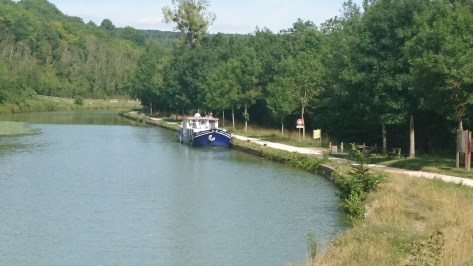
We had already come across the Comte de Buffon at Montbard; the Grande Forge was the naturalist’s experiment in metallurgy. Built from 1768 with land and money he inherited from his mother, the forge never really was on a commercial scale, but is a fascinating insight into Enlightenment venture into industry. Apart from manufacturing ironwork for the fences and gates of the royal botanic gardens in Paris that he directed, Buffon also tried to use the forge to conduct experiments on the age of the Earth and research for his work in The Supplements of Natural History. Predictably, he ran into trouble for doing so from the Church and the Sorbonne. The complex he built here is a remarkable integrated collection of industrial works, managers’ and workers’ accommodation, and associated infrastructure such as vegetable gardens, bakery, chapel, dovecote and orangerie. On a small scale, a sort of self-contained early industrial age version of a monks’ abbey like the one at Fontenay with which he would have been very familiar.


 Scraping Through France