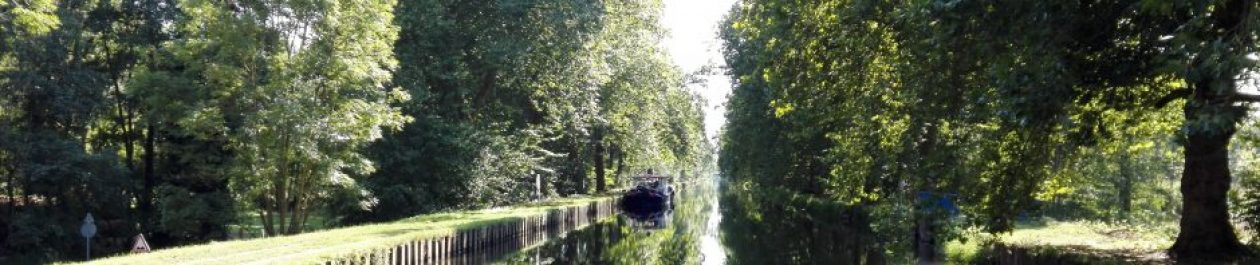
The middle of June saw us begin the next stage of our 2017 season – a cruise along the famous Burgundy Canal, the Canal de Bourgogne. This canal was conceived in the early 17th century but not completed until 1833. It sounded to us like quite a challenge: 189 locks crammed into its length of 242 kilometres, plus a tunnel more than 3 kilometres long. But it also held promise of beautiful countryside, historic chateaux and the city of Dijon, so we set off from Saint-Jean de Losne with great anticipation. Before we entered the canal, we filled up with diesel – 480 litres at €1.62 per litre = €780! As I handed over the cash I consoled myself with the knowledge that this would almost carry us through the rest of our season.
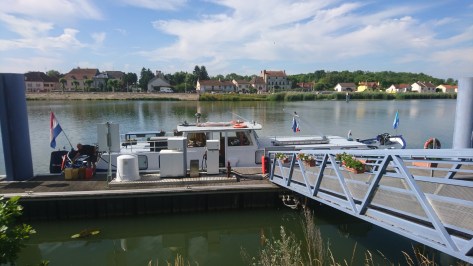
The first stage of the Bourgogne would see us reach Dijon across a fairly featureless plain, not entirely flat since it involved 22 locks in 30 kilometres, so we broke it into two days, with a stop at Lock 65, Bretenière. Not much there, although we did find a decent pizza place behind a warehouse not far from our mooring.
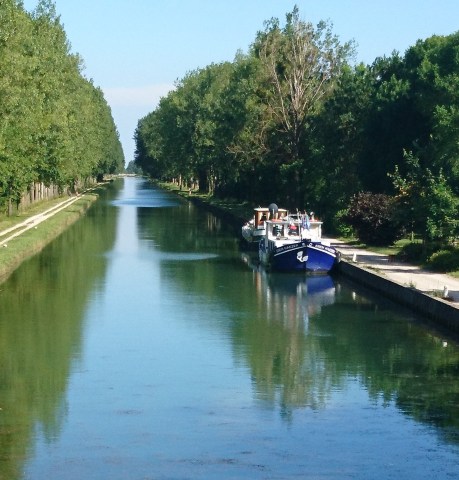
This section of the canal was thoroughly infested with weed, which would have been a problem for boats with water intakes for their engine cooling; we were lucky to have a closed system, so the only difficulty was thicker weeds fouling the propeller, which we could take care of when we reached Dijon. At least the VNF was busy working to harvest and clear the weed, with a strange reaper-craft and banks of weed deposited all along the canal banksides.


In Dijon, we initially moored alongside the quay on the south side of the Ile aux Canards, a smart place with new bornes for electricity and water. Only problem…. they needed tokens to operate and no one, I mean absolutely no one, knew anything about how to get tokens. Since we intended to stay in Dijon for a week, we needed access to power and water, so we moved across to the old marina. It was a delicate operation, since we needed to reverse into our mooring then tie up to tiny, ricketty, aged pontoons, using every bit of rope we had to secure ourselves, hoping our bow was not poking out too far into the channel.
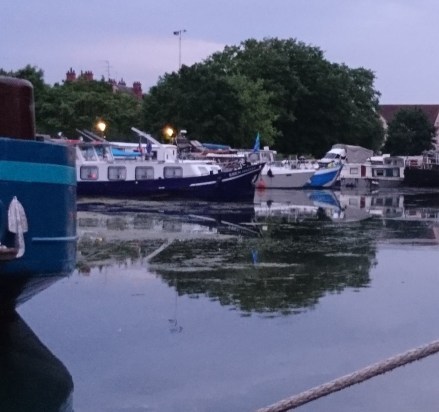
The old marina at Dijon was a funny old job. There were plenty of points for electricity and water, available for nothing, as the marina had been unsupervised since the old capitainerie burnt down a couple of years previously, and no one in the city administration had got around to imposing a new regime. We were happy; and, so it would appear, were numerous others, since the marina was mainly populated by old boats occupied more or less permanently by young folk rapt in their good fortune at finding free accommodation in a major city of France. We felt comfortable and secure, despite all the comings and goings; in addition to the floating squatters, there was a children’s playground adjacent to us (only really used in the afternoons as mothers brought their children home from school), a floating bar/disco (the Peniche Cancale) which mercifully did not have a late night license, and an embarcation point for the hotel barges which were in a constant state of arrival/departure throughout our stay.


The saddest tale we came across was an older Australian chap who introduced himself to us on our first day and proceeded without delay to tell us his story. He had invented something that would have earned him a lot of money but the patent was stolen from him so someone else was cashing in. He had arrived in Dijon some years previously with a campervan and had bought his boat, which he had been in the process of readying for cruising. He had then suffered a fall and had to return to Australia for medical treatment. While away, his campervan had been impounded, never to be returned, and his boat had been taken over by young squatters. He had managed to evict them and was living on his boat, and thought he would be ready someday soon to set off along the canal. Maybe. He wasn’t sure. And anyway, he had never driven it before…. or any other boat. So, maybe. One day. We tried to give as much encouragement as we could.
 Scraping Through France