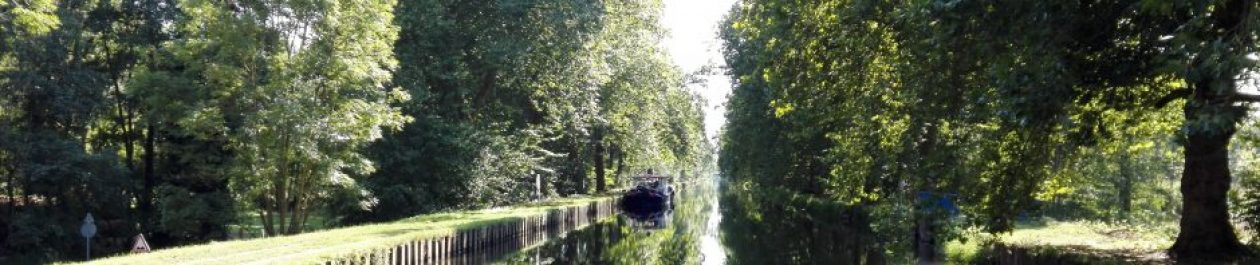
Between Champagne and Bourgogne

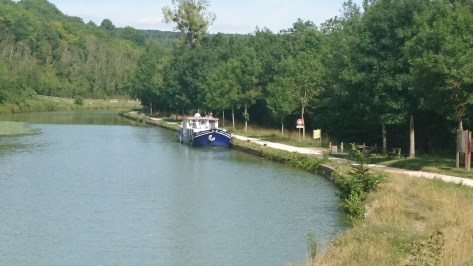
Leaving Châlons-en-Champagne, we headed towards the end of our sojourn in the land of bubbly. Our first call was Vitry-le-Francois, the junction of the Canal Lateral a La Marne (which we had just cruised), the Canal Marne au Rhin ( heading east towards Nancy, Strasbourg and the Rhine) and the Canal Entre Champagne et Bourgogne (where we were headed). Vitry was a non-event, proving that the best laid plans can easily go wrong. Despite pre-booking a day ahead and a phone call 20 minutes before arrival, we found ourselves without a capitain du port and without any obvious place to moor in the tiny tight harbour channel, so we tied up to the industrial quay opposite. Then moved on without a backward look the following morning.

The next day brought a delightful cruise along the canal to a lovely mooring at the village of Orconte. Nothing much there, except a boulangerie (yay) but it was peaceful and pretty so we stayed an extra night.

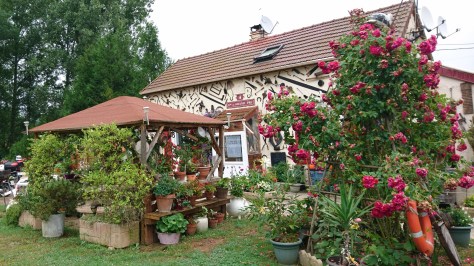
Orconte has a population of 450 and there’s not a lot there. But it has more delightful old half-timbered houses than we’ve seen in other villages. We were there on the day of the Football World Cup match between France and Australia. A patriotic Orcontois had given his garden nymph some extra decoration, and the local boulanger had dyed his hair blue, white and red. We bought his bread and told him we felt sorry for him… but we did not truly expect to be the ones cheering victory that night!

We transited in Saint-Dizier, a large town with a convenient halte, before cruising on to a delightful wild mooring at a little place called Chevillon. Very picturesque and calm, apart from the sounds nearby from the most musical metals foundry I have ever heard — like Tubular Bells with a smattering of a men’s chorus singing Volga Boatmen and a soprano Valkyrie dub. Quite extraordinary and a weird but not unpleasant accompaniment to our evening BBQ. On the way there we experienced unusual waterfalls in some of our locks.

From Chevillon we cruised to Joinville, a delightful town with much going for it. There are two moorings – the municipal quay, which seems quite satisfactory (except that it shares space with a park for camping vans), and a private mooring just before town at the Hotel de la Vinaigrerie, a former light industrial site that has been transformed into a pleasant gîte hotel. A large supermarket, brico (hardware store) and gamm vert (garden store are within a few hundred metres. Even better, behind the hotel is the Restaurant La Vallée Gourmande where, despite us being the only booking for the evening, we were served the most magnificent four-course meal, prepared in miraculous time, and served on the terrace by the owner as if we were royalty.

Joinville itself offers an interesting range of sights for a visit of a day or two, including the Château du Grand Jardin and a setting on a kind of island between two branches of the Marne that lends some interesting vistas of water and bridges.

Cruising between Joinville and Froncles, we experienced all the best and most ordinary of French canal cruising. Some lovely scenery, a broken lock that took ages to pass through, and a trifecta lock – first the lock, then a pont-canal (aqueduct over a stream) and then a lifting bridge. It made for a long but very interesting and picturesque day.

We also experienced one of those unique French locks where the lock-keeper’s house boasts an extraordinary collection of garden gnomes. We have seen many of these but this particular one might just take the cake…. particularly for its combination of Snow White and a display of naked gnome and gnomette.

Our stop in Froncles was a delight in several ways. The setting was beautiful, and we enjoyed a fully-serviced mooring pretty much on our own, except for some camper vans that were placed at a discrete distance. The adjacent Marne in its upper reaches was a small, calm, tree-lined stream and we enjoyed a serene riverside park right by our mooring.

Froncles is known for its metal forges, originally from the 18th century and then, from 1927 until quite recently, production of sheet metal sections for the fabulous old Citröen 2CV. We explored the place on foot and our interest turned to joy when we found the best village boulangerie we have so far discovered. Guillaume Perreau and his wife Sandra welcomed us and showed us their set-up. Guillaume is a true artist, battling through rising prices of flour and butter, and competition from cut-price supermarkets, to make superb products that he sells from his shop and and a mobile operation with a van. We salute him and Sandra.

After a couple of lovely days in Froncles we enjoyed another delightful cruise to our next stop at Viéville…. again, a village pretty much in the middle of nowhere with not a lot of services, but a sweet place with a cool surprise. We discovered that there was a concours de pétanque (boules competition) scheduled for later in the day just across the canal from our mooring, with a music concert to follow. We couldn’t resist… we grabbed a cheap meal, some cheap drinks, checked out the play and stayed for a great show – a very good four-piece playing covers of The Who, The Stones, Led Zep, U2, The Police, and at least four from Acca Dacca. Truckloads of fun.

From a small party to a big one…. After Viéville we stopped in the larger town of Chaumont, in time to witness the 81st edition of their “Grand Pardon” (Great Forgiveness), a traditional religious/popular festival with a 500-year history. Some religious ceremonies aside, the streets were festooned with crepe flowers, people everywhere walking, drinking, eating, and fireworks in the evening.

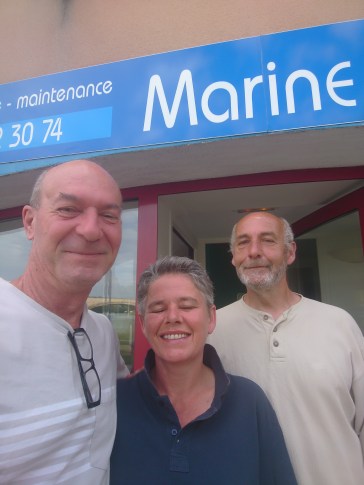
In Chaumont – first we spotted the hanging meat, on the rear of the boat right behind us, then we met the owners, a delightful Norwegian couple, Eddy and Sigrid, who were taking their yacht to the Med for a couple of years. The meat is a cured lamb, which they never refrigerate, cutting thin slices as needed. It’s delicious. They became firm friends over after-dinner drinks. And they were kind enough to lend us their electric bike and cart to fetch 100 litres of fuel in our jerry cans from a nearby servo. Permanently sunny-humoured, they had to cope with setbacks at Chaumont including water in their fuel (fixed by a local garage for big bucks) and the disappearance of their cat (unresolved when we left them but we were glad to find, at our next stop, with a happy ending).


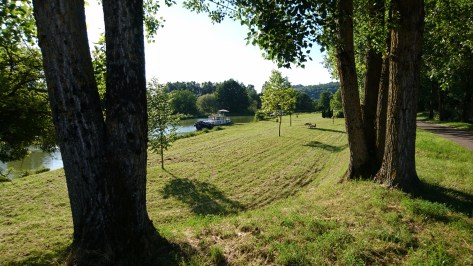
After the bustle of Chaumont, with its many boats and festive atmosphere, we were glad to find some serenity at our next stop at the tiny village of Foulain. No services, no rush, no hassle, just quiet balm for the soul.
2018-06-26 19.04.17

Our next stop was nearly as calm and peaceful, but this time with power and water, in the small village of Rolampont. We were greeted by a girl who seemed to think she was the port capitain, and who insisted on introducing us to her clan. Rolampont has a typical French village intersection, a pleasant church square and an interesting historic communal wash house (lavoir). Not a lot of people sighted on a Saturday afternoon. Signs on fences indicating not much happiness at the plan to cease recyclable waste collections door-to-door in favour of central “voluntary” collection points (increasingly common throughout regional France).

From Rolampont we had a pleasant cruise to Langres, an attractive and ancient hilltop town in the Haute-Marne department. It had considerable strategic importance and religious power for a long time and it has retained its impressive defensive walls. It was the only town we have visited by shuttle bus from our mooring, being just too damn high and steep to attempt walking or cycling. At least the bus was regular, and free! We were rewarded with fine views of the region, a marvellous 12th-century cathedral, and enchanting narrow streets with Renaissance houses.

Langres offered something unique…. a continuous 4km path along its encircling defensive walls, with numerous old towers and gates, and fabulous views. It also offered another day above 38 degrees. So we took the easy option, with a covered electric trolley cycle. Jane went faux Bedouin.

Like all French towns, Langres is proud of its notable sons and daughters…. In this case, the famed 18th-century Enlightenment figure Denis Diderot (co-founder and editor of that jewel of the Enlightenment, the Encyclopèdie) and the lesser known but also remarkable 17th-century nurse and colonial pioneer, Jeanne Mance, acknowledged as the co-founder of Montreal, Quebec.

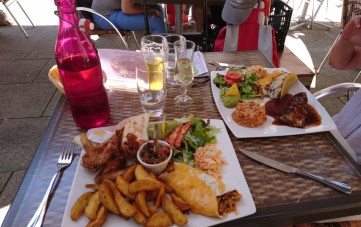
In Langres there were plenty of lunch options, we settled on a nice tex-mex place for a change from the usual French delights. Sitting outdoors on the town’s main street, we were even more aware than normally, of that special French phenomenon…. the sanctity of lunch. On the strike of noon, cars became fewer, previously dense foot traffic slowed to a trickle, shops closed, and cafes and restaurants filled. Then as 2.00pm approached, normal busy life resumed.
2018-06-30-12.53.55.jpg

Leaving Langres, we faced our first big test of the season…. navigating the Tunnel de Balesmes. At nearly 5 kilometres long, it was more than half as long again as the Pouilly Tunnel we conquered in 2017. One hour out of a lifetime doesn’t seem like much until you are halfway through, no light at either end, each minute like a quarter-hour. Then you finally emerge into sunshine and greenery. Aaaah!

After exiting the tunnel we had a short coffee break and then headed down the canal to Villegusien-le-Lac. Not a particularly attractive mooring between two industrial sites, though very peaceful, and we found a delightful little restaurant in the village for a light dinner in the evening sunshine… the Logis Hôtel le Relais du Lac.

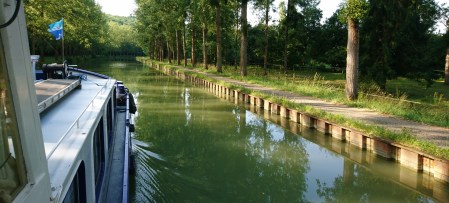
The next few days were similar, having left the busy port at Langres and cruising through the rural, uncrowded section of the Canal Entre Champagne et Bourgogne. Almost no boat traffic, and we shared a mooring with another boat on only one occasion. Very calm and peaceful, except for some lads having a drink and a dip at Cusey, and the aircon generator starting up at the old grain silo at Champagne-sur-Vingeanne. Five days after leaving Langres we were at Maxilly-sur-Sâone, the last stop on the canal before entering the river.

Before our next canal stage, we had nearly 100 kilometres of the Sâone River to navigate, including the towns of Auxonne and Saint-Jean-de-Losne, both of which we had visited before and quite liked, as well as the port of Seurre, which was unknown to us.

Auxonne is an old fortress town that gave Napoléon his first leg up while studying at the Artillery School there. We had explored the town on our last visit in 2017, so this time we took the opportunity to relax and take in the ambience. Our first evening brought a riverside Night Market… mostly cheap tat but also cheap drinks, decent street food, wonderful atmosphere and outstanding musical entertainment. A real-life princess on a life-size musical box stage was thoroughly enchanting. An then it was an easy short walk along the river to our mooring for a restful night’s sleep.

The next day we didn’t strain ourselves…. we strolled through the town and took lunch at our favourite restaurant there, at the Hôtel du Corbeau, in the square by the cathedral. It was nice to be greeted by the bells of the cathedral chiming the hour of noon as we arrived, after which we enjoyed a thoroughly classic French 3-course lunch of pâté de campagne, boef bourgignon, crême brulée and some nice wine.

After we left Auxonne, we made good progress down the river with the current to Saint-Jean-de-Losne, which is styled as “the centre of the French watwerways” because of its position at the junction of several cruising routes, and its collection of chandleries, boatyards and ship brokers. We had a pleasant meal in the riverside cafe by our mooring and the following day filled our fuel tanks at the Rives de Saône on-water station du carbeurant before continuing downstream to the pleasant port of Seurre. Unfortunately no spaces for a boat our size so we had to raft up outside another even larger boat, a péniche owned and occupied by some lovely Australians who were restoring her and committing to a permanent on-board existence.

We then passed through the highest, darkest, most forbidding narrow-gauge lock we have ever seen, to rise up from the Saône into the Canal du Centre, and the next stage of our cruising season.


Into Champagne

After the rigours of the transition from the Seine to the Marne were soothed away by our pleasant stay in Lagny, we continued up the river towards our rendezvous with a bit of bubbly. Our next stop was in the town of Meaux, still only 50 kilometres from Paris, at the end of a slow, relaxing cruise upstream along the meandering Marne. We arrived as the only boat in the port, and it was clear why: the mooring pontoons were undergoing major repairs after the January floods and the gangways from the pontoons to the shore had been removed! No problem – we pulled out our DIY passarelle and voilà, connection made. Power and water, no mooring fee, and a lovely city to explore.

Meaux is most famous for its variety of brie… which is truly delicious…. and also for its mustard, one of the great alternatives to Dijon. It is full of beguiling, narrow streets, many of which have been pedestrianised, hosting all the major brands, plus lots of boulangeries, patisseries, chocolateries, epiceries and restaurants and cafes. On our first evening we stuffed ourselves silly with a magnificent meal at the Chinese resto just across from our mooring.

The city is dominated by its Gothic Cathédrale Saint-Etienne and the episcopal palace and gardens behind it. It was interesting to see all the statues of saints and angels, decapitated during the French Revolution. Apart from the magnificent 17-century organ, the cathedral is best known for its association with Bossuet, bishop of Meaux 1681-1704, known as l’aigle de Meaux and reputedly one of history’s greatest orators and rhetoricians .

After a couple of days in Meaux, a delightful morning cruise up the river brought us to a very different place,  the small village of Mary. Nothing much there, except calm, peace and an excellent restaurant, the Quai des Brumes, right by the mooring.

Another easy meandering morning cruise delivered us to La Ferté-sous-Jouarre, where we moored in a lovely secluded channel behind an island in the river. It was peaceful, but sobering to see the markers on the pontoon pylons showing how high the water had been during the floods of February – only 4 months previous!

La Ferté boasted a fine Hotel de Ville and, even better, a café that made excellent coffee using beans roasted on site – a rare find anywhere in France, in our experience.

We gave our new electric bikes their first real workout with a 3km uphill ride to the Abbaye Notre Dame de Jouarre. The abbey was first established by Saint Columban in the 7th century, then devastated and rebuilt in the 11th century, again during the Hundred Years War, and yet again in the Revolution. Today it hosts a community of 33 Benedictine nuns; the church is a suitably austere affair, without ornamentation, and the whole place and its gentle sisters give off an air of calm, serene contemplation, but not removed from the outside world. When not engaged in prayer and contemplation and good works, the sisters seem to be well occupied in producing rather kitsch pieces of ceramic figurines of children and saints.

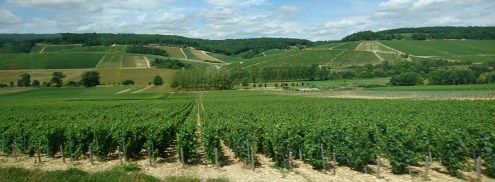
As we moved on up the river from La Ferté, the hills on either side of the canal gradually gave more evidence that we were moving deeper into Champagne, with vineyards shyly revealing themselves then combining into vistas of vines stretching into the distance on both sides. We pulled into the town of Château-Thierry after a long day, having decided not to stop at Nanteuil or Nogent d’Artaud further downstream.

Château-Thierry is a sweet town with a handsome Hotel de Ville, a distinctive art déco cinema and a fascinating ruined château of the 12th/16th centuries. It was also the home of the 17-century fabulist storyteller, Jean de la Fontaine whose most popular and best-loved tale of the grasshopper and the ant (la cigale et la fourmi) is celebrated with whimsical statues about town.

Especially in this Centenary year of the Second Battle of the Marne, reminders of WWI were never far away in Château-Thierry, from the American monument on Hill 204 above the town, to a small ceremony of remembrance one afternoon at the Jean Moulin Resistance memorial just by our boat.

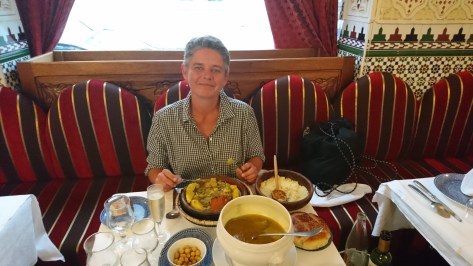
Château-Thierry also offers a couple of lovely restaurants; we chose the Moroccan Palais de Marrakech in the town square and were not disappointed!

2018-06-05 20.35.59

After a thoroughly enjoyable couple of days we set off for our next stop, the town of Dormans. By this time we were really in the thick of Champagne country. We postponed our thirst, though, and took a visit to the lovely old 14th-century Château de Dormans and its delightful gardens, and the adjacent Great War Memorial built on the orders of Maréchal Foch to commemorate the victories in the battles of the Marne. Impressive, sombre, but a little too glorious, we thought…. It was refreshing to come back down the hill and see some locals playing pétanque in the grounds of the château.

The next day we pulled out our bikes and went for a delightful cycle along the banks of the Marne, to the villages of Verneuil and Vincelles. We came across Champagne Jacques Copin and managed to score a tasting and a bottle of their Polyphénoles 2006, a fabulous drop from a very good year. The deep red roses around Verneuil’s little 12th-century church were stunning!

In Dormans we enjoyed two other delights, both surprises and both unplanned. The first was when I got a flat tyre on my bike when we were visiting the château, which meant walking the bike back to the village… where we found a bicycle and lawnmower service shop in the centre of town, 5 minutes before closing. The lovely man let me in, threw my bike on his repair cradle, and replaced the inner tube in about 3 minutes, then refused to charge me more than the cost of the tube itself.

The second delight was out discovery of the restaurant Sylvain Suty, where we had a magnificent four-course meal for a bargain price, complete with the most extravagant cheese chariot and dessert chariot.

The next day’s cruise was delightful, and the mooring we found at Damery was fantastic. The village is crawling with champagne houses! We picked out J. de Telmont and were treated to a wonderful tasting by Lucille, our knowledgeable and friendly hostess. We scored a 2006 vintage and an excellent ratafia, which we enjoyed from our rear deck as we took in the magical slow dying of the light across the river.

The following day we cycled along the river from Damery to Cumières, then up the hill to Hautvillers, which styles itself as the berceaux, or cradle, of Champagne, because of Dom Perignon who lived and worked at the village’s Abbaye de Saint-Pierre in the late 17th century. In fact, he was not responsible for discovering or developing Champagne, despite claims by many, including the well-known Champagne house of Moët et Chandon, which now owns the Abbaye (closed to the public but undergoing expensive renovations) as well as extensive vineyards in the surrounding hills. It’s quite a touristy town, but still attractive, with fabulous views back down to the Marne River.

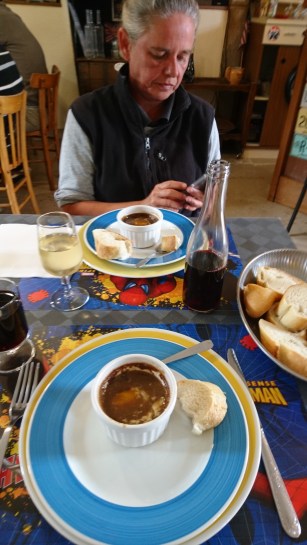
On our way back to the boat we met a man in Cumières who gave us a bag of fresh cherries and introduced us to his extensive collection of geraniums, including one whose leaves he claimed were an excellent mosquito repellent. We enjoyed lunch at a lovely little cafe, run by an old couple with serious mobility issues. Essentially, you ordered your meal and collected each of the three courses from a laminate-top table, ladling the stew course into your bowl and collecting a thick cut of bread to go with it, then returning for cheese and/or pudding which you selected from the table and served onto your own plate. La Paillotte (The Hut) has adopted the motto à la bonne franquette, which basically means “homely and unpretentious”. The steady stream of cyclists who stopped in seemed to agree, and the river views and ambience were priceless.

We cruised up the river to Mareuil-sur-Ay, where we had decided to base ourselves rather than in the centre of Épernay (the self-proclaimed capitale de Champagne), whose port seemed a bit pokey and outrageously expensive. We were unable to connect to the services at Mareuil, but never mind, it was a pleasant stop and the village was filled with champagne houses, while Épernay was an easy, level 7km ride away.

Our first stop in Épernay was the Avenue de Champagne, where the major houses have their HQs. They date mostly from the mid-late 19th century; it’s a bit like what I imagine LA aimed for with Rodeo Drive, but with class and history. Surprisingly, with the exception of Moët et Chandon, it was not at all touristy.

Returning from Épernay to our mooring at Mareuil-sur-Ay, we had hoped for a tasting at Billecart-Salmon, a small-medium house that in 1999 earned the accolade of “champagne of the millenium” for its 1959 vintage… alas, they only receive visitors by prior appointment. Our consolation was a visit to the House of Bénard Roland, where the owner Philippe Bénard (fourth-generation champagne producer), cigar permanently planted, greeted us with a fine and generous degustation. Really good champagne at bargain prices. The portraits of his family on the walls were a nice touch.

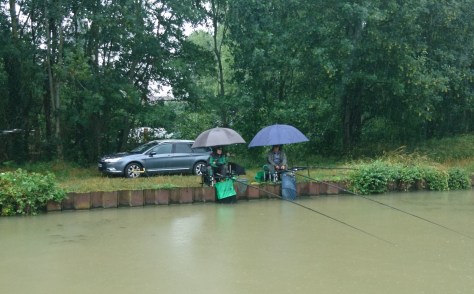
The next day was wet and rainy.. not that it deterred the ubiquitous French anglers. I reckon most Frenchmen would fish in a puddle… after all, they’ve spent a fortune on equipment!

2018-06-12 14.16.14

After a long wet day we arrived in Châlons-en-Champagne, scoring the last available place at the port. we had not expected much of Châlons, the last outpost of the champagne-producing region, but we were pleasantly surprised. A fine cathedral and church, some lovely 16th-century half-timbered houses and handsome 17th-century stone residences, a nice square and a couple of lovely parks, and an excellent marché couvert made us wish we were able to spend longer here, and vowing to return as soon as we can.

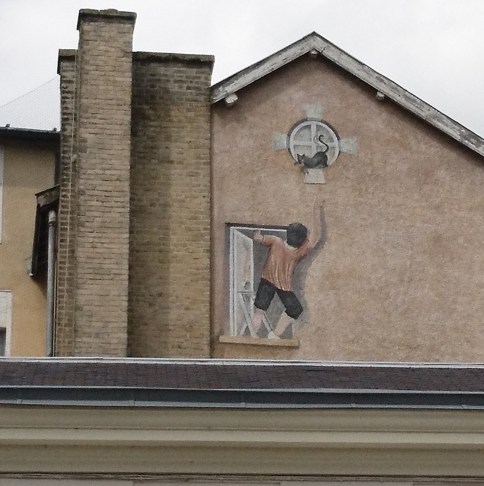
Châlons-en-Champagne is the birthplace of humourist-satirist Pierre Dac (aka André Isaac), best-known as the inventor/creator of the “schmilblick”, an imaginary and utterly useless object which can be used for anything, being ‘rigorously entire’. It became popular in the French vernacular, and “pushing the schmilblick” (faire avancer le schmilblick) now means ‘providing a small amount of help to a large problem’. It appears Châlons has inherited some of Dac’s sense of humour….

2018-06-13 11.16.50

Everywhere we travel in France, we witness examples of the devastation wreaked by the Revolution….. closed and ruined churches and abbeys, defaced and decapitated statues, destruction of places and objects from hundreds of years before. In Châlons-en-Champagne we saw an example of the Church doing that work itself, 30 years before the Reign of Terror and the Committee of Public Safety. The Cloister of Notre-Dame-en-Vaux, built in 1170-1180, was demolished in 1759 by the canons of the church to provide building materials for their row of houses. The Museum and Garden on the site, excavated and created in the 1970s, provide a fascinating insight into what was lost for the priests’ comfort.

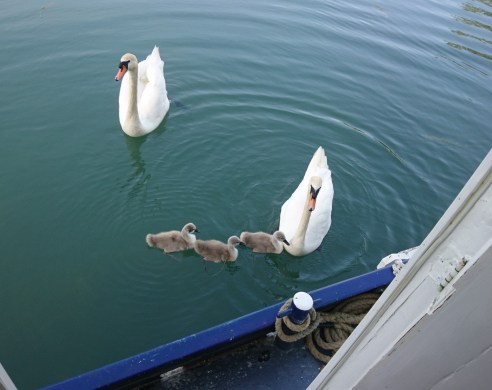
On the morning of our departure from Châlons-en-Champagne, a family visited to bid us farewell from the land of Champagne. And maybe to join us for breakfast.

2018-06-14 08.20.20


Towards the Marne

It was such a delight to be on the move again after all the work we had done on Eben Haezer in the port at Saint-Florentin…. getting back into the rhythm of slow, calm movement along the canal, the neat little lock-keeper’s cottages with their garden gnomes, and of course the lunch-break stuck in a lock for the éclusier’s lunch. On our first day we made it as far as Migennes, at the very end of the Canal de Bourgogne, ready to enter the river systems of the Yonne and Seine.

The next day we went through the last lock on the canal and entered the river, increasing our speed and covering a good distance to Villeneuve-sur-Yonne, where we endured a vigorous downpour before the evening turned calm and mild.

Our next stop was at Pont-sur-Yonne, modern pontoons without services, but a pleasant walk over the bridge to a riverside park and walking path, and a welcoming little bar in the town square for a pre-dinner refreshment.

The next day we made good progress to Montereau-fault-Yonne,, at the river’s confluence with the Seine. We reacquainted ourselves with one of our favourite friends along the waterways,  Thierry, who used to be responsible for managing the municipal mooring, which is now absolutely chaotic since the authorities withdrew their agreement and basically abandoned the place to chance. Thierry found a mooring nwhere we could not, and ensured we were able to connect to water and electricity. Wonderful man!

2018-05-26 09.01.59

We experienced a very pleasant awakening at our next stop, on the Seine at Melun. We had previously formed the impression that this was a necessary but not very attractive mooring, buffeted by the wash of large commercial vessels. We found this time that the town has charms if you seek them out beyond the immediate environs of the quay., and we enjoyed a lovely meal at L’ Atelier des Saveurs just off one of the little town squares, where live music entertained the dinner crowds..

After spending the next night at a waiting pontoon before one of the big river locks on the Seine, we endured one of the hardest, longest days  – 9 hours in total – that we have so far experienced on the European waterways. We had to deal with lots of major commercial traffic. In itself this is not normally as problem, but coming off the Seine into the lower reaches of the Marne, we were forced to wait for extended periods on precarious dolphins as the big vessels and tourist boats were given priority into the difficult high locks, and we then had to follow them through narrow tunnels before we could emerge into the easier sections of the river. It didn’t help that they were laden the aromatic garbage refuse of Paris!

The rigours of the day were more than compensated by the delights of our first stop on the Marne, at Lagny. This delightful town offered peace, calm, a good bistro and an excellent boulangerie/patisserie, which was nearly everything we might have wanted. It also boasted the very atmospheric abbatial church of Notre-Dame-des-Ardents, an attractive church with an interesting history and a connection with Joan of Arc. Plus a very excellent tourist office. We spent a couple of lovely days in this delightful town.

We were now well and truly on the Marne River, cruising our way westwards to the delights and indulgences of Champagne.


Our Third Season

After a delightful southern summer in Australia, we returned to France in April 2018 to start our third season of cruising through France on Eben Haezer. We arrived in Paris to rain and a rail strike, so we delayed our travel to Saint-Florentin by a day and stayed overnight at a lovely little hotel at the airport, the Citizen M. On April 10 we made our connections from Charles de Gaulle to Paris-Bercy and caught the train to Vergigny, where we were met  at the station by the port capitain Vincent. It was wonderful to get back on  board and to reconnect with friends – our lovely group of local residents, as well as our Welsh friends Terry and Linda, on their new boat.

We were so pleased to be back on board and planning our longest season so far. We had plotted a circular route that would take us up the Marne River into the Champagne region, then south towards the Sâone River, before heading eastwards along the Canal du Centre and down the Loire Valley, heading north again up the Canal de Briare and the Canal du Loing, then returning along the Yonne to winter once more at Saint-Florentin.

Unfortunately, we found Eben Haezer in a state that required a significant delay to our plans. Weather and time had taken their toll on her condition; the decks were all filthy and stained from leaves and twigs that had fallen during the autumn and winter, and there were areas where the paint was old and dangerously smooth and slippery, or where small pockets of rust needed treatment. More seriously, we found that sections of the wooden wheelhouse had suffered water damage from rain and snow… not only were there sections of major timber rot but gaps had opened to allow more water to invade. Urgent repairs were called for. So we motored a few hundred metres along the canal to the chantier workshop, moored up and got things ready for scraping and painting, as well as engaging professional help from Nicolas at the chantier to effect the repairs to the wheelhouse. We were to stay here for the next month.

2018-04-20 13.13.48

As we worked away on painting the decks – when wind and falling blossoms, or else rain, didn’t slow us down – Nicolas got to work repairing the woodwork in the wheelhouse. The more we peeled back and removed, the more serious it seemed, and all Nicolas’ skills in filling and packing and cutting in new sections of timber were called into play (he even called in another specialist to cut certain sections to size using off-cuts from his personal collection of fine timbers). Then, of course, extra work developed, when for example the big window panes that needed to be removed to allow repairs to the timber were accidentally cracked and needed replacement. It’s only time and money! At least we were able to replace the windows with a heavier gauge glass, so I suppose there was a bright side.

We were absolutely delighted, though, with the job that Nicolas did, and the repaired sections of the wheelhouse looked as good as we had ever seen them. We also were able to congratulate ourselves on the job we did in repainting the decks and the wheelhouse roof; Eben Haezer was starting to shine again. We scraped back dozens of small areas of rust or exposed steel, patched them with undercoat and used a non-slip paint on the decks, and the results were very pleasing.

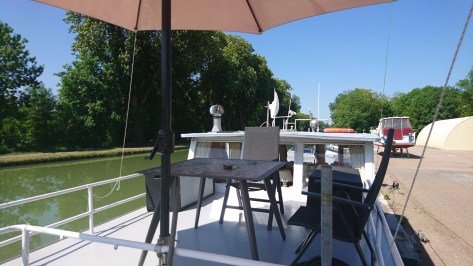
We also managed to offload some unwanted furniture and bought a smart new stone-topped table for our rear entertaining deck. Very schmick!

2018-05-08 11.43.54

We did some other repairs and upgrades, including replacing an aerial for our AIS navigation transponder, and some work on our electrics – installing some lovely big new solar panels and with a smart solar inverter from Victron, as well as finally reconnecting our house battery and engine battery banks with a smart isolator (Victron again).

The time we spent in dock for repairs was also used (and needed) for the process of finally securing my carte de séjours, or long-stay visa, from the prefecture in Auxerre. I had been issued with a temporary one before we left France the year before, and it now required only three more visits (naturellement) to be issued with the shiny new laminated card that allowed me to stay in France for 12 months… well, actually only 6 months, since my original application had been submitted the previous October.

2018-04-27 17.36.08

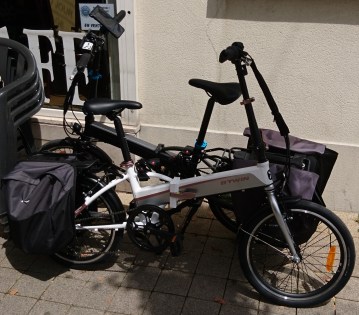
We took the plunge on new bicycles as well… we bought electric bikes from the Decathlon chain of sports stores, figuring they would help us get further, quicker when we wanted to cycle to towns or sites further away from our moorings along the canal or up hills that might have pout us off if we had to rely on our trusty old manual bikes.

2018-06-03 13.21.30

Our extended time in the port at Saint-Florentin stretched out to nearly 6 weeks, putting a serious dent in our plans for a leisurely circle route for the 2018 season. It did, however, also allow us the luxury of spending time with friends we had made and whom we might not see again for a while. We enjoyed more than one sociable al fresco dinner party or BBQ in the port’s little park, and we were also able to host our generous English friends John and Sue for dinner, for their company but also to thank them for all the assistance they had given us during our sojourn. They had driven us several times the 30 or 40 kilometres to Auxerre for official business or shopping for equipment – on the condition that they could visit a big-box shop or, more importantly, enjoy lunch at their favourite Auxerre bistro. We were delighted to share a meal on board with them shortly before we left.

Finally the time came when the major tasks were done and the itch to get moving needed to be scratched. We could almost feel Eben Haezer willing us to get moving, and our resident heron waited impatiently to guide us along the canal. On May 22 we finally set off towards the Yonne and the Seine and our 2018 aventures fluviales.

Summary of our second season

We started our second season in Épinal in the Vosges Department of the Grand Est Region and ended it in Saint-Florentin in the Yonne Department of the Bourgogne-Franche-Comté Region. We arrived in Épinal in late April our cruise lasted from May 18 until September 12; we left Saint-Florentin and returned to Australia on 23 September.

We travelled on the following waterways:

  • Canal des Vosges
  • Las Petite Sâone (La Sâone Haute)
  • La Sâone Basse
  • Canal de Bourgogne
  • La Yonne
  • La Seine
  • Distance covered – 882 kilometres
  • Locks – 330
  • Tunnels – 2
  • Days of travel – 49
  • Days of rest – 79
  • Average hours on travel days – 4.33
  • Average daily distance – 18.0
  • Average speed – 4.2 kilometres per hour
  • Fuel consumption – 720 litres @ 3.4 litres per hour
  • Cost of fuel – total €1100 @ €1.48/litre (inc. delivery)
  • Cost of mooring at Épinal (19 days) – €5 per day, including water and electricity plus wintering for 4 months @ €3 per day (no facilities)
  • Cost of mooring while cruising (128 days) – varied from free (with or without facilities) to €62 per day, including water and electricity
  • Total cost of mooring – €520 @ €5 per day plus €1364 @ €62 per day in Paris
  • Cost of winter mooring 2017/2018 (without facilities) – €120 per month, payable in advance October-December, remainder on return
  • Cost of meals eaten at cafes and restaurants – €12-€40 per head (exc. drinks)
  • Estimated cost of meals for two people, eating out 4-5 times/week – €2800 @ €155/week
  • Estimated cost of wine and other drinks – €900  @ €50/week)
  • Estimated cost of groceries – €1800 @ €100/week
  • Total cost of mooring, fuel, food and drink – €7800 @ €1730/month
  • Cost of maintenance, repairs spares and upgrades – €500

includes oil for transmission and engine + small electric oil pump; paint and painting equipment; hand tools and small electrical tools

  • Marine insurance – €900
  • Cost of household items and upgrades – €300

includes rugs, shelving, manchester, decor, plants, other sundry items

Moored up in the City of Light

You’ve probably read and seen so much about Paris that t seems a little like there’s not much we can add. And there’s so much to this magical city that whatever we do have to add could only ever be snapshots of highlights. But it was our first visit, we were as excited as little kids, and we want to share our experiences with you. So bear  with us!

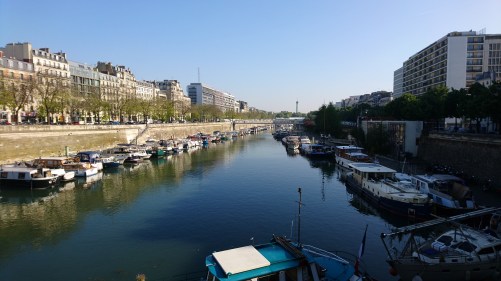
If you are going to spend a couple of weeks or three in Paris, there’s probably not a much better way to do it than on a boat, moored in the Port de l’Arsenal. It’s very central (inner 11th Arrondissement, right by the Place de la Bastille and a few paces from a handy Metro station; it’s one of the cheapest options around (it cost us around €42 per night, at the height of High Season, with power water and showers/laundry included and, of course, we had the option to cook at home rather than eat out every meal); and it’s a safe, open, picturesque and sunny spot (with gates closed at sundown, keyed access, and 24-hour security guards with dogs). We loved it.

DSC_0043

With one or two exceptions (e.g. Le Louvre) we didn’t visit iconic tourist facilities like the Eiffel Tower and Notre Dame. Life is too short to queue for 3 hours or more in the middle of a hot summer. We might try those at another time in low season if we ever have the chance.

We will try to give some flavour to our visit to Paris by sorting it into themes rather than chronology. There was just so much we could never do it justice, but some things really stood out for us.

Famous Districts

The Marais was only a few minutes walk from our mooring; we checked out this chic area on our first full day in Paris. Full of tourists, beggars walkers, cafes and shops. Its pre-Revolution houses and narrow streets retain much of what Paris looked like before Napoleon III and Haussman got their hands on it and bulldozed broad boulevards everywhere. It’s also a noted Jewish neighbourhood, with a museum, jewellers and some fabulous Israeli and Eastern European restaurants. 

Montmartre was naturally a must-see and it was well worth the walk up (we declined to take the funicular). Of course, it’s no longer a haven of artists and bohemians, who have long been replaced by tourists, hawkers, instant portrait artists and souvenir shops. But there is, along its narrow hilly streets, much of interest still. We enjoyed the Musée de Montmartre at 12 Rue Cortot, where Renoir, Toulouse Lautrec and Suzanne Valadon lived and worked, and the nearby Bateau-Lavoire, home at times to Picasso, Modigliani and others (sadly, after a 1970 fire, all that remains is the shopfront).  We thought the Basilique Sacre-Coeur was striking enough on the summit of the butte, but really, it is only a recent construction (1875-1914), its architecture is somewhat pedestrian neo-Romano-Byzantine, and its spirit a bit too nationalist and authoritarian for our tastes. It marked the beginning of the end for Montmartre as an artists’ village and the district’s incorporation under the control of the City. So a bit meh, for us, despite it being the second most-visited monument in Paris. 

Despite a degree of gentrification and tourist invasion, Saint-Germain-des-Prés is a wonderful district for a visit, especially if you plan to drink, dance, or eat. The centre of the Parisian “Left Bank” tradition of non-conformism and musical and intellectual foment, Saint-Germain’s narrow streets and alleys survived Napoleon III’s modernisations, lying between Hausmann’s Boulevard Saint-Germain and the riverside, as a dense complex of narrow streets filled with bars, clubs, restaurants, tiny hotels and bookshops… which has kept the invasion of tourist-tat vendors and souvenir shops to a minimum. Nevertheless, on any given night the streets are utterly crowded. We ate the best falafel ever, anywhere, at Maoz Vegetarian on the narrow rue Saint-André-des-Arts – where you help yourself to as much salads and condiments to top your falafel as you wish. Our bellies thus filled made it easier to reject the enthusiastic urgings of the doormen at almost every other restaurant in the district to come in and try their unique bounty. Maybe next time….. 

Butte-aux-Cailles was a district not so famous, and one we would probably never have visited, if we hadn’t been encouraged to by Guy, with whom we became friends in Paris, and who accompanied us to show us around. Located in the 13th Arrondissement, with a decidedly village-like atmosphere, it reminded us of Paddington in Sydney in the 1970s, before gentrification really took off. and workers could be found in small houses and apartment blocks next to larger, grander terraces, in this case often with lovely art deco influences. It’s obviously a pretty hip place, with a lot of street art and curated graffiti. 

Markets

Paris is blessed with a multitude of markets for food and bric-a-brac, although surprisingly not as many as we had thought before arriving, given the size of the city and the confirmed French love for good, fresh food and cheap bargains. Les Puces at Porte de Clignancourt are deservedly noted as the largest antique/bric-a-brac markets in the world… but we were not drawn magnetically, because the prices are not brilliant, we live on a boat (not much space for collections), and we would do battle with maybe 150,000 other buyers/gawkers for the privilege. We knew we could find more than enough little gems at regional brocante markets elsewhere on our travels. One advantage of our mooring location, however, was its proximity to the two best fresh food markets in Paris – the Marché Bastille (Thursday and Sunday) and the Marché Aligre (Tuesday-Saturday). During our time in Paris we basically lived off what we could buy at these two markets, and they are guaranteed marvellous experiences into the bargain. Nous les aimons!

The Marché Bastille is open air in the park space between the two arms of Boulevard Richard Lenoir running north from the Place de la Bastille. Maybe 60 or more stalls, including multiple fruit and veg, seafood, meats, cheeses, breads, and cooked foods such as BBQ chicken, paella, stews, gozleme and such. Yum. 

Our favourite and most frequently visited market was the Marché Aligre, in the 12th Arr. Every day except Monday we could tow our little shopping trolleys here to source some of the best, freshest food possible. Not just a multitude of stalls taking over the rue d’Aligre, but also numerous permanent shops behind them selling all kinds of scrumptious. Then we could enjoy a surprisingly excellent coffee and unsurpringly good pastry in one of several cafés before towing our loads back home. 

Gardens, Parks and Squares

Paris is blessed with a multitude of squares and parks large and small, but four stood out for us, places that we went back to again and again for their beauty and ambience, their use by all members of the community young and old, and their sense that one was sharing the communal spaces that Parisians cherished and enjoyed.

We discovered Place des Vosges early on, close to our mooring as we walked through it to reach the Marais and looked forward to walking it again on our way back. The oldest planned square in Paris, and originally named the Place Royale, it was the playground of nobility and the rich in the 17th and 18th centuries. Illustrious residents of the houses surrounding the square have included Cardinal Richileu, the renowned French orator Bishop Bossuet and the writer Victor Hugo. It is now enjoyed by families, couples and people on their way home from work. 

The Tuileries is a classic of Parisian open space, yet when we were there it was surprisingly uncrowded… despite the adjacent Place de la Concorde (leading to the Champs Elysee) being jam-packed. The Tuileries has seen a back-and-forth between playground for royalty and parkland for the public for centuries but for most of the past 200 years it has been public space, and was for a long time a favourite area for Parisians to stroll and seek cheap small-scale fairground entertainment. When we were there a small section was occupied by a ferris wheel, sideshow rides and galleries for the summer vacances. It’s also seen the installation of significant sculptures and statuary over the years. 

The Jardin du Luxembourg is a magnificent, multi-layered space that we visited on several occasions and were never bored or disappointed. Over its 23 hectares it includes orchards and an apiary, lawns, tree-lined promenades, magnificent beds of flowers, a basin pond with model sailboats, the Luxembourg Palace and the Medici Fountain (1620), as well as tennis, basketball and pétanque courts, covered areas for playing chess and draughts, a band rotunda, a puppet theatre and a carousel. It was also the site of the execution by firing squad of a number of insurgents during the Commune de Paris in 1875. 

We were introduced to the Parc des Buttes Chaumont by our Australian friend Sandy, who spent a night with us on his way through from Berlin to Barcelona. This 25-hectare park is in north-east Paris in the 19th Arr., created by Napoleon III in 1867. Before that it had not enjoyed a charmed life, being a site for the execution and display of the corpses of criminals, a refuse dump, a sewage dump and a horse abattoir, as well as a gypsum and limestone quarry. Now it contains a lake, a grotto, a miniature mountain with cliffs topped with a Tivoli-like Roman temple, grassy slopes and picturesque winding paths. On the day we were there it was obviously a place to enjoy the sunshine for a large number of Parisians… and very few tourists. 

Streetscapes and Life

There is an old term for people who walk the streets of Paris, detached, observing life – le flâneur. It has a raft of connotations and maybe it didn’t apply to us, but perhaps in some ways. In any case, we were in the city long enough to enjoy some interesting and often unexpected discoveries and observations.

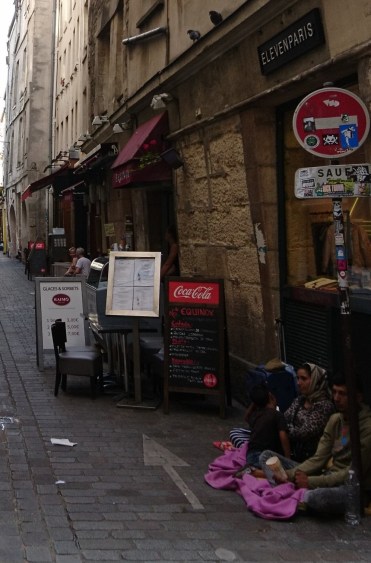
One thing we did notice… and definitely noticed changes even in the three months between our first brief visit in May 2017 and our return in August…. was the prevalence of refugees and poor migrants on streets and in parks. Often from Eastern Europe but also many from Syria and elsewhere in the Middle East, refugees were everywhere to be seen. In the Jardin Villemin between Gare de l’Est and Gare du Nord, for example, in May we saw nothing but people enjoying their lunch in the spring sunshine. By August, there were numerous small groups of men, clearly refugees, waiting for their papers to be processed. And in every district where crowds or tourists gathered, one frequently came across a family group squatting on the pavement, listless, patient, hopeful of a few coins. And always with their young children. It was an unsettling experience.

DSC_3060.crop

Other things we came across were much less sombre, and often humorous. We could not explain, for example, the pastry cutter shaped like a map of Australia, nor the kangaroo mascots with French lifesavers we came across in side-street shops.

And always examples of the whimsy and quirks of a great city…. be it someone who ignored the sign and put the bike up, not down, or an old man determined to bring a smile to every man, woman and child with his music and eccentricity.

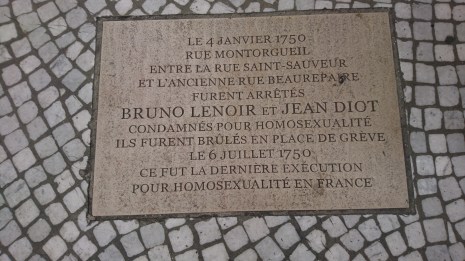
Sometimes, to bring you back to the sombre and meditative, you would come across a memorial or reminder of harsher days… like a memorial stone in rue Montorgueil in the 2nd Arr., marking the arrest and burning at the stake in 1750 of Bruno Lenoir and Jean Diot, the last execution in France for homosexuality. Paris today is vastly different!

DSC_2720

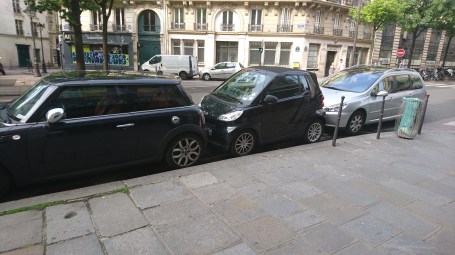
Parisian driving accords to a unique style… parking is similarly distinguished. We had no idea how this car got in or would get out!

DSC_2991

Always, though, in this marvellous city, no matter how busy or crowded or noisy or commercial or tourist-mad the spot you are in, there is, around the corner, a vista that will calm and please the eye and the soul.

dsc_2788.jpg

Boulangeries and Patisseries

Being bakers in our Australian lives, we made our visit to Paris a bit of a pilgrimage. Paris, after all, takes its bread and pastries VERY seriously; there are some 6,000 boulangeries and patisseries in the city, and it was only two years ago that a 1790 law was finally repealed that had made it compulsory for half of Parisian bakeries to stay open while the other half took holidays in July, and vice versa in August.

We managed to narrow our targets down to a dozen bakeries, two dozen patisseries and a handful of chocolate-makers. It made our 21 days in Paris a busy time!

Most boulangeries also make pastries – typically viennoiserie (think croissants, and danish), and simple tarts, rather than more complex creations – but we basically divided our visits into those who mainly did bread, and those who mainly or exclusively did pastries and cakes. The other thing to note is that when it comes to bread, the typical boulangerie’s overwhelming majority of sales is the baguette, although they will generally also offer a smaller selection of other varieties such as wholemeal, grain, rye and levain breads.

The internet is full of articles and blogs on the “best bakeries in Paris” so we won’t try to repeat that here, maybe just a few pictures of some of our favourites (scroll over the pics for their names):

There were a couple of boulangeries where we were lucky enough to meet the baker/owner, oddly enough both of them female, in a country where there are surpringly few female boulangers (boulangeuses?). The first was Ten Belles, a modern bakery/cafe in a residential neighbourhood near Canal Saint-Martin in the 10th Arr., founded by Alice Quillet. Alice was born in Paris but has some British heritage; she honed her skills at illustrious bakeries like Tartine in San Francisco and Mirabelle in Copenhagen. This heritage shows in her breads, which are hearty, sturdy levains, often laden with grains and very different from the usual Parisian fare. Plus she does decidedly un-French things like pies and breakfasts with toast and jam alongside ther more usual pastries. She gave us a warm welcome when we visited and introduced us to her lieutenant Mathilde. We are already looking forward to our next chance to visit.

The other highlight – THE highpoint – of our Parisian bread odyssey was meeting Veronique Mauclerc at her bakery in the 19th Arr., between La Villette and the Parc des Buttes-Chaumont. Veronique welcomed us like old friends, and her tiny bakery with its woodfired oven and small range of rustic traditional breads reminded us very much of our own operation back in Australia. She had just sold her bakery, after 30 years in the business, to the legendary Parisian bakery concern of Poilâne, and she invited us back in a week to celebrate her last bake and join in her closing-down party.

Many Parisian specialty patisseries are like little boutiques, with much emphasis on visual presentation. And some of the creations were truly stunning to look at, as well as indulgently delicious to taste. Our favourites, different in their own ways from each other, included the following:

Carl Marletti
Cyril Lignac
Hugo&Victor
Maison Mulot
Pierre Hermé
Popelini
Sadaharu Aoki
Stohrer
Jacques Genin
Un Dimanche à Paris

Whew!

Cafés and Restaurants

Still on the subject of food…… of course, Paris is famous for its restaurants and cafés, bistrots and brasseries. It’s probably one of the best large cities in the world to get a meal across a wide variety of cuisines, at just about any hour of the day, at reasonable prices. The first thought for many people is probably of classic French foods, but there are hundreds of restaurants offering Mediterranean, Middle Eastern, Afro-Caribbean, Asian and Indian cuisines, and more. Eating in Paris is not an “event”, nor merely sustenance; it is an essential part of civic and social life, to be shared and enjoyed to the fullest extent possible. Parisians do not eat in a car, and only very rarely on the move, from their hands . And there is no such thing as a 15-minute lunch. “Fast food” is almost unknown and, where you do encounter an American-style chain, it is a lonely and alien experience.

My first meal in Paris, back in May, had been at the opulent and ridiculously over-staffed Terminus Nord, opposite the Gare du Nord and was quintessentially Parisian.

Our last meal in Paris was equally French/Parisian, at Le Soufflé, in the 1st Arr. near Place Vendôme which, as its name implies, is a concept restaurant of long tradition that does nothing but soufflés, across all three courses.

In between these, though, we experienced a variety of meals including wonderful tagines at the little Moroccan La Kabylie off the Place de la Bastille; divine falafel and zakouskis with perfect Israeli gherkins at Chez Marianne in the Pletzl district of the Marais; equally good but even more generous falafel in flat bread at Maõz Vegetarian in Saint-Germain-des-Prés; Mediterranean delicacies at Da Rosa in Saint-Germain; and Portuguese custard tarts (pasteis de nata) at Comme a Lisbon near Saint-Paul in the 4th Arr.

Nor did we ignore our between-meals needs, with visits to the luxurious Angelina on the Rue de Rivoli and Ladurée on the Champs Élysée (both crowded but totally worth it!) plus the much simpler but equally delightful Lebanese ice-creamery Glace Bachir in the Marais.

You may not believe us when we tell you after all this food that we left Paris… indeed, we left France… lighter than when we arrived!

Museums and  Galleries

We are not going to post any pictures here, because we don’t know when we could stop. Paris has so many magnificent galleries and museums that you could easily spend a couple of months without reaching the end of the treasures and delights they contain. There was so much we did not get to, but we did manage to spend many hours in the Louvre (3 visits), the Musée de Cluny, the Musée de l’ Orangerie, the Musée d’Orsay, the Musée Nationale d’Art Moderne (in the Pompidou Centre), and the Musée des Arts Decoratif as well as the Musée de Montmartre, Sainte-Chapelle and the Palais de Justice. We visited Notre Dame but did not go in (too many people!)

Our visits to most of these places was made enormously easier and cheaper by purchasing a Paris Pass. Available at various levels and durations, these passes not only provide hefty discounts against the door price of the museums and galleries but they permit accelerated access, which was especially useful at places like the Louvre, where casual visitors without passes might have to queue for hours to get in.

Time with Friends

We were lucky during our stay in Paris to enjoy a visit from one of our dear Australian friends, the globetrotting Sandy Smith, on his way through from Berlin to Barcelona. We met him at the Gare de l’Est and strolled up to Panifica bakery/cafe at the foot of Montmartre for some lunch, before heading out to the Parc des Buttes-Chaumont, which Sandy insisted we should not miss. Sandy had made tentative plans to stay overnight with a friend in Paris but we insisted he stay with us on Eben Haezer, especially since it was only a short walk the next day to his train at the Gare de Lyon. He readily agreed and his friends Guy and Marcel joined us that evening for dinner on board. It was wonderful to catch up with our old friend, to entertain, and enjoy some great company. A few days later, Guy arranged to guide us to the Buttes-des-Cailles district in Paris, which we would never have discovered on our own and was a revelation (see section on Famous Districts above). Sandy also tried to give me some lessons in selfies, which didn’t immediately take hold, as some of the shots below readily indicate.

And so it came to our time to leave Paris on 3 September, after three wonderful weeks. We would now head back up the Seine and the Yonne towards our winter port at Saint-Florentin on the Canal de Bourgogne, with only a couple of weeks or so before we were due to return to Australia for the southern Summer.


It took us nine days to navigate our way back from Paris to Saint-Florentin, including a stop for a few days at the lovely port of Sens on the Yonne. We then had another 11 days to organise the boat and our affairs before leaving for Paris-CDG on the fast train for our flight back to Australia. The time flew as we busied ourselves with maintenance, painting, cleaning and winterising Eben Haezer, and applying for my carte de séjour in the regional prefecture office in Auxerre. All too soon it came time for Vincent, the wonderful capitain of the port de plaisance to deliver us to the railway station at Saint-Florentin-Vergigny. Our second season had come to a close.

Towards Paris

Now that we’d settled a few important things – our winter port, the paperwork for my long stay visa, a bit of maintenance – we could depart Saint-Florentin in a refreshed, relaxed state of mind, knowing we were under no pressure and that we could just cruise and enjoy ourselves. A week to Paris, a fortnight or more there, then a week back to Saint-Florentin. Bliss!

It was just as well we were feeling relaxed. We had advised the VNF that we would be leaving at 9.00am for the first lock on the edge of the port, but they obviously forgot and didn’t turn up until an hour later. Never mind… we had a pleasant cruise on a sunny day. We kept going past Brienon-sur-Armançon, which we were not particularly impressed by – lots of dirty old boats stacked up nearly on top of each other – and kept going another couple of hours to Migennes, the wide basin at the very end of the Canal de Boourgnon. Migennes has a long quay with services as well as a Le Boat hire boat base. As it turned out, it was smelly and noisy (major rail station opposite) and were not particularly impressed… we wondered why many people decided to winter their boats there. But it was handy, and we managed a decent pizza for dinner from the nearby hole-in-the-wall Pizza Mania.

The following day we set off through the last lock on the Canal de Bourgogne, lowering us down onto the Yonne River. Since leaving the Sâone about two months before, we had gone through 189 locks in 22 days of travel, or just under 9 locks in 12 kilometres for the average cruising day. We did a little fist-pump as we floated onto the wide expanse of the river. We would still have a few locks – but they would now be large and wide, as the river ran over weirs and barrages as it wound its way downhill towards the Seine. We could also let the engine out and travel, with the current, at about 12-15kph instead of the maximum 6kph we enjoyed on the canal. Zoom zoom!

It wasn’t all racetrack, though. We still had to pause for lunch inside Lock 4 at Villevallier, since for us the locks did not work through lunchtime, and there were no commercial craft to piggyback on. All the same, we pulled into Villeneuve in good time mid-afternoon, having travelled an amazing 28 kilometres through 6 locks!

The following day we set off originally planning to cruise a similar distance, to Pont sur Yonne but, when we arrived in Sens, there was good space at the quay, the town looked inviting, so we decided to check the place out. We were glad we did… Sens is delightful.

On the way, we came across a new kind of lock at Rosoy, peculiar to the Yonne, with sloping sides. There was a floating pontoon to tie up to, however, so it was no trouble. There are apparently a few of these further downstream, however, without the pontoon, so we weren’t sure how we’d go with those.

sloping-side-ecluse-8-rosoy-yonne2.jpg

Sens proved to be wonderful, with an excellent stone quay with services (although water access was eccentric and some power points were disabled because of recent floods). The town is charming, with a wonderful historic church (for centuries it was superior in the church hierarchy to Paris) and a fantastic covered market hall, which we managed to visit before departing the nest morning – a triumph of art deco ironwork and stained glass, with a marvellous array of vendors inside.

After leaving Sens we had a short hop to Pont sur Yonne, where we moored on modern pontoons without services, before travelling to Montereau-fault-Yonne, the confluence of the Yonne and the Seine. At that time the mooring at Montereau was pleasant and efficient (it has changed since, we can assure you!) and we enjoyed a delightful dinner of moules et frites (mussels and fries) at a little restaurant overlooking the river confluence.

Now we travelled on the Seine, heading towards Paris. It is a big river, but not yet wide enough to mitigate wash, with plentiful commercial traffic. It has to be said, though, that the large locks, of which there were only a few, were easy to navigate. We stopped overnight at Melun, where we felt constantly the weaves and wash and flow of big boats as they passed. Convenient but not delightful.

Our final stop before Paris was at the quai dáttente immediately before Lock 7 on the Seine. It was a somewhat desolate but nevertheless pleasant stopover, without services, but lightened with a delicious barbecue dinner we cooked for ourselves, before the final day’s journey into Paris.

Seine, Quai d'attente Ecluse 7 Ablon

And so it was, that on 12 August 2017 we found ourselves cruising the Seine into the centre of Paris. It was a far from relaxed experience, with a multitude of commercial and tourist boats bobbing up and down and speeding along the river, which was choppy and sloshy with all the traffic as we waited for the go-ahead to enter the lock into the Arsenal boat basin, but we had arrived. We were in the City of Light.

Paris - Bassin d'Arsenal.crop

Of chateaus and wine

The next leg of our journey would see us leaving the Cote d’ Or region of Bourgogne and entering the Department of the Yonne. The middle of July saw the sunflowers in France in full bloom and, as we cruised along the canal, we were treated to views of brilliant golden fields.

We had more mundane issues when we pulled into our next mooring at Ravières. As we completed our engine checks, we noticed that the transmission case had leaked a significant amount of oil into the collection box underneath, just above the bilge. This prompted me to check the automatic greasers along the propellor shaft, of which there were three. They were marvellous little gas-driven injectors, of the “set-and-forget” type. And I had forgotten. I normally changed them at the beginning of the season but they had plenty of grease left when we left Èpinal so I had left them in place. A bit too long. Now, with the extra effort of pulling through weed, the shaft had worked too hard and overheated the transmission, which had then ejected a far bit of oil. No damage, but an immediate need to replace the lost oil. Out here, in the middle of nowhere. After checking my online maps I located an agricultural machinery service place a couple of kilometres away, so I set off to cycle there, fingers crossed. Fortunately, I was able to buy some oil rated for large tractor transmissions, and I felt this would probably see us through until we could find somewhere with the real stuff. I kicked myself, then counted my blessings.

These mechanical tasks meant we missed the marvellous stained-glass windows in the 12th/15th-century church of Saint-Panteléon in Ravières, but not too much else in this small but attractive village. Like so many similar villages in France, it lost population continuously over the course of the 20th century, and today has only about half the number of inhabitants it boasted in 1910. Still, it has a boulangerie, a small supermarket, schools, a post office, a retirement home and a stone quarry. It persists.

Keeping a close watch on our gauges to make sure our transmission was OK, the next day we cruised three hours to Ancy-le-Franc, where we spent a couple of days. First order of business was the renowned Château d’Ancy-le-Franc. This 16th-century Renaissance marvel was designed by the Italian Sebastian Serlio with interiors by Francesco Primaticcio, both of whom worked at Fontaineblau. Its lofty ambitions were later continued by the work of landscape architect Andre le Nôtre, famed for his work at Versailles. The most notable features, however, are the amazing interiors, murals, motifs, trompe l’oeil and glazed tiles on every surface.

It was almost a relief to escape all this richness for a light lunch at the modest Bar du Chateau in town, before heading out on a bike ride to the nearby village of Chassignelles, for a look at the extraordinary Église Saint-Jean-Baptiste. This smallish 12th-century Romanesque church sits lonely on a hill above the village. With a roof of flat stones, its interior is a wonder of 12th and 13th century murals and paintings. On a very hot and windy day, we waited in the cool of its portico for the man to come and open the church for a couple of hours; he was a very keen and talkative guide and commentator and we even managed to understand some of what he said!

Back in Ancy, just by the Chãteau, we came across a 19th-century communal wash house, or lavoir, another of these facilities that dot the towns and villages of rural France.

Another nine locks down the Canal de Bourgogne (including one in which we stopped for the lock-keeper’s lunch break) brought us to the village of Tanlay. Another pleasant mooring in a wide basin, with a top little café/restaurant right by the quay, where we joined an extended family of English boaters for an excellent dinner of buckwheat galettes.

Tanlay’s claim to fame is another 16th-century Renaissance château, built around the same time as the château we visited in Ancy-le-Franc, but in different circumstances, this time by a leader of the Protestant Huguenot faction, Francois de Coligny dÁndelot. His death during the Wars of Religion meant the castle remained unfinished, until the work of its new owner Michel Particelli d’Hemery in the 17th century. It then passed to Jean Thevenin when he was created Marquis de Tanlay in 1705 and has been in the same family ever since. We especially liked the trompe-l’oeil work in the main gallery, and the frescoes in the original Tour de Ligue, where the Huguenot rebels met in secret… as well as the massive stables complex and the nymphaeum at the end of the “Grand Canal” within the grounds, separating the chateau from the neighbouring golf course.

We were looking forward to our next stop, at Tonnerre…. because we knew there were a number of interesting sites in the town itself, but also because it was where we would take a side trip to the wine village of Chablis. We didn’t know how we would do that yet, just that it was obligatoire. An easy morning cruise through six locks brought us to the mooring basin at Tonnerre; we spent the afternoon catching up on paperwork, researching our visit to Chablis and catching up with a New Zealand couple and their friends with whom we had played canal leapfrog since we had first met them back in Pont Royal. Part of our research and socialising revealed that we could catch a bus to Chablis the next day for the princely sum of €2 and return later in the afternoon for the same price via the Mobigo regional service. Problem solved; we rang the number, reserved our seats and planned to gather with our NZ friends at the SNCF car park at a bit after midday, trolley bags at the ready.

On the morning of our trip to Chablis we squeezed in a trip to the small but excellent covered market (marché couvert) in Tonnerre for provisions.

A 40-minute ride through picturesque wine country brought us into central Chablis, home to some of the world’s best Chardonnay and a miracle of recovery from the phylloxera decimation of the late-19th century and a slow decline up until the 1950s. The village itself is an attractive collection of old buildings, narrow alleyways, shops and winesellers, and we had a pleasant walk down the main street, to an old riverside lavoir and back to catch some sustenance before our tastings.

vineyards-nr-chablis2.jpg

We bypassed the Domaine de la Moutonne… it looked closed and, with mainly grand cru wines, it was beyond our range in any case!

Our target was La Chablisienne, a co-operative of growers and winemakers formed in 1923 housing a great representation of Chablis wines at various levels of quality, complexity and price. The tasting started well, with a couple of excellent wines, but it really got interesting when our NZ friends let it drop that they had owned a South Island winery some years before. When our host asked for the winery’s name, the answer produced a gasp and wide-eyed smile; she disappeared momentarily and came back with a couple of bottles… from that very winery! I’m not sure but I think this connection resulted in us tasting at least 7 different wines (a casual tasting usually gets only 3) as our host strove to introduce us to her range. Jane and I left with several cases stowed in our trolley bag, including Chablis “Les Vénérables”, Premier Cru “Les Lys” and a single Grand Cru “Les Clos” which our La Chablisienne host snuck into my hands as we were leaving, a fantastic, unexpected complementary extra!

We returned to our boat well satisfied with our outing and well-stocked to remember and enjoy it for some time to come.

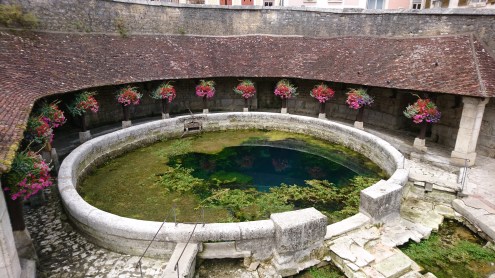
The following day, our third in Tonnerre, was spent wandering the town and exploring some of its sights. The most famous is the Fosse Dionne, a spring-fed pool with a prodigious flow of water averaging 300 litres per second. The town of Tonnerre was essentially built around this spring, and in the 18th century an eleborate lavoir wash basin was built to surround the pool.

Fosse Dionne, Tonnerre

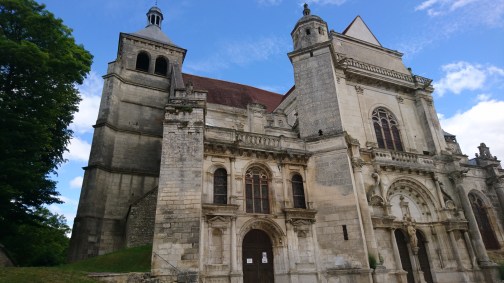
We then ascended to the Eglise Saint-Pierre, with its original foundation and choir surviving from the 11th century, its Renaissance side chapels dating from rebuilding works after fire in the 16th century, and its classical-style southern facade and portals from the completion of those works in the 17 century. It’s therefore quite a mix, but very imposing and commanding a great view over Tonnerre.

Eglise Saint-Pierre, Tonnerre3

Back in the centre of town we had a look over the Hotel-Dieu, the 13th-century hospital for the poor built by Margeurite de Bourgogne. At the time it was the longest medieval hospital in Europe. After 350 years it was replaced as a hospital by a new adjacent building and it became a chapel and mausoleum, then a market after the French Revolution, before being declared an Historic Monument in 1862. It contains the tombs of its founder Margeurite de Bourgogne (died 1308) and the Marquis Louvois, Count of Tonnerre (d. 1691). The space inside the Great Hall of the Poor is impressive, as are the 16th-century altar and the sacristy with its 15th-century marble Mise en Tombeau.

Leaving Tonnerre we travelled to Flogny-la-Chapelle, a somewhat out of the way place but where we had expected to find a stone mooring with services. To our disappointment when we arrived, much of the quay had collapsed into the canal, we had to moor alongside another boat that had already arrived, and there were no services to be had. A shame, as it was quite a pretty spot. There were metal baffles ready to be driven into the bankside to repair the damage; we hope it won’t be too long before the work starts.

Passing on from Flogny, the next day we arrived at Saint-Florentin, where we found a pleasant, well-equipped and well-managed port de plaisance.

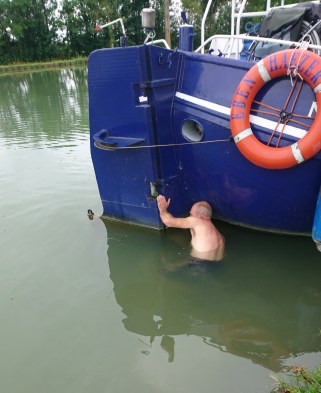
With a week in Saint-Florentin and in no hurry to keep moving, we took the opportunity to undertake some necessary maintenance and administration. First up, we stripped down for a swim and manually cleaned the weed and debris that had collected around the propellor and shaft. Then, with the help and advice of Didier, who ran the excellent marine works yard near the port, we had some specialist marine transmission oil delivered so we could empty and refill our precious gearbox.

cleaning-the-prop-saint-florentin3.jpg

Then we set about discovering the town. Delights included a couple of half-timbered houses, an historic church and old towers, and a market that operated on Saturdays in a market hall and on Mondays in the hall plus the surrounding streets.

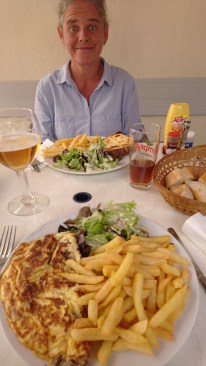
We also found a lovely little place for a beer, wine or casual lunch, the Café des Fontaines, where we could enjoy our new favourites – croque madame with frites, and omelette composée with frites. Bonnes frites!

Lunch, Cafe des Fontaines, Saint-Florentin

Saint-Florentin, we found, is also blessed with an excellent supermarket, a couple of very good hardware stores, a garden centre, several boulangeries and butchers and various other commercial services. There is a nearby rail station with services direct to Paris. The marine atelier was a useful facility for any work we wished to do or have done – mechanical, painting, repairs. And the capitain of the port de plaisance, Vincent is an absolute gem – good-humoured, endlessly helpful, fluent in English. It didn’t take us long to change our plans for the season and decide to make “Saint Flo”our winter port, where we would leave Eben Haezer in mid-October for six months when we returned to Australia. There was an added bonus:  because we no longer needed to travel so far to a winter port such as Briare, we could afford to spend a good length of time in Paris – an idea which, in its own regard, of course but also after so much rural cruising, took on a brilliant shine.

As a result, we decided to travel to the regional prefecture in Auxerre and apply for my carte de séjours, or long stay visa, using the port at Saint-Florentin as our residential address in France. This was to be the first of several trips to Auxerre, we were sure (not just because French bureaucracy would demand it), and we were delighted to find it a beautiful, welcoming, historic, buzzy town.

We entrusted our paperwork to the prefecture in Auxerre and were told to return in a couple of months for the next stage of the process. Having read all kinds of stories of woe concerning the barriers to gaining a long stay visa, we found it no so difficult so far and could only resolve to deal with things as they emerged.

Cruising westward down the Bourgogne

From Pouilly we were faced with a few challenging days as we scaled down from the summit of the Canal de Bourgogne through a series of lock “chains”, with several days of up to 19 locks to navigate each day. From Pouilly to Pont Royal = 13 locks, the first 12 of them in only 7 kms; Pont Royal to Marigny-le-Cahouët = 13 locks in 11.5kms; Marigny to Pouillenay = 19 locks in 5.7kms; Pouillenay to Venarey = 10 locks in 4.5kms. Fortunately, we were aided by the efficient travelling lock-keepers and managed to complete our daily passages fairly quickly and without incident. The countryside we passed through, when we had a chance to take it in, was beautiful and enchanting.

Our first stop was Pont Royal, a tiny village in the middle of nowhere. We spent a couple of pleasant days there, with power and water provided by the Maison du Canal at the halte (which also operated as a Maison d’hôtes  or B&B). The village restaurant, Le Pont Royal was a typical roadside cafe/bar but was unfortunately closed for meals during our stay.

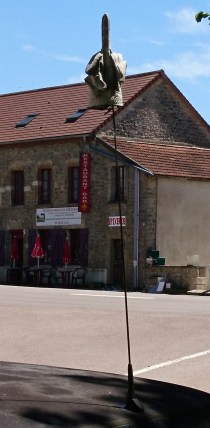
One of the local residents clearly had an unsubtle sense of humour, judging by the decoration on his car’s radio aerial….

Pont Royal

We only spent one night at the next stop in Marigny-le-Cahouët, but we received a pleasant surprise when we visited the nearby Château de Marigny-le-Cahouët. This castle was originally built in the 13th century by Montaigus of royal blood, then remodelled in the 17th century and restored in the 19th century. It was acquired by the family of the current owners in 1962 and early on was the location for the noted French film Angélique, Marquise des Anges. The day we were there, work was being done restoring the wonderful Burgundian tiled roof; we admired the walls and the moat and the gate but did not expect to see inside, since it is a private property. As we were about to leave, a voice came from one of the huge old windows… a young girl cried out to us, asking if we wished to come in. Of course we did! She was the daughter of the current owners and she and her friend guided us around the main interiors of the castle, clearly pleased to be practising their English. We were delighted.

After a long, hot day with many locks out of Marigny, the calm quiet of our solitary mooring at Pouillenay (no services) was a chance for a restful afternoon, and later a walk through the village.. not a lot there, but neat and quite attractive, mostly modern building styles with an occasional touch of old French rural.

Another slog of 10 locks brought us to Venarey-les-Laumes – only 4.5kms further along the Canal, accomplished in under 2.5 hours. We had to settle for an uncomfortable temporary mooring nearly under the bridge and against the rocky canalside, until a couple of large hotel boats departed and we claimed a spot along the quay. To be honest, although the port included a Nicols hire boat base and marine shop, it was a little bit run down in many respects. The town was interesting, all the same, with a pleasant bike ride through a park to reach the town centre, which boasted all the services one could wish for.

Mooring, Venarey

Our main interest in Venarey lay in the nearby Gallo-Roman ruins of Alesia, the site of Julius Caesar’s last and greatest battle against the Gauls, under their leader Vercingetorix, in 52B.C.  After the battle the Gallic town was occupied and rebuilt by the Romans and today the archaeological diggings have uncovered a treasure of fascinating relics and ruins of this significant town, while further diggings have uncovered extensive evidence of the extraordinary siege fortifications built by Caesar in the weeks and months leading to the decisive battle… which saw the besieged Gallic forces of 80,000 and their reinforcements of 100,000 or more overcome by a Roman-Germanic force of 60,000. We caught a taxi to the site and spent a couple of hours wandering the remains of houses, arcades, forges, bathhouses, theatre and basilica, before our taxi returned to take us back to the boat – but not without a detour to see the bronze statue of Vercingetorix commissioned by Napoleon III in 1865

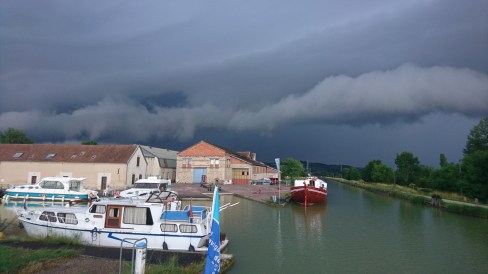
I am tickled pink to report that once again we defeated the best efforts of bad weather to deter us…. it rained in the taxi out, stopped for our walking tour of the historic site, then began again just as we got back into the taxi and thundered down once we got back to the boat.

Storm over Venarey

While in Venarey, we also enjoyed a visit to the modern interpretive museum attached to the historic ruins, known as the MuséoParc Alesia – a modernist building within a large park with a recreation of the siege fortifications. Inside there are various interpretive displays and we managed to catch a rather quaint performance of a battle between Gallic and Roman troops.

We also managed to fit in lunch at Bistro de Louise, a delightful restaurant with modern minimalist interior, tiny open kitchen and truly delicious menu.

Our next stop was the provincial town of Montbard, where we hoped to enjoy three principal points of interest: the Parc and Musée of the town’s most famous inhabitant, the Comte de Buffon; Bastille Day celebrations; and a visit to the nearby Abbaye de Fontenay.

After a pleasant morning’s cruise we elected to moor at the old port near the railway station, in preference to the newer port de plaisance further along. We felt this was closer to the action in town and had more space for larger boats. We tied up right outside the VNF (French Waterways) offices and set off to explore the town.

The Parc de Buffon sits on a hill overlooking the town. Not much remains of the château, originally built in the 11th century and transformed by Buffon into kind of botanic gardens and zoo dedicated to his studies in natural history. Today it makes a pleasant walk before diving into the crazy, eclectic collection of oddities preserved in the Musée de Buffon by its side. Buffon, born George-Louis Leclerc in Montbard in 1707, was a naturalist, cosmologist, mathematician and encyclopédiste in the age of Voltaire, with whom he corresponded. He was the director of the Parisian botanic gardens, the Jardin du Roi, for nearly 50 years, and he was a member of both the French Academy of Sciences and the Academie Francaise, as well as an Honorary Member of the American Academy of Arts and Sciences. He propounded a number of ideas that could be considered loose precursors of Darwin’s theories of evolution a hundred years later. Today there is evidence of Buffon everywhere in Montbard – statues, the Parc, the Museum, street names. What you will not find is his body; although he was buried there, during the French Revolution his grave was looted for the lead casing to make bullets, and his body parts were lost…. except for his cerebellum, which was preserved in the base of the memorial statue and is today located at the Natural History Museum in Paris. Weird, what?

Our second visit of interest in Montbard was to the Abbaye de Fontenay, about 6kms from town. It was built in the early 12th century by Saint Bernard of Clairvaux (whose mother Aleth was born in the Château de Montbard), and is one of the oldest and most complete Cistercian abbeys in Europe. It was declared a UNESCO World Heritage Site in 1981. It is a remarkable collection of gardens, dormitory, cloister, chapter house, church and forge. Its forge from 1220 was the first metallurgical factory in Europe and was the original hydraulic hammer, fundamental to later industrial manufacturing. Its spirit of austerity and self-sufficiency (in reaction to the worldliness that had become attached to the great Benedictine Order based in Cluny) is obvious even today, although it hasn’t been home to any monks since the French Revolution. It was turned into a paper mill by the Montgolfier brothers (of hot air balloon fame) and was extensively restored in the early 20th century by a Lyon banker, whose family still owns it today.

In the run-up to Bastille Day, we took the opportunity to stock up at the excellent covered market (marché couvert) in Montbard, a wonderful facility in a small town of only 5,000 people.

Some towns and villages in France celebrate Bastille Day with fireworks on July 13; others hold them back for Bastille Day itself, and this was the case in Montbard. The night before, we celebrated the Fireman’s Ball, or Bal de Pompiers. In France, most firefighters are volunteers and the Fireman’s Ball is a special occasion. We enjoyed cheap beer, cheap seats and easy dancing.

Bastille Day itself was as thoroughly French as we could have hoped for. We started the evening with a meal of oefs en meurette and escargots; then we followed the Pompiers’ Parade with the children carrying lighted lanterns to the old bridge across the Brenne river, where we took up our positions to watch the fireworks. There was a marvellous atmosphere of family celebration, but the serious side of the occasion was brought hoke by the narration that boomed out from the public address system. We witnessed something I’ve never seen before: from time to time, the fireworks would continue bursting in colour above us, but somehow in silence, as the narrator spoke about patrimony, loyalty, community and heritage. Then the noisy fireworks would begin again, only to turn silent again a few minutes later for more narration over the PA. Extraordinary! Overall, it was a wonderful celebration of France’s national day…. patriotic but not jingoistic, joyful but not drunken, ritual but not mindless.

After a thoroughly memorable and enjoyable few days in Montbard we bade farewell and set off for our next stop, which was only 7kms and 5 locks further along, at a wild mooring adjacent to La Grande Forge de Buffon.

Mooring, La Grande Forge2

We had already come across the Comte de Buffon at Montbard; the Grande Forge was the naturalist’s experiment in metallurgy. Built from 1768 with land and money he inherited from his mother, the forge never really was on a commercial scale, but is a fascinating insight into Enlightenment venture into industry. Apart from manufacturing ironwork for the fences and gates of the royal botanic gardens in Paris that he directed, Buffon also tried to use the forge to conduct experiments on the age of the Earth and research for his work in The Supplements of Natural History. Predictably, he ran into trouble for doing so from the Church and the Sorbonne. The complex he built here is a remarkable integrated collection of industrial works, managers’ and workers’ accommodation, and associated infrastructure such as vegetable gardens, bakery, chapel, dovecote and orangerie. On a small scale, a sort of self-contained early industrial age version of a monks’ abbey like the one at Fontenay with which he would have been very familiar.


Climbing the Canal de Bourgogne

Before we left Dijon, I decided to have a go at my first effort at splicing rope. I had bought some lengths in Saint-Jean de Losne, and needed to create a loop for one of our new mooring ropes. It was fine rope and I didn’t want to muck it up. I think I managed a good job… and subsequent intensive use has proved its longevity. I quite enjoyed it…. I might take it up as a hobby!

A couple of days after our unforgettable tour to the wine country of the Cote d’Or, we set off from Dijon to continue our journey along the Canal de Bourgogne. The canal starts fairly soon after Dijon to climb into hilly country, in contrast to the plains we have left behind. Our first night was spent in the fairly forgettable village of Velars-sur-Ouche, moored outside the supermarket, with a decent boulangerie but with not much else to recommend it. The next day, however, we arrived at Lock 34(S), Ecluse de Banet. This was more like it! This mooring is run by a couple who lease the lock and lock-house, and who have turned it into a shop, cafe and delightful stopover. Electricity and water for a few euros per night, a delightful ambience, a place to savour. The cafe was closed when we were there but we bought a few pretty nick-nacks from their shop as gifts for friends back home. We shall return!

As we proceeded up the canal, our surroundings became more and more picturesque and we felt ourselves enveloped in a soft blanket of calm and peace. We had left the city behind and we felt things unrolling in a decidedly slower fashion.

Canal de Bourgogne, nr Banet2

The next day brought us to La Bussière-sur-Ouche, a pleasant stop in a sweet little village, but without much in the way of services or commerce. Our highlight here was a visit to the Abbaye de la Bussière, a remarkable 12th-century Cistercian abbey that had been broken up in the Revolution, renovated at the end of the 19th century, donated to the bishopric of Dijon, which then granted it to a friends’ association, before it was sold in 2005 to an English couple who have transformed it into a luxurious estate and hotel/restaurant. Its grounds and buildings are amazing and it has a Michelin-star restaurant and bistro where we enjoyed a magnificent lunch.

Back at our mooring, walking along the canal below the village, we were reminded of how proud many French people are of their gardens, and how so many of them lovingly tend to their vegetable plots. Food in France is relatively cheap, fresh and readily available; with so many domestic veggie gardens, it’s little wonder shops and supermarkets offer superb variety at low prices… if they didn’t, the French would simply grow it!

Our next stop was at Pont d’Ouche, another village in the middle of nowhere, but a very lovely mooring with a sweet little bistro attached to the port. The proprietor, Sonya, is an absolute gem and made our stay worth every moment.

After a couple of days at Pont d’Ouche we set off quite late, on the advice of the VNF, and settled for a mooring at Crugey, a small village by the busy Autoroute de Soleil. It was pleasant enough, without services, and we were lucky to enjoy a delightful meal at Le Chemin bar/restaurant, where I had the best whitebait so far experienced in France and some really good scalloped fries.

The next day a short morning cruise brought us to Vandenesse, a pleasant mooring not far from the famous 15th-century fortress at Châteauneuf-en-Auxois. We spent three lovely nights here. On the second day we rode up to the hilltop Châteauneuf, a very hot and very difficult climb on our bikes! Not at all for the first or the last time (we have been miraculously blessed in this regard), the weather gods smiled on us: the ride up was sunny, but as soon as we entered the chateau and its museum it poured with rain, then stopped when we emerged for lunch, a walk around the village and the ride back, then bucketed down again just after we stowed our bikes and were comfortably inside.

The château and its surrounding village are delightful and fascinating and would reward an extended visit. First constructed in the 12th century by the lords of Châteauneuf, whose reign came to a sad end when the last heir, Catherine was burned at the stake in 1456 for poisoning her husband, it passed to the Dukes of Burgundy and their favoured advisors. It passed through various hands over the next 500 years, undergoing the usual ritual defacement in the Revolution, and eventually was handed to the state and, with the surrounding villlage, was declared a ‘monument historique’ .

The views from the château and the village were outstanding. The village itself was also charming, with many narrow alleys, stairs and lanes, many small shops and ateliers and studios, and a very pleasant cafe/restaurant.

Our last treat in Vandenesse was lunch on our last day at Chez Lucotte, a small restaurant opposite the port, one of those treasures of regional France, a country restaurant for workers with great food and atmosphere. A menu that offers little variety, a small carafe of wine and a large basket of bread at every setting, and some classic French dishes such as oefs meurette, boeuf bourgignon, a cheese course and creme brûlée, and absolutely no pain for the wallet. No tables for two, we shared our meal at long tables with the workers, and a few friends including a French photographer we had met a few days before at our mooring in Crugey and a couple of fellow boaters.

Cheap lunch, Chez Lucotte, Vandenesse

This sustenance and a good night’s rest prepared us for our work the next day, travelling through 8 locks and the tunnel (souterain) de Pouilly to reach the summit of the canal. One of the locks just before the tunnel was a riot of colour with flowers and a fascinating museum of old tools fixed to its walls.

Ecluse 4 Grand Pre, Canal de Bourgogne3

The Pouilly tunnel, at 3.3 kilometres, plus another 2 kms or so of narrow cuttings at both ends of the tunnel itself, was the longest we had navigated so far. We’d approached it with some trepidation, but in the end it was a breeze*…. although after 20 minutes of the one-hour passage, time seemed to stretch on an on and on to an eternity before the light at the end appeared and approached.

* Jane has reminded me that our tunnel journey was not in fact a breeze. It was over an hour in a very narrow, low, dimly lit, dank and damp underground tube. The air was so moist that we had to keep wiping the wheelhouse windows so we could see; and our windscreen wipers didn’t work, so Jane had to crawl out onto the foredeck to wipe them by hand. I later found that our electrics system has a quirk that means you can’t operate the spotlight (which was absolutely necessary) and the windscreen wipers (which would have been decidedly handy) at the same time. 

Pouilly itself is a broad stretch of the canal offering a large and convenient port, although there’s not much there and you have to walk or ride a distance into town for shops, services and cafes. Nevertheless ,it was a pleasant stay with some nice vistas and pathways for pleasant walks along the canal.

Pouilly represented the summit of the Canal de Bourgogne, at 378 metres above sea level the highest apex of any canal in France. We could  now look forward to falling down some 290 metres (in 156 kilometres) west towards the Atlantic coast… and only 112 locks until the Yonne River!