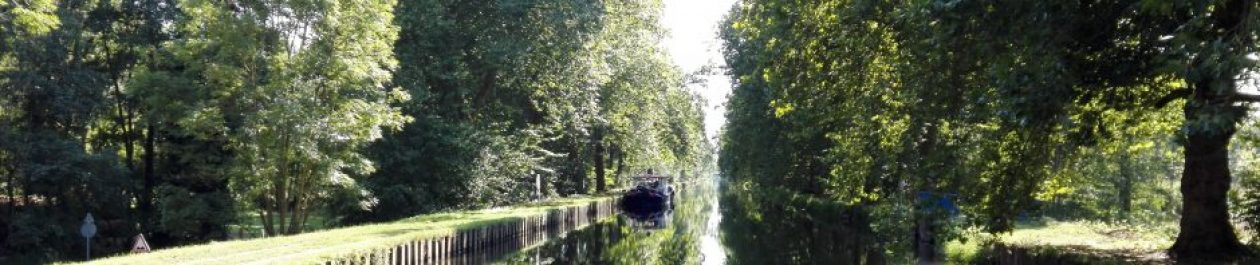
Down the Sâone

We had planned to cruise directly from Gray to Auxonne but the forecast was for a day or two of foul weather and possibly heavy rain, so we decided to get off the river to a little mooring at Maxilly, a short detour up the Canal entre Champagne et Bourgogne. There’s nothing much there, with a factory on the road opposite the mooring and the village a short bicycle ride away, but it was pleasant enough. To operate the electricity and water we had to cycle to the village, where we could buy tokens at the mairie, the boulangerie, and the hairdresser. The mairie and the boulangerie were closed, it being Saturday afternoon, but the hairdresser was open, so no problem. There is never a problem with a village hairdresser in France!
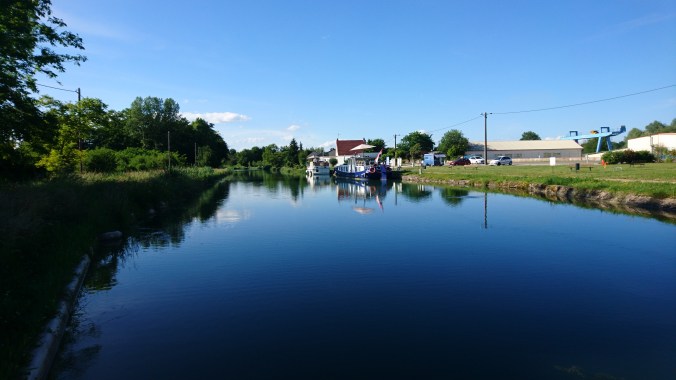
Maxilly-sur-Saone2

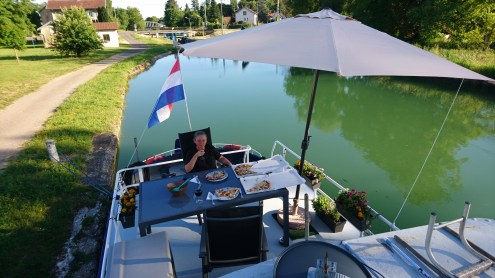
As we settled into our mooring, thinking about what we might cook for dinner, a van pulled into the carpark, at about 5.00pm. Over the next hour, an assortment of cars also pulled in, the driver or passenger approaching the van, before leaving again. Had we stumbled across a drug dealer’s rendezvous? After all, this was  more or less in the middle of nowhere, not a town square or main street but a featureless road between one small village and its neighbours. With some trepidation we approached the van for a better look. It turned out it was a woodfired pizza truck! The drivers had been placing their orders, to be picked up at an assigned time. So we did the same. Two fabulous artisan pizzas, full of flavour, cooked to perfection, enjoyed on our deck in the last rays of sunshine before the bad weather rolled in.

Pizza dinner, Maxillysur-Saone

When the weather cleared after a couple of days, we continued our journey down the Saone, to Auxonne – an interesting town which is well worth spending time in. It has a long history as a garrison town and was one of the chief defensive centres of Louis XIV’s noted military engineer Vauban: today the headquarters of the 511th Logistics Regiment, it was once home to an Artillery School where a young Napoleon Bonaparte first trained.

There are three choices for mooring in Auxonne; we ignored the well-appointed but expensive marina at Port Royal, and we also passed on the municipal pontoons where space was tight and in any case the services were switched off (damaged by that year’s winter floods, we think). We settled on mooring on the stepped quay just downstream of the old bridge, immediately by the Château d’Auxonne. This spot requires care with varying water levels but we figured we’d be OK, as long as we were also vigilant about wandering locals.

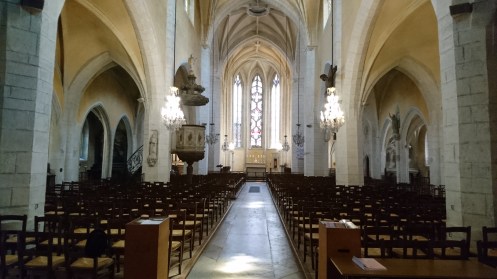
Auxonne has some excellent historical architecture – civic, military, domestic and religious. The Chateau d’Auxonne has elements dating from Louis XI, Louis XII and Francis i (15th/16th centuries) and was significantly enlarged and strengthened by Vauban under Louis XIV in the 17th century. The Eglise Notre Dame was commenced in the 13th century, with side chapels added in the 14th/15th centuries and the “crooked spire” of slate added in 1858. It has some impressive gargoyles!

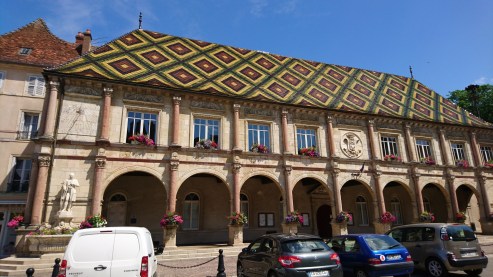
Notable civic and domestic buildings include the hotel de ville (town hall), originally built in the XVth century for the Dukes of Burgundy; some half-timbered houses from the 15th century, and a set of fine turned-wood stairs and balustrades from the 16th century on another old house. There are also various remnants of military construction from across the centuries – ramparts, gates and towers.

We particularly liked the half-timbered house of a local plumber, especially his unique but typically French sign advertising his trade.
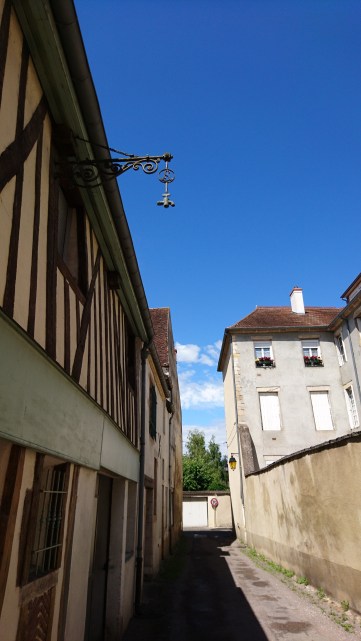
Auxonne25

We stayed two nights in Auxonne and, sure enough, the stepped quay where we moored was a popular hangout with young locals and fishermen, though it didn’t really cause too many problems. On our second day we were amazed to see the size of the fish one man pulled out of the river… absolutely massive, on a standard hand line. The river is apparently full of these monster catfish! (We thought the girl with the pink hookah was an interesting touch as well)
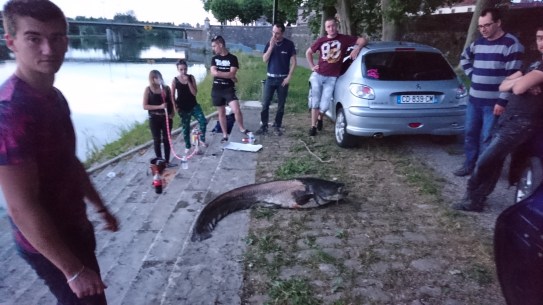
Giant catfish, Auxonne7

Auxonne has a number of excellent choices for dining, whether lunch or dinner (no catfish on the menu), but we recommend the Restaurant des Halles, where we had an excellent meal in the sunshine of the town square opposite the church.

From Auxonne we travelled down the Sâone to Saint-Jean de Losne, the self-styled “centre of the French waterways”, so-called because it is a convenient stopover or departure for trips along several routes – down the Rhône towards Lyon and the south of France, north up the Sâone, or up the Doubs towards the Rhine, or along the Canal de Bourgogne or the Canal entre Champagne et Bourgogne. The town itself is pleasant but fairly unremarkable, except for the large gare de l’eau or marina, several ateliers des bateaux or marine workshops for repairs and maintenance both light and heavy, and a large number of boats for sale.Almost everyone who travels the French waterways for more than a season or two ends up spending time at Saint-Jean. We moored on the stepped quay on the river, very pleasant and handy to the several options for riverfront dining along the quay. Our choice generally was Bistrot La Cotinière.

Having reached the wide reaches of La Basse Sâone, we became aware of how much commercial traffic the river still sustained. Every day brought a multitude of vessels large and small – peniches, massive cargo vessels (mostly carrying construction materials) and river cruise vessels.

Like many other places along French waterways, it was also a place where swans expected to be fed.
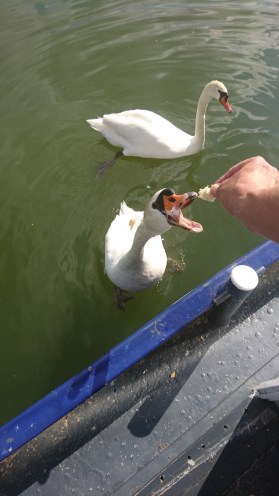
Greedy swans, Saint-Jean-de-Losne6

Saint-Jean was to be our last stop on the river, as we turned westwards along the Canal de Bourgogne.

Gray

The River Sâone at Gray is wide and deep, one of the reasons the town had been an important port and trading centre for the Franche-Comté region.

The town, population about 7,000, has several places of interest to a visitor. The 15th/16th-century Basilique Notre Dame is a fine church, well decorated with a nice bell tower.

Basilique Notre Dame, Gray4

The Commune or Town Hall is a lovely Renaissance building with a colonnade, sundial, pink Jura stone columns and a roof of coloured glazed tiles like those found in Bourgogne.

Commune de Gray4.JPG

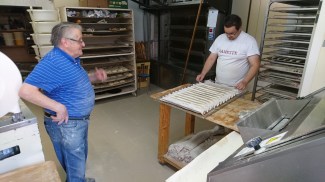
The Saturday marché, it must be said, was something of a disappointment, but we were delighted to discover one of the few female boulangers we have come across, with a woodfired oven, no less.

The Musée Baron Martin, an art museum, is housed in the chateau of the Count of Provence, brother of Louis XVI. It has a collection of 1200 interesting but not outstanding works – paintings, sculptures and Gallo-Roman relics.

DSC_0478

The Hotel-Dieu, or ancient hospital, first constructed in the early 18th century, is an interesting survivor, now converted and overbuilt into a nursing home but containing the original chapel and apothecary within.

In Gray we came across our first encounters with the traboule, or staircase tower, which we later found many variants of throughout Franche-Comté and Bourgogne. Built into the side of buildings, with tiny windows and low doors, traboules are essentially covered stairwells, often located in the courtyards of communal buildings and providing entrances to private apartments.
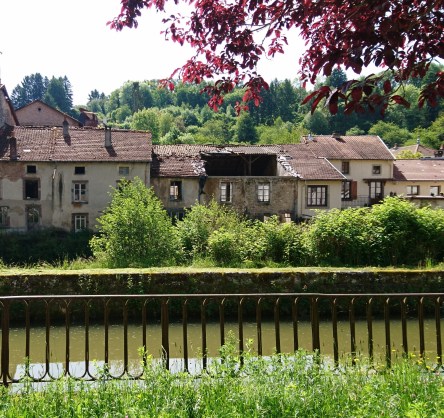
Although we found no memorable dining in Gray, we enjoyed a few days exploring the town and would be inclined to visit again if we had the chance. The mooring at Quai Mavia is comfortable and convenient, although it has a dearth of electrical/water points to match the ample space for boats large and small.

La Petite Sâone

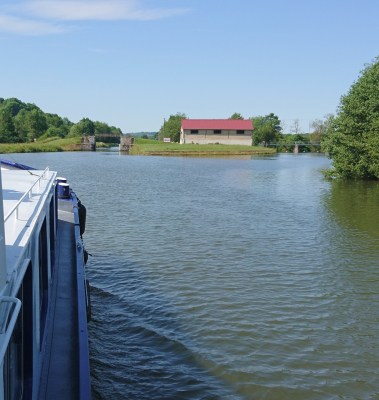
Leaving Corre we progressed through the last lock on the Canal des Vosges before entering the Sâone at its junction with the Côney River, which the canal had been tracking for the past week or so of our journey. At this stage the river, known as La Petite Sâone, is a canalised waterway, alternating between sections of unchanged river and wilder sections where the river has been bypassed by sections of canal with locks, weirs and spillways. So, while it is a river, it retains the intimacy and calmness of a canal, albeit one that meanders through fields and wooded hillsides.

Near Cendrecourt.crop

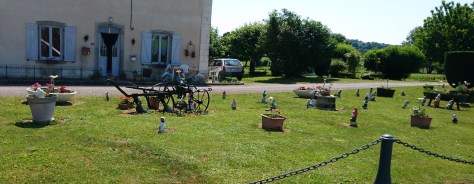
The first larger town we would encounter, the old river port of Gray, was several days away; in the meantime, we cruised at a leisurely pace through small towns and villages such as Fouchècourt, Scey-sur-Sâone and Savoyeux. Here, as in many other places we had passed, there were lock-keepers inordinately fond of garden gnomes

Ecluse 2 Cendrecourt, La Saone.crop

.Fouchecourt was a tiny village without commerce, but possessing a quiet charm with its farmhouses and old lavoir wash house.

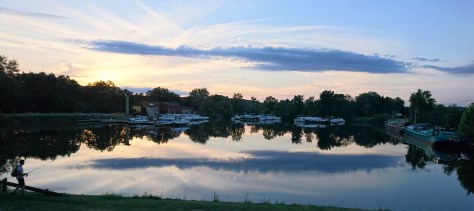
At Scey-sur-Sâone we encountered one of the very few unpleasant characters on all our travels through France and Europe. We had pulled into the port de plaisance, into the only vacant spot we could find. The facility was operated under license by the hireboat company Le Boat; the office was closed but we located an employee and asked if it was OK for us to stay the night and how much might it be. He indicated that it would be €10, with water and electricity, and that his boss would be along later to collect. We plugged in to shore power and broke open a bottle to celebrate the end of a long and tiring day. An hour later a man came storming along the quay, yelling at us to get away. We tried to explain our earlier enquiries and encounter but he was having none of it. He said we were moored too close to a crane and had no right to be there, accusing us of telling lies and taking advantage.. By this time the sun was beginning to set and we didn’t have much idea of what we could do, but he didn’t care. No choice but to move…. somewhere! As it happened, there was a rickety old pontoon on the opposite side from the port. It didn’t look ideal but it was our only choice so we farewelled our nasty little Le Boat man and made the best of it. The best was nearly perfect, in the end, since the old wooden pontoon was a private mooring for a very nice little restaurant, where we enjoyed a delightful meal overlooking the river, with only a few paces to retire afterwards to our comfortable bed on Eben Haezer. In contrast to our earlier experience, our restaurant host (and the owner of our mooring)  was friendly, welcoming, and apologetic for his countryman.

Scey-sur-Saone6.crop

Before reaching Gray, our next major challenge was the tunnel at Savoyeux, not a particularly long or tricky underground passage but a tunnel nevertheless and our first one of the season. Once through, we found the river widening, more resembling a real river and allowing for faster, though still relaxed, passage through fields and forests.

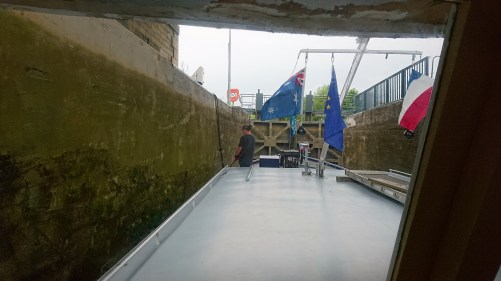
Before we reached Gray we came across a new (to us) method of controlling the locks in the canalised section of the river. Earlier, where locks were not controlled by lock-keepers, the automatic controls had been operated by a télécommande unit, a remote control issued by the VNF, which you pressed as you approached a sensor a couple of hundred metres before the lock itself. Now, it necessitated passing close to a rod suspended over the river, which a crew member needed to grasp and twist to activate the lock process. To add interest to the day, we shared our last lock before Gray with an adventurer in a kayak. Although they are not really supposed to do so, our kayaker entered the lock behind us and we helped secure and steady him to our side as the waters rushed out to empty the lock. As we left we waved him goodbye, while keeping a close watch on a dinghy full of fisherman on the other side.


Last days on the Canal des Vosges

The end of May 2017 also saw the end of our sojourn on the Canal des Vosges, which we had entered in September 2016 in our first season. This canal, only 122 kilometres long, was built in the 1870s following the Franco-Prussian War, which saw France cede much of Alsace-Lorraine to the victorious Prussians, thereby losing important maritime trade routes along the Rhine. It is the southern part of what was originally named the Canal de l’Est, the longer northern portion now named the Canal de la Meuse.

After leaving Côney, we cruised into the small town of Fontenoy-le-Chateau which, it has to be said, has seen better days, most of them quite some time ago – although it did flourish as a centre of embroidery for a while in the 19th century. Nevertheless, it has a charm to it and rewards a couple of days of exploration. Its 10th-century Château began a long decline after the Thirty Years War in the 17th century and now consists mainly of the ruins of its keep.

Fontenoy also has a handsome 15th/16-century Gothic church, the Eglise Saint-Mansuy, much of which has managed to survive various depredations.

Not so much for some of the canalside houses… ironically, many of them were built using materials reclaimed from the château, although lately they’ve taken a bit of a beating.

Fontenoy-le-Chateau21crop

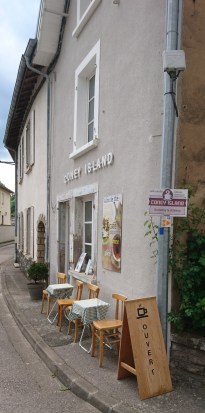
Even in this place, however, there is resistance to decay. We discovered a delightful maison de thé, with the charming name of Coney Island, where we enjoyed an ice cream and cake and nearly decent coffee.

Coney Island Maison de The, Fontenoy-le-Chateau3crop

Our next stop, in Selles, did not reveal much beyond a very quiet village, except for a still-thriving boulangerie, for which we gave thanks.

Selles boulangers

Our last stop on the Canal before we entered La Petite Sâone was Corre. The town itself is not particularly interesting, although there are some interesting characters about, judging by canal traffic.

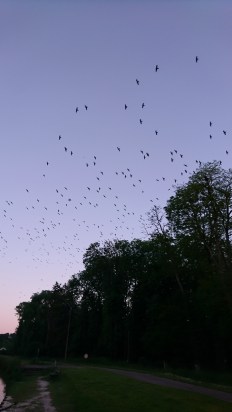
Corre is also blessed with a surfeit of crows, who gather in crowds in the evening despite the regular activities of people with guns aiming to reduce their number.

Crows of Corre

The most interesting aspects of Corre are the nearby attractions of the village of Jussey and the glassworks at the Verrerie de la Rochère, both of which we visited by hire car. Jussey is known for its waterworks…. its wells, fountains and wash houses (‘lavoirs’).

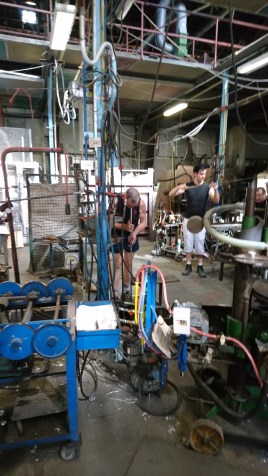
La Rochère is a fascinating centre of traditional and modern glassmaking, with daily demonstrations and a fabulous shop.

La Rochere Verrerie18

And now, we are set to leave the canals and flow with the river….


Into the countryside

On our third day we woke to clear weather and set off from Trusey, the summit of the Canal des Vosges, for our next stop at Méloménil, 14 locks down to a picturesque free mooring. It was a lovely run down the canal, although some of the locks had quite rough sides, and often very wet and mossy.

For dinner we sought out the nearby Ferme Auberge des Sept Pécheurs, a farmstay with dining, run by a delightful lady and her daughter and grandchildren. A salubrious establishment it was not, but we were provided with a delicious, substantial homestyle meal in a warm, inviting space. We enjoyed it so much we returned for breakfast the following morning! And we were also delighted to meet Peter, an older Swiss gentleman who was on a massive walking tour through France.

The next day was a sunny run through a further 13 locks to another free mooring by the delightful Auberge du Coney. Once again, pretty much in the middle of nowhere, although a relatively simple ride several kilometres to the spa town of Bains-les-Bains, if we had stayed for longer. Maybe next time, for we were keen to get on to Fontenoy-le-Chateau and beyond.

Start of our second season

After a pleasant couple of weeks in our winter port of Épinal, the French autumn sun rose on 18 May 2017 and we cast off to begin our second season of barging. Our first day saw us busy with 15 locks up the higher part of the Canal des Vosges, but we consoled ourselves with the thought that we had reserved a table at a very nice restaurant for our first evening on the water.

Ecluse Golbey, Canal des Vosges2

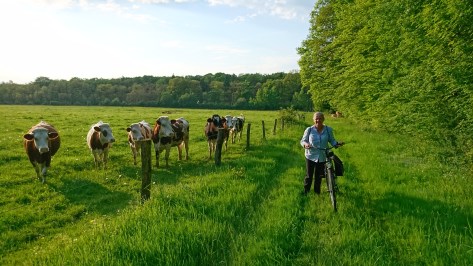
We had hoped to pull up to a small mooring in the village of Chamousey where the restaurant was located, but we found we had been beaten to it by an English couple on their narrowboat, so we continued upstream one more lock and a few kilometres to Trusey. No matter, we thought; we donned our evening wear, mounted our bicycles and trundled off in the direction of Le Clamosien, our destination for dinner. I thought I was very clever, having put the coordinates into my smartphone and let Google Navigation find the shortest route. The shortest route it was, but it turned quickly from a formed road into a barely discernible track through a paddock, then a deep muddy track through a dark forest.

Detour on way to dinner from Trusey to Champusey

We eventually made it to the restaurant, having managed to keep the mud from rising and splashing higher than mid-calf. Ah well, at least we were in a fine space with the prospect of fine food. And we were not disappointed: the service was fantastic, the food was magnificent.

Our lovely waiter even ventured out in the developing rain after dinner to show us a shortcut back to the canal towpath, a much better option for cycling back to the boat. It was a brisk ride through howling winds and driving rain, with lightning and thunder exploding all around us. We arrived back on board, our first night out of port, soaked and giggling with embarrassed, well-fed delight. The meal kept us in a great mood through the following day, as it bucketed down with unrelenting rain, keeping us inside as we decided to delay our next stage of the journey until it cleared.