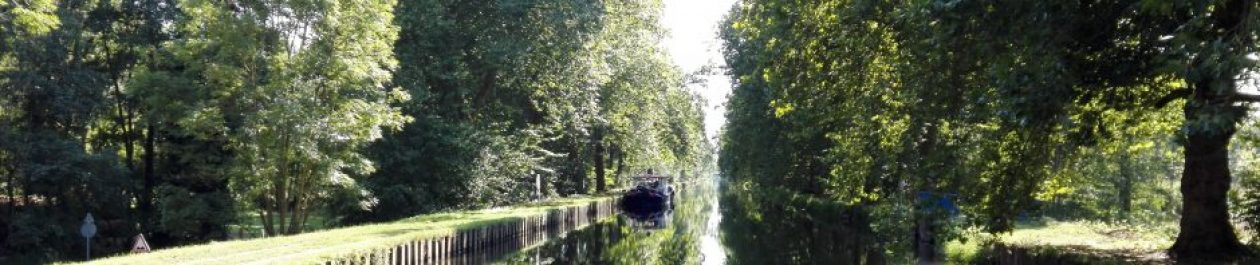
On 4 September we slipped out of Consevoye and, with great anticipation, made our way 4.5 hours (24kms, 4 locks) to the iconic town of Verdun.
War and its effects, human and physical, are everywhere to be seen along this section of the Meuse.
We had formed a grim but clearly imagined view of our visit to Verdun. It’s a town that holds a very special place in every French heart, especially in this, the 100th anniversary of the gruesome but heroic scenes that unfolded in the First World War. Grim might be the wrong word yet, as we pulled alongside the stone quay in the city centre, we had already unconsciously adopted a solemn, reverential mood as we moored in a place that has seen more than its share of horrors.
The city itself has a sombre but not unattractive tone in its architecture, dominated by stone and serious-looking edifices along the canal/riverfront. This atmosphere was accentuated by the overcast conditions on our day of arrival, which lent added solemnity to our thoughts.


The name of the city is a latinised version of a word meaning ‘fort’, and it seems Verdun has always played a strategic role. In the 17th century a large citadel was built on the site of a former abbey, significantly strengthened in the 17th century by the famous French military engineer Vauban. The Prussians held the city briefly in 1792 and again in 1870, after which an extraordinary ring of 28 fortifications ringing the city was built.
These fortifications, or many of them, played a major role in the event Verdun is most famous for…. the Battle of Verdun between February and December 1916, the longest, costliest and nearly the most deadly in the entire First World War, possibly ever.
The day after our arrival we caught a hop-on-hop-off shuttle bus into the hills above Verdun to try to get close to the scenes of destruction that still evoke these horrors 100 year later.
A few statistics help to put the carnage into context. By 1916, WWI had become a war of attrition, and the Germans chose Verdun as a place where they hoped to wear down the French through massive destruction when national prestige could not permit retreat.There was no real aim to gain territory for strategic purposes; it was more about harvesting a killing field.
In an area not much greater than 20 square kilometres, both sides launched some 30 million rounds of heavy artillery in 6 months. One strategically identified hill absorbed so much bombardment, it was reduced in height by 27 metres. Seven villages were destroyed, utterly and forever wiped from the landscape. Most deaths occurred through artillery bombardment, not through direct combat; bodies that had been buried were repeatedly uncovered and pulverised by fresh bombardments.
Both sides suffered some 1 million casualties, including perhaps 300,000 deaths, very many of whom were not recovered but could only be listed as missing. At times at the height of battle there were 10,000 or more deaths and injuries every day, for weeks.
We visited the Douamont Ossuary, site of one of the largest war cemeteries in France, with more than 16,000 graves. More gruesome still is the ossuary itself in the basement of the building, which you can glimpse through small windows, where the bones of at least 130,000 unidentified soldiers are interred. More are discovered and placed there even today, 100 years later, whenever roadworks or building excavation uncovers yet more bones in the killing fields of Verdun.


On a more direct level, we also visited one of the seven destroyed villages, Fleury-devant-Douamont, where today the sun-dappled groves of trees strive to camouflage the scene of total destruction suffered in battle. Fleury was desperately fought over, changing hands 16 times in little more than a month at the height of the battle. We wandered the pathways, reading the plaques which marked where once had stood a house, a bakery, a butcher’s shop, a small farm. Now all that remained were craters. And memories of people’s destroyed lives.


In the end, the Germans failed to destroy the French Army and its spirit at Verdun. Due to the policy of high rotation adopted by the French command, more than 70% of soldiers in the French Army in 1917 served there, embedding memories of their experiences in millions of French soldiers and millions more of their family members. Fundamentally, for the French, Verdun became the embodiment, the representative memory of WWI.
More positively, in recent years, Verdun has come to represent more than war and death. In the 1960s it started to become a symbol and place of Franco-German reconciliation, culminating in a moving visit in 1984 by Chancellor Helmut Kohl, who stood hand in hand with Francois Mitterand in driving rain at Douamont to remember common sacrifice.And Verdun’s 18th-century Episcopal Palace has become the World Centre for Peace, Liberty and the Rights of Man, which focuses on peace and harmony generally but with a special emphasis on Franco-German relations.
I should mention here that while we were in Fleury and Douamont, many of the visitors we shared these places with were small groups of young Germans, each with a guide explaining places and events. Clearly, there is a desire to understand how such things came to pass and, I like to think, not just because so many tens of thousands of their relatives and countrymen are buried in these hills.
 Scraping Through France