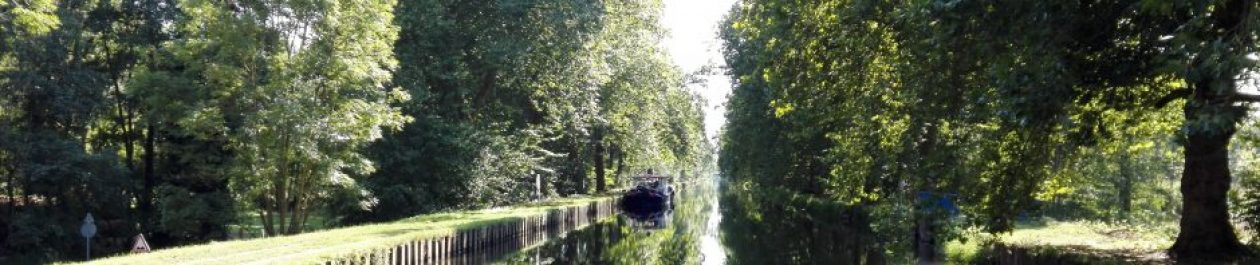
After an enjoyable three days in Charleville-Mézières, we left the city on 28 August, bound for Sedan and the limit of navigation of the Meuse River. South of Sedan the Meuse becomes a canal which follows the river bed but with many canalised sections.
We arrived in Sedan after 5.5 hours and the final 28 kms (6 locks) of the navigable river. To be honest, there is nothing especially remarkable about the city of Sedan, save the fortress Chateau de Sedan, which is reputedly the largest medieval castle in France, dating from the early 15th century with numerous additions and fortifications over the centuries. The chateau certainly is massive. It’s worth a couple of hours but frankly there is little else in the city to detain you for more than a day or two.
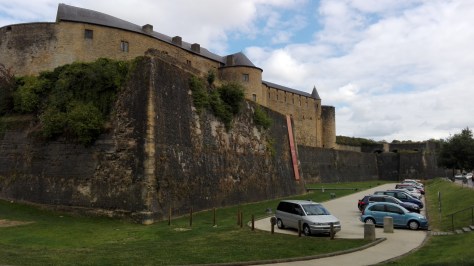


Rather ironically, for a town with such a massive fortress castle, is that it was the scene of not one but three humiliating military defeats for France in the space of 70 years. In 1870 during the Franco-Prussian War it saw the French Army beaten and Emperor Napoleon III taken captive along with 100,000 of his troops, leading to the Siege of Paris and the formation of the Third Republic and the Government of National Defence. In WWI the town was captured early and occcupied for four years, during which Crown Prince Wilhelm victoriously paraded his troops through the town to mark the annexation of Alsace-Lorraine. Then in WWII a decisive battle in May 1940 resulted in swift victory for the Germans, the effective destruction of the French Army’s capacity and the quick advance of the Germans to the Channel… and the famous evacuation of the Allied forces at Dunkirk.
Poor old Sedan!
On 30 August we left Sedan and travelled along the Canal de la Meuse for 3 hours and 16 kms (2 locks) to the village of Mouzon. The main feature of this rather pretty village is the wonderful Abbatiale Notre-Dame de Mouzon, a church originally established by the Abbey of Mouzon in the 9th century, and which prospered on account of the relics it held of Saint Victor and Saint Anulf, which encouraged strong pilgrim traffic. It was enlarged in the 13th and 14th centuries and again in the 17th and 18th centuries and was saved from the destruction that befell much of the Abbey itself in the Revolution. Our visit to the church was curtailed by a funeral in progress but we nevertheless saw much that was impressive.


The other notable presence in Mouzon is a marvellous little restaurant, Les Échevins. This charming establishment is located in one of the 17th-century “Spanish houses” on Rue Charles de Gaulle. Run by Julie and Damien Hacquard with utter lack of pretension, the atmosphere is remarkable and the food really excellent, at great value.


The following day on 31 August we left Mouzon and travelled 25kms (3 locks, 4 hours) to the village of Stenay. What we found was challenging. The small port, which is in a narrow dead-end channel off the main canal, is quite well formed and equipped, but seemed utterly full and, though we were told there was possibly a spot further up, we were unwilling to risk it, so we rafted up outside another large boat close to the narrow entrance. It was of little consequence to us since we planned to leave the next morning; but the manoevring in and the reversing out were testing for a first-season skipper and crew.
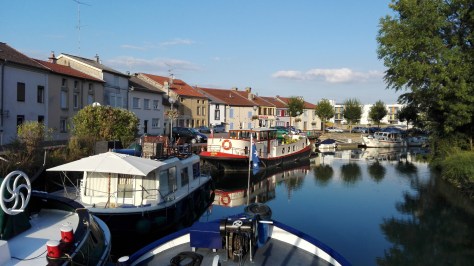
On 1 September we slipped our ropes from our host boat, reversed with maximum care and caution out of the side channel, and travelled on to Dun-sur-Meuse, an easy 2.5 hours (13kms, 3 locks) along the canal.
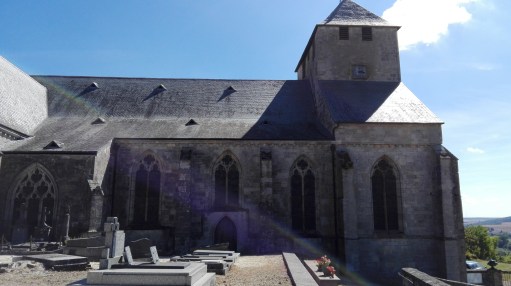
There’s not a lot to the small village of Dun-sur-Meuse and its 750 inhabitants. It has a pleasant well-formed pontoon-based halte plaisance and is not unattractive in its way. Its main attraction is the remarkable 14th-century Eglise de Dun-sur-Meuse high on a hill (Haut-Dun) overlooking the village and river, surrounded by walls of the original 11th-century citadel that enclose a cemetery and a collection of ancient houses, some of which have been renovated and clearly provide a superior quality of domicile. Sadly, much of the upper village was destroyed in WWI.


We actually made two departures from Dun-sur Meuse, the first on 2 September which was aborted after two hours when there was a major lock malfunction, necessitating a return to Dun and a second departure the day following. So it was on 3 September we arrived in the village of Consevoye, 17kms, 5 locks and 3.5 hours up the canal.
The mooring at Consevoye turned out to be up a narrow and short side channel from the canal, at an acute angle, requiring a delicate reverse manouevre which we achieved – very slowly – like old hands.Which we were… this was now our 17th operational day in nearly a month of cruising!
Consenvoye is a village of less than 300 inhabitants, but is pretty and charming, despite its lack of shopping and infrastructure. In WWI it fell to the Germans early and was always behind the German lines. Its inhabitants were expelled and on their return four years later they found most of their homes had been destroyed.
For us, it was delightfully quiet, yet welcoming, and we enjoyed a lovely, simple dinner at the auberge by the rivulet.


Not all was quiet in Consenvoye, however. Not long after we arrived, we heard the strains of a woman’s voice singing an aria, echoing across the canal. Was it coming from the silo/warehouse nearby? We couldn’t tell but it was captivating. After a while our curiosity demanded exploration, so we set off into the village to find the source of the magical sound. What we found was not a woman, but a small group of people in a courtyard, one of whom was operating a sound desk with pre-recorded music, the courtyard littered with what looked like props from a movie set.
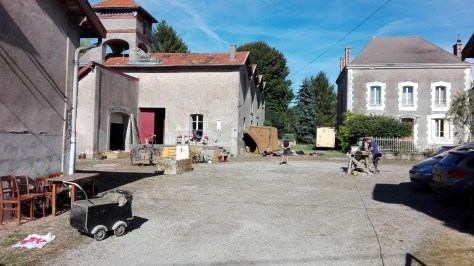
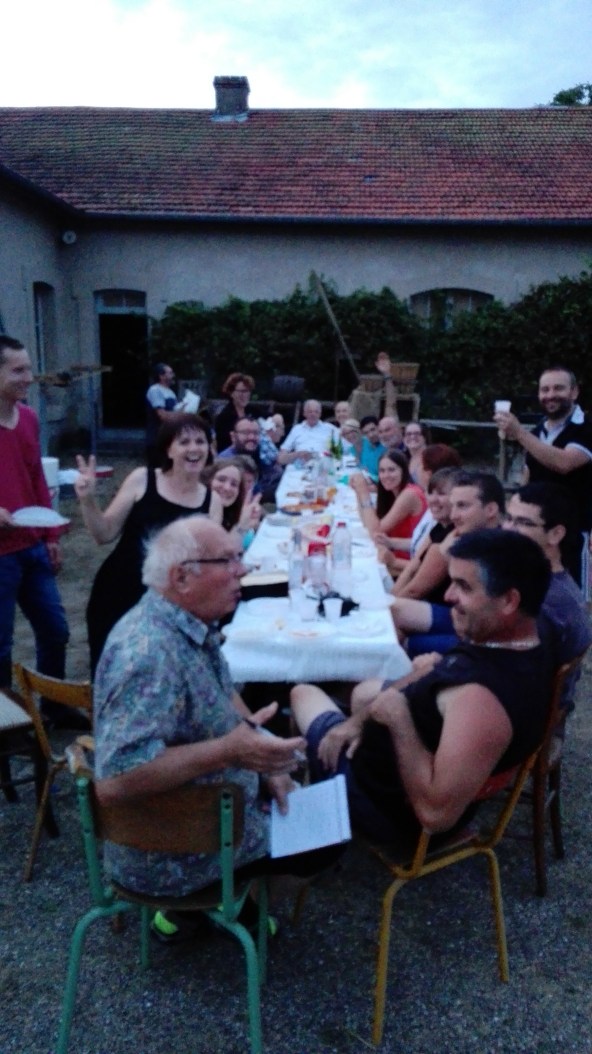
We looked on, and finally gained the courage to ask what it was about. In fact, it was a rehearsal for an upcoming community performance, marking the anniversary of the sacking of the village by the Germans in WWI. They invited us back later that evening for a full dress rehearsal. So, after dinner at the auberge, we returned to the courtyard a little after 8.00pm to see what we might see. Alas, no performance, no dress rehearsal, because the cast were still doing what the French do best…. enjoying a communal feast! They toasted us and made us feel completely welcome in their happy crowd. It was a magical moment.
 Scraping Through France