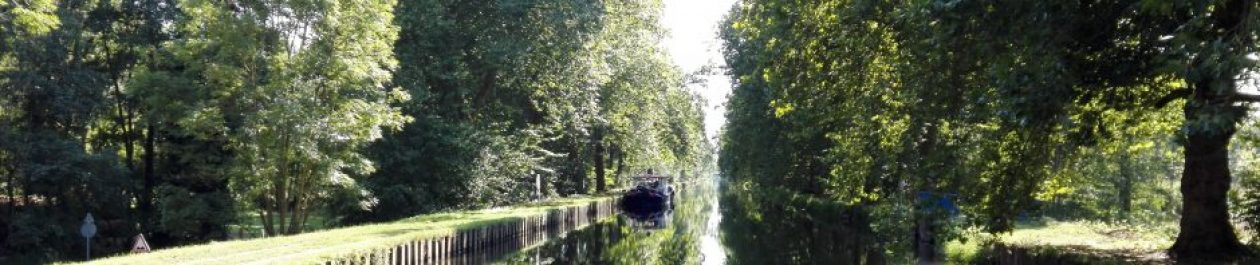
As you can imagine, the process of buying a boat to live on and cruise the waterways of Europe is no easy thing. Unless you are fabulously wealthy, in which case you probably wouldn’t bother with canals…. too slow, too cramped and too far from Cannes, for a start.
For us, it began with a few things we didn’t want. New was out. Plastic was out. Wooden hulls were pretty much out. Too big and too small were definitely out.
From there, it became an agonising process of compromise and conceit. We wanted romantic but practicable, heritage with mod cons, atmosphere with ventilation, professional appointments at budget prices.
We had spent several years looking at hundreds of boats listed for sale – modern motor yachts, replica barges, converted workboats including tugs and rescue vessels, and many, many French peniches and a bewildering variety of Dutch barges, most of them built between 1890 and 1950.
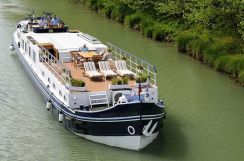
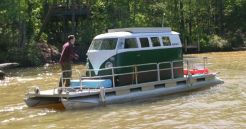
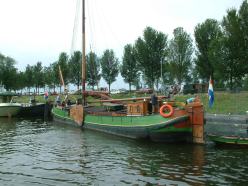
The options seemed endless. How would we ever decide what we wanted? And how would we convert that into a list of actual, real boats that were for sale that we could consider? And how much did we want to spend?
We developed a spreadsheet which we used to compare the features of the many boats we had found online. I tracked down – through Google and the Kindle store – numerous blogs, diaries, books and online forums that had been written by people who had been there and done that, which I scoured for clues on the good and the bad, learning from other people’s mistakes and good fortune.
Every tale and every forum revealed useful information…. but also many biases, opinions and personal preferences that needed to be weighed and weighted. There is no universal formula for solving the riddle of what makes a good boat, and in the end it is an intensely personal choice. Nevertheless the research enabled us to identify most of what we wanted to avoid and much of what we wanted to find.The following is a partial list of the factors that influenced us:
- less than 14 metres in length is too small for extended living aboard. I don’t know about you, but even for a couple used to being together for most of every day, a boat without the space to escape each other, even for a small bit of private time, just doesn’t appeal. Plus we cling to the idea that we might entertain guests from time to time and we want to be able to provide those guests with their own discrete space rather than camping on the lounge.
- more than 20 metres in length imposes additional rules and regulations and costs. You need advanced training and licensing to operate a larger vessel, and even the traditionally tolerant French in recent years have been tightening the rules regarding additional structural modifications and safety equipment for larger boats, some of which makes the cost of purchasing or modifying a conforming boat beyond our budget. Besides, the idea of a boat longer than 20 metres gives the shivers to Jane in terms of handling and manouevring.
- Draft and air draft – a hull draft of no more than about 1.2 metres and and air draft of no more than 3 metres, so we can navigate some of the smaller canal systems in France such as the Canal du Midi and the Canal de Nivernais.
- materials – hull of steel or, if in good condition, iron. We pretty much detest fibreglass, and wood, though romantic, requires too much maintenance. Same goes for decks and superstructure, although a bit of wood on the wheelhouse is fine.
- engine – the power needs to be sufficient to enable navigation against the current on fast flowing rivers and it needs to be of an age or condition to be as worry free as possible; we like a bow thruster because it is enormously convenient in manouevring a large vessel in tight spaces.
- generator and electrics – we feel a generator is essential to be able to handle days and nights away from access to onshore power. Battery storage for house power needs to be adequate to last a couple of days in the wild; equipment like inverters, isolators, chargers, switches, wiring and so forth needs to be adequate, comprehensive and well-fitted. You would not believe the spaghetti trails of wiring, non-marine suitable switches and circuit boxes and underpowered (or non-existent) current control devices that many boats have collected over the years by a series of owners trying to do things on the cheap-and-quick. It’s electricity, folks! It needs to be adequate, reliable and SAFE.
- living space – a kitchen that is not just a closet or a corner, with adequate food preparation space, storage and ventilation. A lounge that one can actually relax in, even if a section is given over to dining. A main cabin with a good bed and space to store and easily retrieve your clothes. A second cabin that can suffice for guests staying a few days without feeling they are stowaways. A bathroom that can accommodate a proper toilet and a separate shower without feeling like you are bathing in a tent or a packing box. And through all these spaces, lots of light and ventilation.
- equipment – a full-sized fridge/freezer, not a bar fridge or, worse still, ice box. A washing machine – it is possible to get by with lugging our washing to a local laundromat and washing knickers in a basin, but this takes up valuable time for sightseeing, entertaining and boat maintenance. Electric anchor winch – these days the use of an anchor is an exceedingly rare requirement on the canals, primarily an emergency measure when your engine fails or you find yourself in the middle of nowhere after dark and you are unable to tie up to a pontoon or bank; even so, we would prefer to be able to retrieve the anchor without having to call on seven strong men for help.
- heating and cooling – our preference has always been for central heating fed by a diesel boiler. Cross-ventilation is a good thing in hot weather – you can always buy small fans or a mobile evaporative air conditioner, to cope with the worst of a French summer. Or just hang out in the shade of a nice tree.
- communications/navigation – the minimum requirement for travelling almost anywhere in Europe on a boat of any size is two marine radios (one for communicating with shore, the other for communicating between boats). On rivers and canals there is no need for a full-blown marine radar system, but a GPS/mini-radar navigation set-up is invaluable. Larger boats and commercials are required to have an Automatic Identification System (AIS) transponder onboard and it can be really useful for a vessel of reasonable size; there are a couple of really excellent AIS-based software packages that offer route planning/passage monitoring. A depth sounder is optional and probably only marginally useful for a flat-bottomed steel boat.
- helm position – we have never been attracted to an exposed cockpit or helm position open to the elements, no matter how wonderful the rest of the boat is; we like a decent wheelhouse with a nice wheel and reasonable instrumentation, large windows and access to the deck on both sides.
- deck – it’s great for at least part of the deck to be available for sitting/entertaining outside; cruising primarily in the summer we want to be able to take advantage of good weather to soak up sun or enjoy Europe’s seemingly endless sunsets. Plus space for storage of bicycles, operating a barbeque and hanging out the washing.
One thing we didn’t want was a “project”. We had read several stories of people buying a hull ready for conversion or gutting an interior and starting over, but that was certainly not for us. Fascinating as these stories were, and envious as we sometimes were of people who tailored their boats precisely to their specifications and taste, we knew this involved two ingredients we couldn’t afford or didn’t want – time and money.
We knew this meant making compromises, settling on something that was nearly but not completely everything we wanted and dreamed of. But that seemed good enough to us, so we spent months and months collecting dozens of online boat advertisements, sifting them and sorting them to try to find something that fitted our needs and desires, at an affordable price.
This entire process of looking for a boat had taken place in a kind of dreamworld. We maintained a rigorously practical approach to everything except how to make it work. We needed still to earn a living, we had family obligations, and we had finite financial means.
In early 2016, our circumstances had changed sufficiently to make our project a possibility. How much longer could we put it off, how much were we willing to countenance the possibility that it would end up merely as an unfulfilled dream, a coulda-been thing?
By May, this thought had become an independent force. We collected all the best available boats we could find into our database, made appointments with private sellers and a couple of boat brokers, booked airline tickets to Europe and temporarily shuttered our business.
Jane would stay in Australia. I would scout our selection of boats and, maybe or maybe not, return in a few weeks with ownership papers in my pocket. We were about to embark on the next stage… Finding a boat.
 Scraping Through France