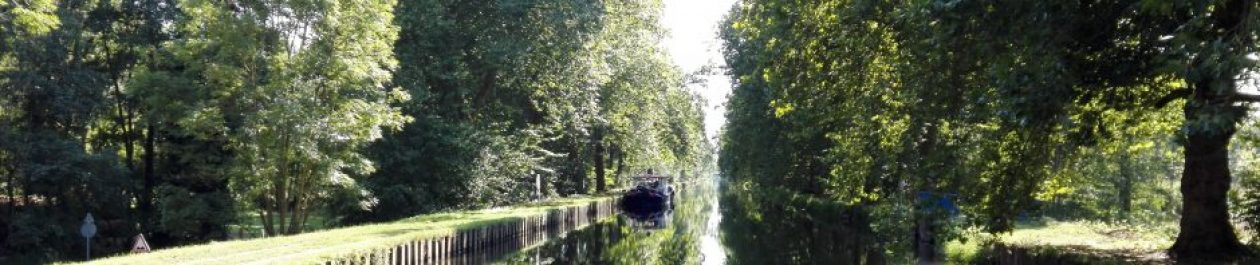
We describe elsewhere (Looking for a boat; Finding a boat; Buying a boat) the process of finding and buying the right boat for us to live on and cruise the European waterways. It was a nerve-wracking experience but it worked for us and we now have a vessel that is sound, comfortable, reliable and eminently resaleable.
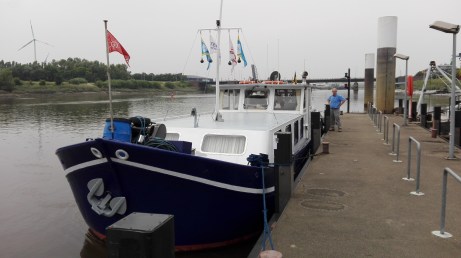
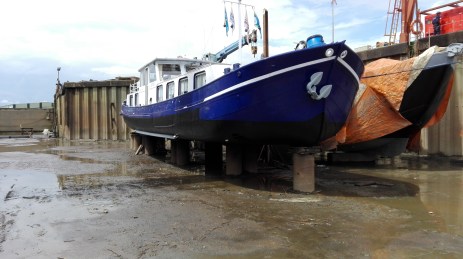
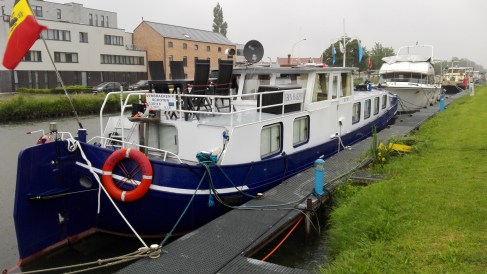
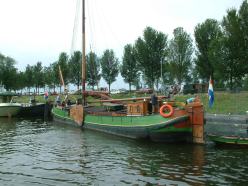
Eben Haezer* is classed as a “Klipperaak””, distinguished from many other styles of Dutch barge by her upswept bow and high stern, with a graceful curve along her gunwale.
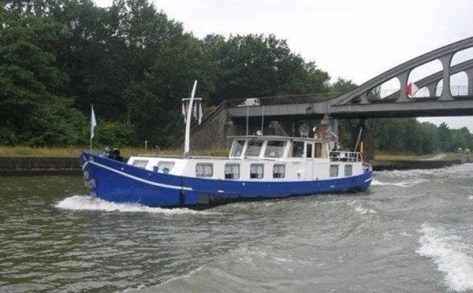
She was built in 1916 in the shipyard of Worst Brothers (later Worst and Dutmer) in Meppel, a Dutch shipyard that originated in the late 18th century. She was first registered on 28/06/1917 in the nearby city of Zwartsluis, then again in 1943 in Groningen in the northern Netherlands, presumably when she first had an engine installed to replace her original sailing rig. Her latest registration before we purchased her was in 2006 in Brussels, when her papers were transferred to the Belgian registry.
Her hull and superstructure are steel. She is surveyed at 18.54 metres in length, 3.86 metres wide and with a water draft of 0.90 metres. Her air draft is 2.80 metres and her total maximum displacement is 37.38 tonnes.
She is fitted with a 1973 DAF 575 diesel engine, delivering 77kW or 103 horsespower, driven through a 3:1 reduction via a driveshaft to a three-blade bronze screw propellor. The engine is located midships, below the wheelhouse, and is cooled along the hull via a closed system (no raw water intake). The engine was removed, completely reconditioned and replaced in 2013, since when she has operated for no more than 320 hours. Fuel capacity is 600 litres in a steel tank.
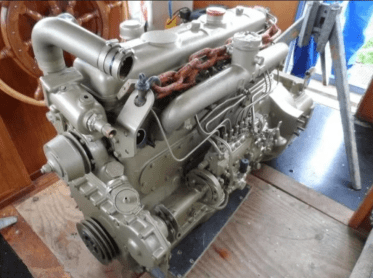
She is also fitted with a hydraulic (not electric) bowthruster driven off the main engine.
A 7kvA Lister diesel generator is located in the bow, fed by a 500-litre steel fuel tank for “red” diesel*, which also supplies a Kubola boiler in the main engine room. The boiler feeds a closed central heating system, with eight radiators located throughout the boat.
Hot water is provided via an electric immersion-coil boiler in the bathroom. Total water capacity is 1100 litres in a rigid plastic cylinder in the aft well.
Electrics are 12v/24v/220v. 220-volt power is supplied by the generator or by shore power connection. Two batteries provide 24v to the main engine; a single battery provides 12v to the generator; and 4 x 200amp hour batteries provide house power for lights, cooking and appliances. There is a double solar panel on the wheelhouse roof providing trickle charge via a regulator to the house batteries. The system is completed by a Mastervolt 3200 inverter, a Mastervolt isolator and a Mastervolt dual battery charger.
This seems a pretty good system, well-fitted, to my layperson’s eyes… but I am the first to admit I have a great deal to learn about it and how to make it work best for us. Certainly I would like to upgrade the solar power capacity, and to examine fitting more power-efficient lighting and power points throughout.
The greatest drain on electric power comes from the hot water heater and the four-burner electric cooktop. The former is easily dealt with since it operates efficiently while under way, with power fed by the engine alternator. While on shore power, we use it only when not using other significant drags on power (e.g. cooking or heating).
The question of cooking is interesting. When I first saw the electric systems (four-burner stove top and combi convection-micro oven) my first thought was to replace them as soon as possible with gas. I prefer cooking on a gas flame, and I knew that electric cooktops sucked a helluva lot of power.
But I kept coming across professional boatmen (Eben Haezer’s previous owner was one of them) residing on their own live-aboard vessels, none of whom would countenance having gas on board. For them it was a safety issue. Gas is heavier than air and, if there is any leak, no matter how insignificant, it will sink and collect in the bilge, presenting an unacceptable risk.
You might ask, as others have, why then do so many live-aboard boats have gas? It’s a fair question, and I’m not arguing one way or another. The risk of an explosion is most likely very low (otherwise we’d see more news reports of accidents) but, on the other hand, the consequences are pretty dire.
So for the time being I’m comfortable to stick with our current set up. If I need to, I can switch on the generator and for a few drops of red diesel have all the power I need for cooking as well as running other circuits. Plus, for much of our cruising season, we can and we adore cooking outside with one or both of our barbeques (one gas, one charcoal).
Accommodation on Eben Haezer is pretty damn comfortable, I have to say. Not luxurious, but everything a middle aged couple and their occasional guests might desire.
Amidships is the wheelhouse providing an excellent helm position, as well a comfortable lounge seat and room for a small dining table. Jane and I spend much of our time here, even when we are not underway, since it’s a great space with large windows for reading, relaxing and eating with a view on the outside world.
Forward down a few steps you enter the open-space kitchen (galley!) and lounge area. The galley is equipped with a four-burner cooktop, extractor hood, sink, benchtop combination oven (convection-microwave) and plenty of bench space for food prep and small appliances such as toaster, coffee grinder/espresso machine and kettle, as well as lots of cupboard space above and below.
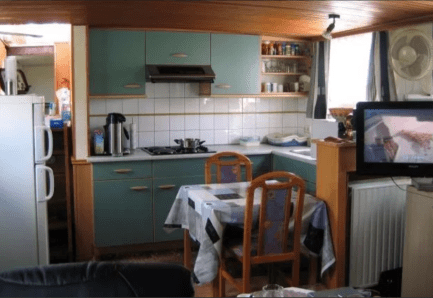
It also has a full-size upside-down fridge/freezer that runs on 220v and I have to say is quite magnificent. I cannot imagine living full-time on a boat (or in a house) with a tiny bar fridge, even though we shop most days and don’t really have a need to store huge amounts of perishable food.
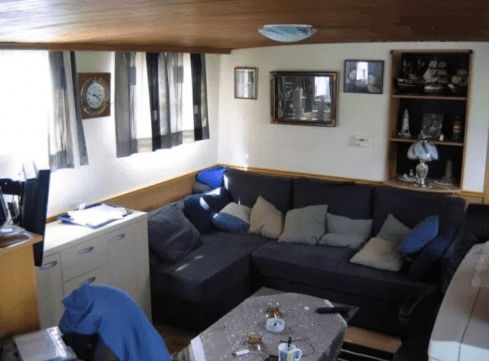
The lounge is separated from the galley by a small dining table, and includes a large sofa with pull-out bed, a coffee table, and a couple of cupboard units for storage. There are two separate central heating radiators in the lounge and they are more than enough.
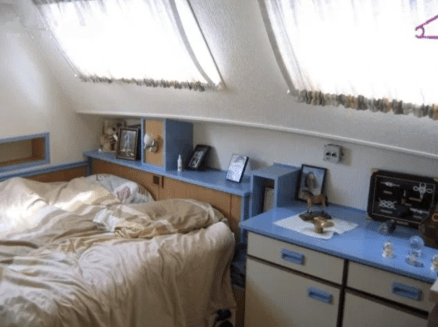
Moving forward from the lounge is the door to the main cabin, with a large double bed on one side, lots of storage for clothes and personal effects, and large windows to give plenty of light. The mattress on the bed was gifted to us nearly new by the previous owner and is utterly magical. Apparently it cost a small fortune and it shows. I have never had such an extended period of restful sleep as the months we spent on Eben Haezer in 2016.
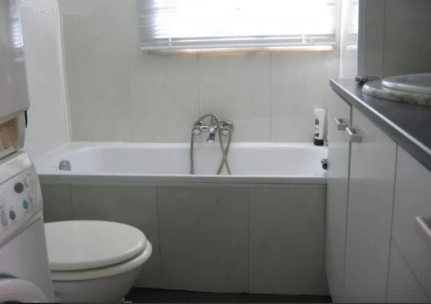
Back in the wheelhouse and moving aft, down a few steps is the passageway to the rear guest cabin. Before you get there is the door to the bathroom, which is equipped with a vast vanity counter and basin, a macerating full-flush marine toilet and a bath with handheld shower. The bathroom also holds a front loading washer and a dehumidifying dryer.
The helm position in the wheelhouse includes a lovely old wooden steering wheel, operated by mechanical cable and chain mechanism. The wheelhouse has large windows providing an excellent viewing platform, and an expansive counter area for maps, reference books, computers, binoculars, hats, sunglasses and cold or hot drinks.
Overhead is a console with an AIS (Automatic Identification System) transponder, a Furuno mini radar unit and GPS positioning unit, two marine radios and a car radio with twin speakers. By coupling the Furuno and AIS systems with a laptop computer running PC-Navigo software, we are able to plot our routes, monitor our progress in real time and receive advance warning of approaching large craft fitted with the same systems (compulsory for all craft over 25 metres). It’s not necessary but it’s very reassuring.
On deck, there is a large entertaining area astern of the wheelhouse, sufficient for a table and six chairs, as well as a storage box. Behind that and down three steps is the rear deck with room for our barbeques and two bicycles, as well as the hatch for the rear storage well.
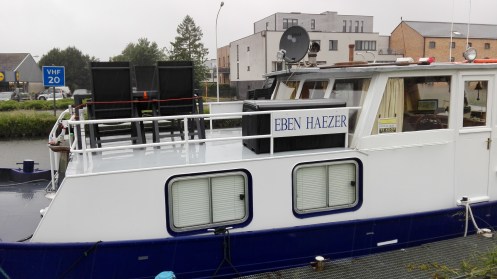
On the forward deck there is the anchor winch with an electric motor, and the hatch to the bow storage-well, plus the raised forward deck over the lounge and main cabin, which supports the mast and provides a large flat area for lying in the sun or storing items such as our passarelle* and boathooks and such.
Much of the finishing inside Eben Haezer – walls, floors, trims cabinets and so forth – features modern materials. One might rue this if you were looking for atmospherics and a heritage feeling, and we may over time attempt to re-introduce a bit of old-time charm. But the huge advantage this Dutch-Belgian passion for clean modernity delivers is an absence of the need to constantly repair and retouch.
We wanted a boat to cruise on, not work on. And Eben Haezer delivers that, while also feeling cosy, comfortable and welcoming.
* Eben Haezer, the name of our boat, is a Biblical reference, shared by a number of boats large and small in Belgium and Holland. Translated as “stone of help”, in the Books of Samuel it was a place that witnessed major battles between the Philistines and the Israelites. The Philistines won the first battle and captured the Ark of the Covenant; the Israelites won the second, after Samuel had offered a sacrifice, and erected a stone in memorial which he named Eben-Ezer. The location of this place is uncertain but has been often placed at Aphek (now Antipatris or more recently Tel Afek) in central Israel. Our boat was originally given this name and has carried it ever since; we believe in maintaining that continuity.
*Red diesel costs about 50-60% of the price for normal diesel. It is reserved for use on farms, in machinery, generators and boilers. There are potential heavy fines for trying to use it in boat’s main engine, and boaters would be well advised to avoid trying to cheat the system.
*A passarelle is literally a footbridge. On a boat it is a small apparatus for getting from the boat to the shore when there is a gap, such as when you are moored against a sloping bank when it might be hard to jump or clamber from the deck to the shore. Our passarelle is a strong ladder with an attached piece of marine ply. Simple but effective.


 Scraping Through France